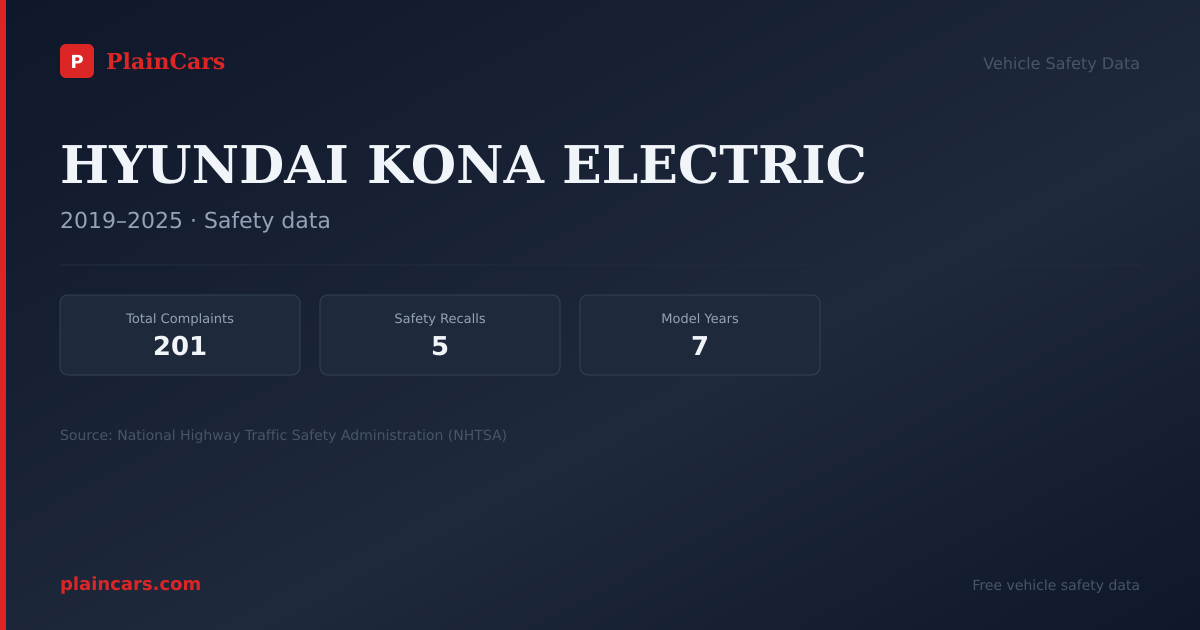
Total Complaints
32 filings
Hyundai Kona Electric · model year
32 NHTSA complaints, 3 crash reports, and 2 recall campaigns listed for this cohort. A VIN lookup is required to determine whether a specific vehicle has an unrepaired recall.
NHTSA overall rating
Not crash-tested
New Car Assessment Program
The verdict
The 2021 Hyundai Kona Electric posts above-average complaint volume among its own model-year siblings.
The 2021HyundaiKona Electric carries 32 consumer safety complaints in NHTSA's Office of Defects Investigation database for this specific model-year cohort. Within that volume, owners reported 3 crashes, 1 fire, 0 injuries, and 0 fatalities. No NCAP 5-star crash-test rating is available for this model year in the federal database.
The most frequently selected component label in reports for the 2021 Kona Electric is unknown or other with 7 filings, followed by electrical system (7) and engine (4). Complaint categories reflect owner reports and intake categorization; they do not establish a defect pattern or cause. This cohort has 2 NHTSA recall campaigns listed below. Enter a VIN in NHTSA's official recall lookup to determine whether a specific vehicle has an unrepaired recall.
NHTSA currently has 37 investigation files overlapping the 2021 Kona Electric, and 1 remain open. Owners comparing this cohort against neighboring years should read the complaint-by-year trend as report volume, not a causal diagnosis. Use the related-complaint feed and the official recall lookup when researching a specific vehicle.
PlainCars' own composite of NHTSA NCAP crash-test ratings and rollover-risk assessment, each dimension normalized against the federal scale or the full national model-year corpus. Not an official NHTSA figure, and not a substitute for a specific vehicle's VIN-level recall check.
Total Complaints
32 filings
Crashes Reported
3 reports
Source
NHTSA ODI
Federal complaints database
At or below the fleet median complaint volume.
| Component | Count |
|---|---|
| UNKNOWN OR OTHER | 7 |
| ELECTRICAL SYSTEM | 7 |
| ENGINE | 4 |
| VEHICLE SPEED CONTROL | 2 |
| SERVICE BRAKES | 2 |
| ELECTRICAL SYSTEM:PROPULSION SYSTEM:CHARGING:MODULE:ACCESSORY | 1 |
| VISIBILITY:SUN/MOON ROOF ASSEMBLY | 1 |
| EXTERIOR LIGHTING | 1 |
| VISIBILITY:DEFROSTER/DEFOGGER/HVAC SYSTEM | 1 |
| ELECTRICAL SYSTEM:12V/24V/48V BATTERY | 1 |
| BACK OVER PREVENTION | 1 |
| AIR BAGS | 1 |
| FORWARD COLLISION AVOIDANCE: AUTOMATIC EMERGENCY BRAKING | 1 |
| FORWARD COLLISION AVOIDANCE: WARNINGS | 1 |
| FUEL/PROPULSION SYSTEM | 1 |
ELECTRICAL SYSTEM:PROPULSION SYSTEM:TRACTION BATTERY:THERMAL MANAGEMENT:FLUID/COOLANT
Hyundai Motor America (Hyundai) is recalling certain 2021 Kona EV vehicles. The Electric Power Control Unit (EPCU) may have been improperly sealed and may leak coolant internally.
SERVICE BRAKES, HYDRAULIC:POWER ASSIST:ELECTRIC:CONTROL MODULE:SOFTWARE
Hyundai Motor America (Hyundai) is recalling certain 2019-2020 Nexo Fuel Cell and 2019-2021 Kona Electric vehicles. The Integrated Electronic Brake (IEB) system may detect an abnormal sensor signal and as a result, may significantly reduce braking performance.
File with NHTSA now please!!!! What do you have to lose??? If anything If they do an investigation we are safe post warranty. Report a Vehicle Safety Problem, Equipment Issue | NHTSA [XXX] The Hyundai Kona Electric Vehicle (EV) has experienced issues with its Integrated Charging Control Unit (ICCU) due to problems with the low-conductivity coolant (BSC-1) used in models produced between 2018 and October 2021. This coolant can crystallize, forming debris that clogs the cooling system, leading to false "Refill Inverter Coolant" warnings and potential overheating risks. A Technical Service Bulletin (TSB 23-01-049H) outlines a recall to flush and replace the coolant with an improved BSC-2 formula to address this issue. However, improper or repeated coolant flushes, if not performed correctly using Hyundai’s specialized equipment and procedures, can leave air bubbles or residual debris in the system, which may impair cooling efficiency and stress critical components like the ICCU, i
Potential Fire and safety risk ... The Hyundai Kona Electric Vehicle (EV) has experienced issues with its Integrated Charging Control Unit (ICCU) due to problems with the low-conductivity coolant (BSC-1) used in models produced between 2018 and October 2021. This coolant can crystallize, forming debris that clogs the cooling system, leading to false "Refill Inverter Coolant" warnings and potential overheating risks. A Technical Service Bulletin (TSB 23-01-049H) outlines a recall to flush and replace the coolant with an improved BSC-2 formula to address this issue. However, improper or repeated coolant flushes, if not performed correctly using Hyundai’s specialized equipment and procedures, can leave air bubbles or residual debris in the system, which may impair cooling efficiency and stress critical components like the ICCU, inverter, and electric motor. Repeated coolant flushes, especially when not executed properly, can exacerbate issues by introducing air locks or failing to ful
Manufacturing defect ... Took it in 4 times for "refill inverter coolant" warning . They had a campaign ' tried by couldn't get the light to go away . It was their first time ever performing this on an EV at Kerry hyundai alexandria . Now TD EV in mason Ohio is confirming my inverter failed as a direct result of the poor flushes and poor manufacturing. I am seeking for hyundai to cover all related costs. I haven't had my vehicle for over a month . It's out of warranty 'however this was a known issue they issued a campaign for 'and then couldn't fix the issue after 4 or 5 tries and 2 different hyundia dealers . All work performed will be listed at Kerry hounding in alexandria KY and Jefferson wyler hyundai cincinnati Ohio.
Hyundia has had my car in for the SAME recall 4 to 5 times . 6 total weeks this time around. The ""refill inverter coolant" light kept coming back on . The last time I got it home it had more issues than when I took it in and wouldn't even catch a charge . (EV) They fried my compassitor trying to fix the inverter coolant recall . I then took had to pay 450 for a diagnostic ' (Kerry hyundai alexandria) They said electric motor is bad and will cost 8000 to 9000. Got a 2nd diagnostic (Jeff wyler hyundai cincinnati) Completely different result- Zero mention of motor ' said Ac compasitor failed. (Had no issues prior to them working on the original recall ) The light for the recall is still on by the way and they want me to pay 3500 for new AC capacitor . (600 diagnostic included in that price ) " The dealership’s failure to properly perform the inverter coolant refill recall directly caused the AC compressor failure in my 2021 Hyundai Kona EV. Before taking the vehicle in for t
The car was unable to charge using level 3 DC fast chargers, necessitating the use of a level 2 charger for an extended length of time in order to be able to return home. A Hyundai dealer replaced the charging inlet lock actuator (invoice attached).
The car was unable to charge using level 3 DC fast chargers, necessitating the use of a level 2 charger for an extended length of time in order to be able to return home. A Hyundai dealer replaced the charging inlet lock actuator (invoice attached).
After powering on the car, the dashboard displayed multiple brake system warnings, including the brake system warning light and a message on the LCD display that read "Check regenerative brakes." A Hyundai dealer replaced the integrated electric brake unit assembly (invoice attached).
My wife's car t-boned another vehicle, but the air bags didn't deploy. Luckily, she wasn't hurt badly, but the vehicle was deemed a total loss, so you can imagine the force of the collision. The forward collision warning and automatic emergency braking didn't activate either. I reported it to Hyundai. They sent an inspector to examine the vehicle, and I also showed them photos and a copy of the police report, but they claim that my car was hit on the side, and the pre collision system doesn't detect imminent side impact. That's completely outrageous. I don't know what their inspector wrote in their report, but the photos and police report are irrefutable proof that my wife had a frontal collision with the side of another vehicle. Hyundai kept denying it because they didn't want to help financially. I attached a copy of their determination letters (the second one was after I submitted a copy of the police report to prove that my wife's car is the one that hit the other vehicle, but Hyun
My wife's car t-boned another vehicle, but the air bags didn't deploy. Luckily, she wasn't hurt badly, but the vehicle was deemed a total loss, so you can imagine the force of the collision. The forward collision warning and automatic emergency braking didn't activate either. I reported it to Hyundai. They sent an inspector to examine the vehicle, and I also showed them photos and a copy of the police report, but they claim that my car was hit on the side, and the pre collision system doesn't detect imminent side impact. That's completely outrageous. I don't know what their inspector wrote in their report, but the photos and police report are irrefutable proof that my wife had a frontal collision with the side of another vehicle. Hyundai kept denying it because they didn't want to help financially. I attached a copy of their determination letters (the second one was after I submitted a copy of the police report to prove that my wife's car is the one that hit the other vehicle, but Hyun
My wife's car t-boned another vehicle, but the air bags didn't deploy. Luckily, she wasn't hurt badly, but the vehicle was deemed a total loss, so you can imagine the force of the collision. The forward collision warning and automatic emergency braking didn't activate either. I reported it to Hyundai. They sent an inspector to examine the vehicle, and I also showed them photos and a copy of the police report, but they claim that my car was hit on the side, and the pre collision system doesn't detect imminent side impact. That's completely outrageous. I don't know what their inspector wrote in their report, but the photos and police report are irrefutable proof that my wife had a frontal collision with the side of another vehicle. Hyundai kept denying it because they didn't want to help financially. I attached a copy of their determination letters (the second one was after I submitted a copy of the police report to prove that my wife's car is the one that hit the other vehicle, but Hyun
Fill coolant warning came on, we checked the coolant and the coolant level was good. I spoke to a Hyundai service center and the rep said that sometimes this happens with Hyundais and it may go off. Indeed it did but then Fill coolant warning came back and the coolant level was still good. After several weeks of the Fill Coolant warning being on more often than not, the car started one morning but couldn’t be driven as the handbrake was stuck on, the fill coolant warning was on and the tire pressure warning was on, (even though the tire pressure on all tires was ok) I guess this was the EVs way of saying “Do Not Drive Me”. We got the car to the dealership, they performed a scan and found no codes. They preformed a total coolant flush as per Service Campaign T9E. This service was performed on 21 April, 2025 and thus far the fill coolant light has stated off. We bought this car used just 2 months prior and found through previous maintenance history that this EV had this ser
The contact owns a 2021 Hyundai Kona Electric. The contact stated while the vehicle was parked, the rearview camera became inoperable. The contact stated that the image on the rearview camera went blank. There was no warning light illuminated. The vehicle was taken to the dealer, and it was diagnosed and determined that the tailgate wiring harness had failed and needed to be replaced. The vehicle was not repaired. The manufacturer was made aware of the failure and offered to pay for 60 percent of the parts and labor cost to repair the vehicle. The contact declined the offer provided by the manufacturer. The approximate failure mileage was 86,612.
Mileage: 86,612
My vehicle has said, refill inverter coolant, I took it in a couple of days ago and they said there is an open recall and they would fix it. They called me back after I dropped it off and informed me that they did not have the specific coolant, and no one in the area did. Over the past couple days, my vehicle has had issues turning on.
The contact owns a 2021 Hyundai Kona Electric. The contact stated that the battery had discharged. The contact stated that the 12-volt battery and “Bring in for Service, and key not detected messages were displayed. The contact stated that while his mother was driving at an undisclosed speed, the vehicle stalled on two occasions. The vehicle flickered, and the vanity lights dimmed and flickered. The contact called the local dealer, where the vehicle was rebooted. The contact stated that five attempts were needed to unlock the parking brake. The tow truck mechanic informed the driver that the 12-volt battery was not registering. The vehicle was towed to the local dealer, who was unable to duplicate the failure. The vehicle was not repaired. The manufacturer was contacted, and no assistance was provided. The failure mileage was approximately 38,000.
Mileage: 38,000
The contact owns a 2021 Hyundai Kona Electric. The contact stated that the battery had discharged. The contact stated that the 12-volt battery and “Bring in for Service, and key not detected messages were displayed. The contact stated that while his mother was driving at an undisclosed speed, the vehicle stalled on two occasions. The vehicle flickered, and the vanity lights dimmed and flickered. The contact called the local dealer, where the vehicle was rebooted. The contact stated that five attempts were needed to unlock the parking brake. The tow truck mechanic informed the driver that the 12-volt battery was not registering. The vehicle was towed to the local dealer, who was unable to duplicate the failure. The vehicle was not repaired. The manufacturer was contacted, and no assistance was provided. The failure mileage was approximately 38,000.
Mileage: 38,000
While driving on the highway at 70 mph, cruise control engaged, there was a sudden loss of drive power. I could not accelerate, or return to the cruising speed. The speed just dramatically fell. The only remedy was to pull over to the side of the road, turn off the car, and start it again. This VIN was not included in the initial similar recall earlier this year.
The contact owns a 2021 Hyundai Kona Electric. The contact received notification of NHTSA Campaign Number: 22V941000 (Electrical System) however, the part to do the recall repair was not yet available. The local dealer was contacted. The contact stated that the manufacturer had exceeded a reasonable amount of time for the recall repair. The manufacturer was made aware of the issue. The contact had not experienced a failure. Parts distribution disconnect.
July of 2022, vehicle went in due to battery not charging. Vehicle kept at Temecula Hyundai repair until September 2022 for EV battery replacement. Upon return, EV battery still didn't change. September 2022 vehicle went back for repairs. Returned October 2022. Was told battery overheating sensor was faulty and was turned off. As a result the EV battery will not be able to charge beyond 90%. Was told nothing else they could do to repair the car. When I asked if there was an increased risk of battery getting too hot, the response was " their should not be". My concern is that their going to be an overheating issue while the vehicle is changing at my home. Contacted Hyundai about it; they did an investigation and determined there was reason for them to buy back the vehicle. They offered to buy it back at less that what the buy out the finance company states. It is now February 2023. Hyundai still has yet to buy back the vehicle at what is owed on it, and still have no idea how to due
After just 18 months and about 5,000 miles, the heater/defroster system stopped working. My local Hyundai dealer (Dick Hannah Volkswagen/Hyundai) confirmed the failure. Even after installing a new heater unit, the dealer reported the system is still not working. My car has been at the dealer since 1-17-23. Having no defroster is a serious safety issue in the winter here in Portland, Oregon, as the car can become unsafe to drive when the windows fog-up (as is common in the winter here). There were no warning lights or notifications to indicate that anything had failed; I just noticed that heat was not coming on, and only cold air was blowing through the defroster vents.
After just 18 months and about 5,000 miles, the heater/defroster system stopped working. My local Hyundai dealer (Dick Hannah Volkswagen/Hyundai) confirmed the failure. Even after installing a new heater unit, the dealer reported the system is still not working. My car has been at the dealer since 1-17-23. Having no defroster is a serious safety issue in the winter here in Portland, Oregon, as the car can become unsafe to drive when the windows fog-up (as is common in the winter here). There were no warning lights or notifications to indicate that anything had failed; I just noticed that heat was not coming on, and only cold air was blowing through the defroster vents.
Data vintage: August 2026. Sources: NHTSA Office of Defects Investigation (ODI) complaints database, NHTSA recall campaign API, NHTSA NCAP crash-test ratings, and NHTSA FARS for fatality cross-reference.
Every figure on PlainCars is rendered directly from NHTSA complaint and safety data, no number is typed in by an editor. This year-specific record is rendered from NHTSA ODI, recall, and NCAP rows for the 2021 Hyundai Kona Electric; no figure is typed in by an editor. See our editorial standards & corrections policy, the methodology behind these numbers, or report a data error. Data current as of August 2026.
Read our methodology - how this data is sourced, computed, and verified.