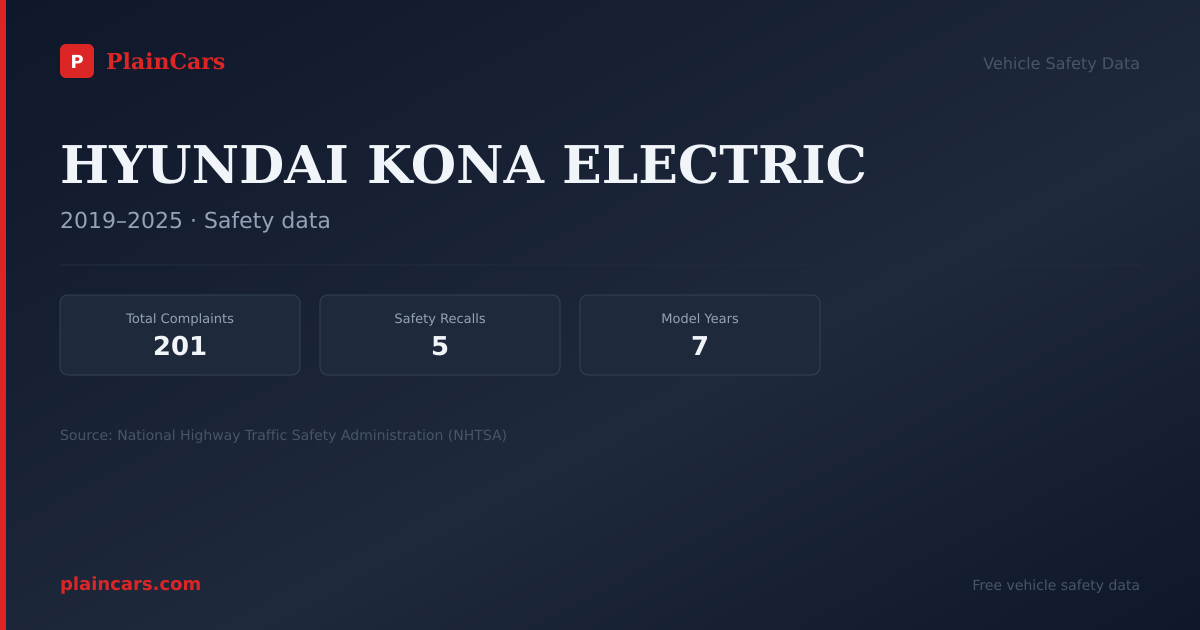
Total Complaints
73 filings
Hyundai Kona Electric · model year
73 NHTSA complaints, 3 crash reports, and 3 recall campaigns listed for this cohort. A VIN lookup is required to determine whether a specific vehicle has an unrepaired recall.
NHTSA overall rating
Not crash-tested
New Car Assessment Program
The verdict
The 2019 Hyundai Kona Electric posts above-average complaint volume among its own model-year siblings.
The 2019HyundaiKona Electric carries 73 consumer safety complaints in NHTSA's Office of Defects Investigation database for this specific model-year cohort. Within that volume, owners reported 3 crashes, 4 fires, 1 injury, and 0 fatalities. For crash performance, NHTSA's New Car Assessment Program gave this cohort an overall Not Rated/5 rating, with Not Rated/5 front crash, Not Rated/5 side crash, and Not Rated/5 rollover scores derived from standardized barrier and dynamic tests.
The most frequently selected component label in reports for the 2019 Kona Electric is electrical system with 40 filings, followed by fuel/propulsion system (10) and engine (5). Complaint categories reflect owner reports and intake categorization; they do not establish a defect pattern or cause. This cohort has 3 NHTSA recall campaigns listed below. Enter a VIN in NHTSA's official recall lookup to determine whether a specific vehicle has an unrepaired recall.
NHTSA currently has 37 investigation files overlapping the 2019 Kona Electric, and 1 remain open. Owners comparing this cohort against neighboring years should read the complaint-by-year trend as report volume, not a causal diagnosis. Use the related-complaint feed and the official recall lookup when researching a specific vehicle.
PlainCars' own composite of NHTSA NCAP crash-test ratings and rollover-risk assessment, each dimension normalized against the federal scale or the full national model-year corpus. Not an official NHTSA figure, and not a substitute for a specific vehicle's VIN-level recall check.
Total Complaints
73 filings
Crashes Reported
3 reports
Source
NHTSA ODI
Federal complaints database
At or below the fleet median complaint volume.
| Component | Count |
|---|---|
| ELECTRICAL SYSTEM | 40 |
| FUEL/PROPULSION SYSTEM | 10 |
| ENGINE | 5 |
| SERVICE BRAKES | 4 |
| UNKNOWN OR OTHER | 4 |
| POWER TRAIN | 4 |
| ELECTRICAL SYSTEM:12V/24V/48V BATTERY | 1 |
| WHEELS | 1 |
| POWER TRAIN:AUTOMATIC TRANSMISSION:CONTROL MODULE:SOFTWARE | 1 |
| FORWARD COLLISION AVOIDANCE: AUTOMATIC EMERGENCY BRAKING | 1 |
| ELECTRICAL SYSTEM:PROPULSION SYSTEM:CHARGING:CABLE/CORD:ACCESSORY | 1 |
| VEHICLE SPEED CONTROL:ACCELERATOR PEDAL | 1 |
ELECTRICAL SYSTEM:PROPULSION SYSTEM:TRACTION BATTERY:MANAGEMENT SYSTEM/ENERGY CONTROL MODULE (BMS/BECM):SOFTWARE
Hyundai Motor America (Hyundai) is recalling certain 2019-2020 Kona Electric vehicles. The lithium-ion (Li-ion) battery may short-circuit.
SERVICE BRAKES, HYDRAULIC:POWER ASSIST:ELECTRIC:CONTROL MODULE:SOFTWARE
Hyundai Motor America (Hyundai) is recalling certain 2019-2020 Nexo Fuel Cell and 2019-2021 Kona Electric vehicles. The Integrated Electronic Brake (IEB) system may detect an abnormal sensor signal and as a result, may significantly reduce braking performance.
ELECTRICAL SYSTEM:PROPULSION SYSTEM:TRACTION BATTERY
Hyundai Motor America (Hyundai) is recalling certain 2019-2020 Kona Electric and 2020 Ioniq Electric vehicles. The lithium-ion (Li-ion) battery may short-circuit.
The contact owned a 2019 Hyundai Kona. The contact stated that while attempting to drive from a complete stop, the vehicle accelerated rapidly through a busy intersection on its own and would not slow or stop, despite the brake pedal being depressed. As a result, the contact briefly lost control of the vehicle as it swerved left to right, only coming to a complete stop after colliding with another vehicle. The air bags did deploy. No warning lights were illuminated. The vehicle was towed to a storage facility and deemed a total loss by the contact's insurance provider. A police report was filed, and injuries were reported. The contact was transported to an area hospital and treated for a broken sternum and hematoma on both her right and left breasts. The manufacturer was not notified of the failure. The failure mileage was 70,000.
Mileage: 70,000
Component Failed: Electric transmission/drive unit failed twice before 150,000 miles. Still in vehicle, available for inspection. Safety Risk: Loss of propulsion while driving creates risk of being rear-ended or stranded in dangerous traffic conditions. Right now the car is not drivable Confirmed By: Problem confirmed by Hyundai dealership/service center on both failures. Inspection: Inspected by authorized Hyundai service center; manufacturer was notified. Warning Symptoms: Before the failure there was a screeching sound coming from the hood. In both failures, these warnings appeared shortly before or during the loss of propulsion.
Component Failed: Electric transmission/drive unit failed twice before 150,000 miles. Still in vehicle, available for inspection. Safety Risk: Loss of propulsion while driving creates risk of being rear-ended or stranded in dangerous traffic conditions. Right now the car is not drivable Confirmed By: Problem confirmed by Hyundai dealership/service center on both failures. Inspection: Inspected by authorized Hyundai service center; manufacturer was notified. Warning Symptoms: Before the failure there was a screeching sound coming from the hood. In both failures, these warnings appeared shortly before or during the loss of propulsion.
Component Failed: Electric transmission/drive unit failed twice before 150,000 miles. Still in vehicle, available for inspection. Safety Risk: Loss of propulsion while driving creates risk of being rear-ended or stranded in dangerous traffic conditions. Right now the car is not drivable Confirmed By: Problem confirmed by Hyundai dealership/service center on both failures. Inspection: Inspected by authorized Hyundai service center; manufacturer was notified. Warning Symptoms: Before the failure there was a screeching sound coming from the hood. In both failures, these warnings appeared shortly before or during the loss of propulsion.
-the gear drive was diagnosed as needed to be replaced -the GRU may lock up during driving causing the vehicle to stop -dealer confirmed needs replacing -no warnings or lights on vehicle, it was noticed that the vehicle made a louder noise while driving but could be confused with tires or normal air noise while driving.
The Charging unit made by Enel X called a JuiceBox 40 failed to complete a charge. Upon examination of the charger it was determined that the plug from the unit to the 240V receptacle was fused to the outlet and could not be removed. When my electrician opened the box he was able to force the plug out of the outlet. He found that the plug was burned as well as the copper wire that went to the plug from the electrical box.
I started directing the car to the side of the road to park. As I was guiding the car to a stop, with my foot on the brake, I was about 12 ft. from the car in front of me when the car suddenly accelerated. The vehicle accelerated for approximately 10 ft. before the anti-collision system auto-braked the car just prior to impacting the car in front of me.
I started directing the car to the side of the road to park. As I was guiding the car to a stop, with my foot on the brake, I was about 12 ft. from the car in front of me when the car suddenly accelerated. The vehicle accelerated for approximately 10 ft. before the anti-collision system auto-braked the car just prior to impacting the car in front of me.
The vehicle began making a clicking/ticking sound under acceleration and deceleration. The noise progressively worsened until The dealer diagnosed the motor as failing internally and replaced it under warranty. Several people online in forums have experienced the same issue, some cases resulted in the reduction gear catastrophically failing causing the vehicle to suddenly stop accelerating. I worry that this issue may result in more sudden drivetrain failures because of how widespread the problem is. Hyundai does not seem to have a definite solution as the noise comes back for many owners.
The vehicle began making a clicking/ticking sound under acceleration and deceleration. The noise progressively worsened until The dealer diagnosed the motor as failing internally and replaced it under warranty. Several people online in forums have experienced the same issue, some cases resulted in the reduction gear catastrophically failing causing the vehicle to suddenly stop accelerating. I worry that this issue may result in more sudden drivetrain failures because of how widespread the problem is. Hyundai does not seem to have a definite solution as the noise comes back for many owners.
The contact owns a 2019 Hyundai Kona. The contact stated while driving at 10 MPH, the steering wheel became stiff without any warning, causing the contact to lose control of the vehicle. The vehicle drove into a parking lot. The contact desperately pressed the brake pedal, but the vehicle would not stop. The contact jumped out of the vehicle and the vehicle struck a pole, causing minor damages to the bumper of the vehicle. The contact had minor injuries but did not seek medical attention. The contact mentioned being shocked after the events. A police report was filed. The vehicle was towed to the police impound. The vehicle was not diagnosed. The dealer was contacted and advised to contact the manufacturer. The manufacturer was contacted but did not provide any assistance. The failure mileage was 70,000.
Mileage: 70,000
The contact owns a 2019 Hyundai Kona. The contact stated while driving at 10 MPH, the steering wheel became stiff without any warning, causing the contact to lose control of the vehicle. The vehicle drove into a parking lot. The contact desperately pressed the brake pedal, but the vehicle would not stop. The contact jumped out of the vehicle and the vehicle struck a pole, causing minor damages to the bumper of the vehicle. The contact had minor injuries but did not seek medical attention. The contact mentioned being shocked after the events. A police report was filed. The vehicle was towed to the police impound. The vehicle was not diagnosed. The dealer was contacted and advised to contact the manufacturer. The manufacturer was contacted but did not provide any assistance. The failure mileage was 70,000.
Mileage: 70,000
I purchased a 2019 Hyundai Kona electric from dealership. They said they had to change the electric battery before selling it to us and now the emergency light went on the dash we brought it back to the dealership and they said the battery the installed is not safe and will take 6 months to get a new one and are not giving us a car to drive.
I purchased a 2019 Hyundai Kona electric from dealership. They said they had to change the electric battery before selling it to us and now the emergency light went on the dash we brought it back to the dealership and they said the battery the installed is not safe and will take 6 months to get a new one and are not giving us a car to drive.
The contact owns a 2019 Hyundai Kona. The contact received notification of NHTSA Campaign Number: 21V127000 (Electrical System) however, the part to do the recall repair was unavailable. The contact stated that the manufacturer had exceeded a reasonable amount of time for the recall repair. The manufacturer was not made aware of the issue. The contact had not experienced a failure. Parts distribution disconnect.
The contact owns a 2019 Hyundai Kona. The contact received notification of NHTSA Campaign Number: 21V127000 (Electrical System) however, the part to do the recall repair was not yet available. The local dealer was contacted. The contact stated that the manufacturer had exceeded a reasonable amount of time for the recall repair. The manufacturer was made aware of the issue. The contact had not experienced a failure. Parts distribution disconnect.
As noted above, the recall (200) for this problem was issued in March 2021. I have been trying to get Hyundai to repair the vehicle since I received this information. Late last year I was told by the dealer in my area that a fix was ready and took the car in for repair on December 27, 2021. The dealer had no fix. I have contacted the dealer several times in the past 6 months, and recently filed a complaint with the national Hyundai Corporation. As of now, I am still driving the car with the urgent battery problem, and have not received a date for the necessary repair
Hyundai has failed to replace the battery after more than a year.
Hyundai has failed to replace the battery after more than a year.
At time of purchase (new) this car did not come with a spare or jack but included a can of fix a flat and a cheep compressor. While traveling I became stranded with an un repairable flat tire and had to have someone come get me with a jack and abandon the car on the side of the road. I then purchased a spare tire kit directly from the purchase point dealer. On a second incident I discovered that the spare tire (donut) does not fit the rear wheels. It does not clear the brake calipers. Come to find out there is no other rim or tire that will fit this car thus leaving the driver with no options should a flat or bent rim happen. Hyundai's solution to this is to throw a can of fix a flat in the trunk. How can that be legal in this country. For the second time in two years.
Data vintage: August 2026. Sources: NHTSA Office of Defects Investigation (ODI) complaints database, NHTSA recall campaign API, NHTSA NCAP crash-test ratings, and NHTSA FARS for fatality cross-reference.
Every figure on PlainCars is rendered directly from NHTSA complaint and safety data, no number is typed in by an editor. This year-specific record is rendered from NHTSA ODI, recall, and NCAP rows for the 2019 Hyundai Kona Electric; no figure is typed in by an editor. See our editorial standards & corrections policy, the methodology behind these numbers, or report a data error. Data current as of August 2026.
Read our methodology - how this data is sourced, computed, and verified.