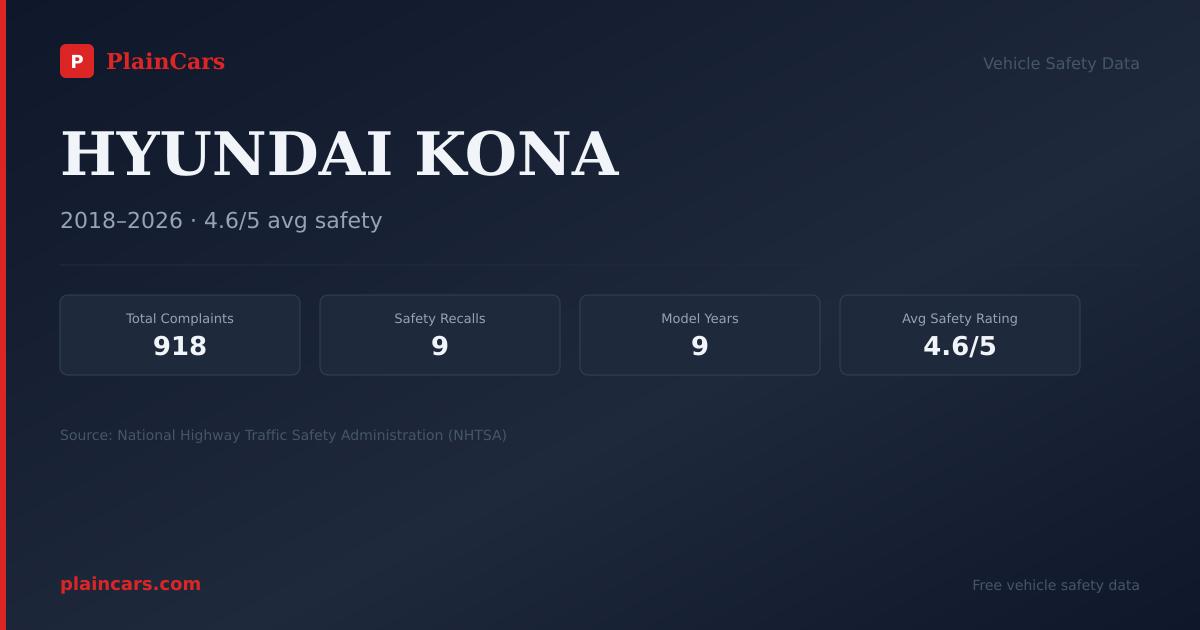
Total Complaints
122 filings
Hyundai Kona · model year
122 NHTSA complaints, 2 crash reports, and 1 recall campaign listed for this cohort. A VIN lookup is required to determine whether a specific vehicle has an unrepaired recall.
NHTSA overall rating
5 / 5 ★
New Car Assessment Program
The verdict
The 2021 Hyundai Kona pairs above-average complaint volume with a top NHTSA safety rating.
The 2021HyundaiKona carries 122 consumer safety complaints in NHTSA's Office of Defects Investigation database for this specific model-year cohort. Within that volume, owners reported 2 crashes, 5 fires, 3 injuries, and 0 fatalities. For crash performance, NHTSA's New Car Assessment Program gave this cohort an overall 5/5 rating, with 5/5 front crash, 5/5 side crash, and 4/5 rollover scores derived from standardized barrier and dynamic tests.
The most frequently selected component label in reports for the 2021 Kona is engine with 61 filings, followed by unknown or other (16) and power train (11). Complaint categories reflect owner reports and intake categorization; they do not establish a defect pattern or cause. This cohort has 1 NHTSA recall campaign listed below. Enter a VIN in NHTSA's official recall lookup to determine whether a specific vehicle has an unrepaired recall.
NHTSA currently has 37 investigation files overlapping the 2021 Kona, and 1 remain open. Owners comparing this cohort against neighboring years should read the complaint-by-year trend as report volume, not a causal diagnosis. Use the related-complaint feed and the official recall lookup when researching a specific vehicle.
PlainCars' own composite of NHTSA NCAP crash-test ratings and rollover-risk assessment, each dimension normalized against the federal scale or the full national model-year corpus. Not an official NHTSA figure, and not a substitute for a specific vehicle's VIN-level recall check.
Total Complaints
122 filings
Crashes Reported
2 reports
Source
NHTSA ODI
Federal complaints database
At or below the fleet median complaint volume.
| Component | Count |
|---|---|
| ENGINE | 61 |
| UNKNOWN OR OTHER | 16 |
| POWER TRAIN | 11 |
| ELECTRICAL SYSTEM | 10 |
| VEHICLE SPEED CONTROL | 4 |
| LANE DEPARTURE: BLIND SPOT DETECTION | 3 |
| STEERING | 2 |
| FORWARD COLLISION AVOIDANCE: AUTOMATIC EMERGENCY BRAKING | 2 |
| SERVICE BRAKES | 2 |
| FORWARD COLLISION AVOIDANCE: WARNINGS | 2 |
| FUEL/PROPULSION SYSTEM | 2 |
| EXTERIOR LIGHTING:HEADLIGHTS | 1 |
| TIRES:SIDEWALL | 1 |
| WHEELS | 1 |
| POWER TRAIN:AUTOMATIC TRANSMISSION | 1 |
ENGINE
Hyundai Motor America (Hyundai) is recalling certain 2019-2020 Elantra, 2019-2021 Kona and Veloster vehicles equipped with 2.0L Nu MPI engines. The piston oil rings may not have been properly heat-treated, which could result in engine damage.
The cars engine vibrates when accelerating and hesitates. It is always dangerous to stall after hitting the gas. This issue causes many near accidents. It began to vibrate at less than 70k. It has 90k now. These engines have had issues and mine is no exception. They should recall this engine as it's dangerous. top of the line and poop.
The cars engine vibrates when accelerating and hesitates. It is always dangerous to stall after hitting the gas. This issue causes many near accidents. It began to vibrate at less than 70k. It has 90k now. These engines have had issues and mine is no exception. They should recall this engine as it's dangerous. top of the line and poop.
Known problem of oil consumption . 1 week used 3 quarts . Wife driving down road oil light. Engine light seconds later engine seized at 55mph.lucky to drift off road.
Over the last 2 1/2 months the car has shut off approximately 5 times while driving, without warning. Most instances have been while pulling into a parking lot, but one time (so far) it shut off while trying to back into my driveway. I'm fearful it will happen while on the freeway. I took it to the dealer, but there wasn't a fault code so they refused to look at it unless I left the car with them to drive, and wanted to charge me $45/day for a rental so I could get back & forth to work until it happened again while they were driving it.
Over the last 2 1/2 months the car has shut off approximately 5 times while driving, without warning. Most instances have been while pulling into a parking lot, but one time (so far) it shut off while trying to back into my driveway. I'm fearful it will happen while on the freeway. I took it to the dealer, but there wasn't a fault code so they refused to look at it unless I left the car with them to drive, and wanted to charge me $45/day for a rental so I could get back & forth to work until it happened again while they were driving it.
Over the last 2 1/2 months the car has shut off approximately 5 times while driving, without warning. Most instances have been while pulling into a parking lot, but one time (so far) it shut off while trying to back into my driveway. I'm fearful it will happen while on the freeway. I took it to the dealer, but there wasn't a fault code so they refused to look at it unless I left the car with them to drive, and wanted to charge me $45/day for a rental so I could get back & forth to work until it happened again while they were driving it.
The Blind Spot Collision Warning (BSCW) light comes on 10 minutes into a drive (we live in a rural area and drive two lane roads for at least 25 miles before multiple lanes). I have had the car in for service on the system twice before learning that this is built into the system. Others are having the same problem, (see the two Hyundai Kona forum links below). I've spent about $600 trying to solve a problem Kona already knows existed (see p. 5-52 of the 2021 Kona owner's manual). Of course I hadn't read the entire manual, but I feel the service technicians should have. I will attempt to put a more detailed description in the files below. [XXX] [XXX] INFORMATION REDACTED PURSUANT TO THE FREEDOM OF INFORMATION ACT (FOIA), 5 U.S.C. 552(B)(6)
-The engine and related crankshaft components failed. The vehicle experienced complete engine shutdown while driving and later multiple no-start conditions. The vehicle has been inspected and repaired multiple times by an authorized Hyundai dealership and remains available for inspection upon request. -The engine shut down unexpectedly while driving at highway speed, resulting in loss of power and the need to coast and pull over. This created a risk of rear-end collision and loss of control in traffic. Subsequent failures left the vehicle unable to start, creating risk of stranding in unsafe locations. -Yes. The authorized Hyundai dealership confirmed engine-related and crankshaft-related issues and performed repairs on multiple occasions. Despite these repairs, the problem has recurred. -The vehicle has been inspected and repaired multiple times by an authorized Hyundai dealership. -Yes. The check engine light illuminated prior to multiple failures. In at least one instance, the deale
About 2 weeks ago I tried to start my car and the dash board starting flickering and glitch. Roadside assistance said all I needed was a battery. I got a battery and everything seemed fine until today. My car is starting to do the same thing. When I looked up recalls my VIN doesnt match for a recall I think my car should be under. The Battery Charge Sysytem is failing I believe. I have videos.
I’ve been having issues that align with the Safety Recall 239 to repair a condition involving the Electric Power Control Unit ("EPCU"). I seem to be having by a coolant leak, my car is overheating, has stalled and has struggled to start. I started noticing something wasn’t right a couple of weeks ago but wasn’t sure what until more “symptoms” have occurred since and I found the recall information. My air conditioner also will stop blowing cool air when the over heating happens. No lights have come on my dash board alerting me of anything needing to be serviced.
My car consumes a lot of oil. This is a very similar problem as the wrong tempered piston rings. All this car has used is 5W 20 full synthetic oil., which gets changed every 5000 miles. I would burn around 1 quart every 1000 miles. Dealer solution is to put in 5W 30 full synthetic oil. Got a little better but within a few months, back to burning1 quart every 1000 miles. Dealer is now saying Hyundai won’t fix the issue because car now has 116000 miles on it. This has been a problem for a while.
The piston went through the top of my engine with my entire family in the car. We managed to get to a mechanic. And bring it to the dealership. We are very lucky to be alive.
About a month after purchasing my car it shut down on the highway while driving. It completely lost power so I could not accelerate or even press the brake. Only the emergency brake stopped me from going into other cars. I started the car up again and then it worked fine until about another month later it happened again. I was on an exit ramp on the highway and it lost power. Cars had to quickly go around me as I had no control of my vehicle. Neither brakes or gas pedal worked at the time and my check engine light stayed on. I then took my car to Hyundai service where they told me my car went through 2 quarts of oil in one month. They want me to drive this car another 1,000 miles knowing it’s dangerous, unsafe, a risk to me and other drivers and a fire hazard to have an engine consuming this much oil. I fear to drive this unpredictable car any more. The manager of Hyundai knows it’s unfair but must follow protocol. I just don’t understand how they can tell someone to drive a stal
The contact owns a 2021 Hyundai Kona. The contact stated that while coming to a stop, the vehicle stalled. There was no warning light illuminated. The vehicle was able to restart. The vehicle was taken to the dealer and was diagnosed with engine failure. The contact was informed that the engine needed to be replaced. The vehicle was not repaired. The manufacturer was made aware of the failure. The failure mileage was approximately 86,000. The VIN was not available.
Mileage: 86,000
I have experienced the same issues with a known recall for my year, make and model. I am not sure why my VIN is not showing. Have records from a mechanic that there was a fire hazard. I have experienced stalling on several occasions. Could I have help getting my VIN recognized so Hyundai will help me?
The piston oil ring recall. I have had a mechanic determine I am having the exact same problem as the recalls but my VIN is not covered. Please update the recall so my repairs can be covered.
The contact owns a 2021 Hyundai Kona. The contact stated that while driving at slow speeds in stop-and-go traffic, the vehicle inadvertently lost motive power. The contact was able to restart the vehicle but almost immediately lost motive power. No warning lights were illuminated. The vehicle was towed to an independent mechanic, who diagnosed a failure with the piston oil rings, resulting in damage to the engine. The contact was informed that the engine needed to be replaced. After investigating the failure, the contact related the failure to NHTSA Campaign Number: 21V301000 (Engine); but the VIN was not included. The manufacturer was not notified of the failure. The failure mileage was 96,000.
Mileage: 96,000
The HVAC drainage system in my 2021 Hyundai Kona failed due to a clogged AC drain line, which led to water leaking into the cabin and mold growth. The dealer reported the drain was blocked by a spiderweb and that moisture had collected under the driver and passenger carpets. They unclogged the line, but did not inspect beneath the carpet or inside the HVAC system. Soon after, I experienced musty odors, asthma flare-ups, and headaches while driving. At-home mold tests under the passenger seat and footwell came back positive. White mold was also visibly growing under the carpet. A similar issue occurred in my fiancé’s Hyundai Elantra, also purchased from the same dealer. His AC drain was clogged and mold tested positive in the cabin, though his car had no smell. Our vehicles are stored in different environments, which rules out external environmental causes and points to a broader design flaw. There are Hyundai forums online confirming this same issue is not isolated to us. Even if
The HVAC drainage system in my 2021 Hyundai Kona failed due to a clogged AC drain line, which led to water leaking into the cabin and mold growth. The dealer reported the drain was blocked by a spiderweb and that moisture had collected under the driver and passenger carpets. They unclogged the line, but did not inspect beneath the carpet or inside the HVAC system. Soon after, I experienced musty odors, asthma flare-ups, and headaches while driving. At-home mold tests under the passenger seat and footwell came back positive. White mold was also visibly growing under the carpet. A similar issue occurred in my fiancé’s Hyundai Elantra, also purchased from the same dealer. His AC drain was clogged and mold tested positive in the cabin, though his car had no smell. Our vehicles are stored in different environments, which rules out external environmental causes and points to a broader design flaw. There are Hyundai forums online confirming this same issue is not isolated to us. Even if
The HVAC drainage system in my 2021 Hyundai Kona failed due to a clogged AC drain line, which led to water leaking into the cabin and mold growth. The dealer reported the drain was blocked by a spiderweb and that moisture had collected under the driver and passenger carpets. They unclogged the line, but did not inspect beneath the carpet or inside the HVAC system. Soon after, I experienced musty odors, asthma flare-ups, and headaches while driving. At-home mold tests under the passenger seat and footwell came back positive. White mold was also visibly growing under the carpet. A similar issue occurred in my fiancé’s Hyundai Elantra, also purchased from the same dealer. His AC drain was clogged and mold tested positive in the cabin, though his car had no smell. Our vehicles are stored in different environments, which rules out external environmental causes and points to a broader design flaw. There are Hyundai forums online confirming this same issue is not isolated to us. Even if
Data vintage: August 2026. Sources: NHTSA Office of Defects Investigation (ODI) complaints database, NHTSA recall campaign API, NHTSA NCAP crash-test ratings, and NHTSA FARS for fatality cross-reference.
Every figure on PlainCars is rendered directly from NHTSA complaint and safety data, no number is typed in by an editor. This year-specific record is rendered from NHTSA ODI, recall, and NCAP rows for the 2021 Hyundai Kona; no figure is typed in by an editor. See our editorial standards & corrections policy, the methodology behind these numbers, or report a data error. Data current as of August 2026.
Read our methodology - how this data is sourced, computed, and verified.