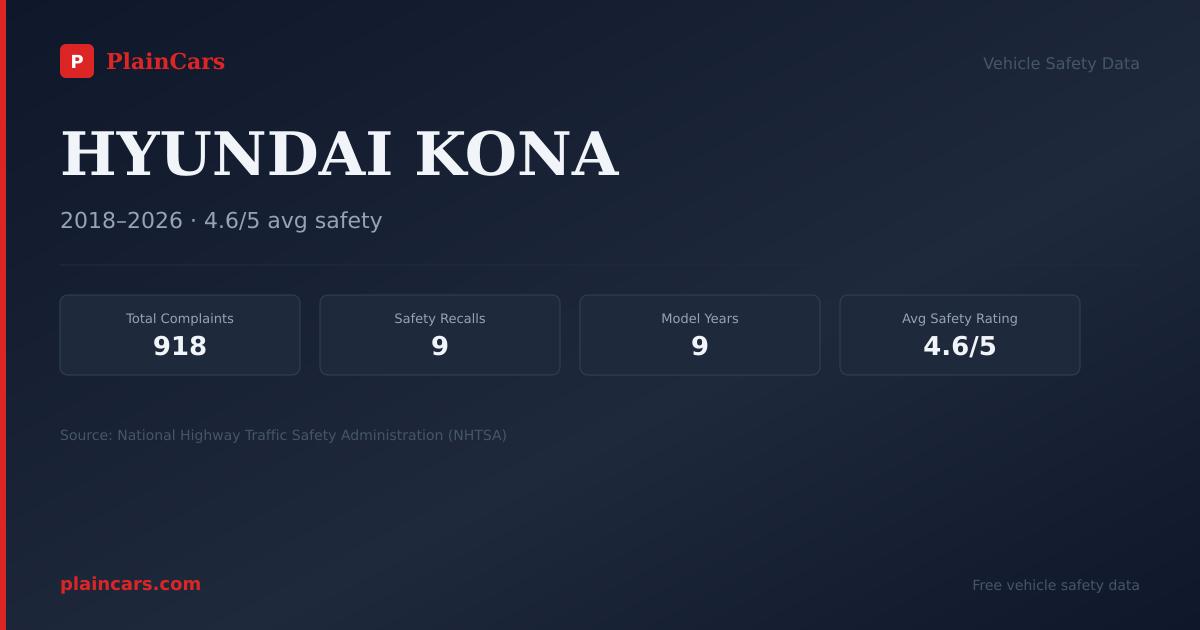
Total Complaints
171 filings
Hyundai Kona · model year
171 NHTSA complaints, 10 crash reports, and 2 recall campaigns listed for this cohort. A VIN lookup is required to determine whether a specific vehicle has an unrepaired recall.
NHTSA overall rating
5 / 5 ★
New Car Assessment Program
The verdict
The 2020 Hyundai Kona pairs above-average complaint volume with a top NHTSA safety rating.
The 2020HyundaiKona carries 171 consumer safety complaints in NHTSA's Office of Defects Investigation database for this specific model-year cohort. Within that volume, owners reported 10 crashes, 1 fire, 14 injuries, and 1 fatality. For crash performance, NHTSA's New Car Assessment Program gave this cohort an overall 5/5 rating, with 5/5 front crash, 5/5 side crash, and 4/5 rollover scores derived from standardized barrier and dynamic tests.
The most frequently selected component label in reports for the 2020 Kona is engine with 89 filings, followed by power train (16) and unknown or other (15). Complaint categories reflect owner reports and intake categorization; they do not establish a defect pattern or cause. This cohort has 2 NHTSA recall campaigns listed below. Enter a VIN in NHTSA's official recall lookup to determine whether a specific vehicle has an unrepaired recall.
NHTSA currently has 37 investigation files overlapping the 2020 Kona, and 1 remain open. Owners comparing this cohort against neighboring years should read the complaint-by-year trend as report volume, not a causal diagnosis. Use the related-complaint feed and the official recall lookup when researching a specific vehicle.
PlainCars' own composite of NHTSA NCAP crash-test ratings and rollover-risk assessment, each dimension normalized against the federal scale or the full national model-year corpus. Not an official NHTSA figure, and not a substitute for a specific vehicle's VIN-level recall check.
Total Complaints
171 filings
Crashes Reported
10 reports
Source
NHTSA ODI
Federal complaints database
At or below the fleet median complaint volume.
| Component | Count |
|---|---|
| ENGINE | 89 |
| POWER TRAIN | 16 |
| UNKNOWN OR OTHER | 15 |
| ELECTRICAL SYSTEM | 8 |
| STEERING | 6 |
| FORWARD COLLISION AVOIDANCE: WARNINGS | 6 |
| VEHICLE SPEED CONTROL | 5 |
| FUEL/PROPULSION SYSTEM | 3 |
| WHEELS | 2 |
| AIR BAGS | 2 |
| ENGINE AND ENGINE COOLING | 2 |
| SUSPENSION | 1 |
| VISIBILITY | 1 |
| ELECTRONIC STABILITY CONTROL (ESC) | 1 |
| SERVICE BRAKES | 1 |
ENGINE
Hyundai Motor America (Hyundai) is recalling certain 2019-2020 Elantra, 2019-2021 Kona and Veloster vehicles equipped with 2.0L Nu MPI engines. The piston oil rings may not have been properly heat-treated, which could result in engine damage.
EQUIPMENT:OTHER:LABELS
Hyundai Motor America (Hyundai) is recalling certain 2020 Kona vehicles. The certification label may indicate incorrect Gross Axle Weight Rating (GAWR). As such, these vehicles fail to comply with the requirements of Federal Motor Vehicle Safety Standard (FMVSS) numbers 567, "Certification" and 11
many times a year, without warning, vehicle dash lights turn off and light up like a christmas tree, followed by fca warning sound and lights going off, and a loud mechanical thud. Lose engine throttle going highway speeds. This can occur at nearly any speed without warning. Car must be powered off and back on to get normalcy. This puts me, everyone in the car and everyone on the highway at risk. Dealership was not able to reproduce or pull error codes.
many times a year, without warning, vehicle dash lights turn off and light up like a christmas tree, followed by fca warning sound and lights going off, and a loud mechanical thud. Lose engine throttle going highway speeds. This can occur at nearly any speed without warning. Car must be powered off and back on to get normalcy. This puts me, everyone in the car and everyone on the highway at risk. Dealership was not able to reproduce or pull error codes.
many times a year, without warning, vehicle dash lights turn off and light up like a christmas tree, followed by fca warning sound and lights going off, and a loud mechanical thud. Lose engine throttle going highway speeds. This can occur at nearly any speed without warning. Car must be powered off and back on to get normalcy. This puts me, everyone in the car and everyone on the highway at risk. Dealership was not able to reproduce or pull error codes.
While driving under normal conditions, the vehicle’s dual-clutch transmission (DCT) failed to engage properly, causing a sudden and unexpected loss of propulsion. When the accelerator was pressed, the vehicle hesitated and did not respond as commanded, resulting in delayed or no acceleration. This occurred while driving in traffic at approximately 30 mph while trying to acceletate to merge onto highway and has happened multiple times. In some instances, the vehicle appeared to remain in gear but would not accelerate, and in other instances the transmission disengaged before re-engaging unpredictably. This created an unsafe situation, as the vehicle could not maintain speed or merge safely, significantly increasing the risk of a collision, especially in traffic or at intersections. The issue occurred without sufficient warning and continues to happen intermittently during normal driving.The vehicle was inspected by a dealership, which stated the condition is related to a clutch issue
the headlights in this model Kona keep burning out after 9 months or so. I have replaced them multiple times in the last 5 years on both left and right sides. I use glove to put in the bulbs and are very careful not to let my hands touch the bulb. I have never had this happen with any other car I have owned. I suspect an electrical system issue, or perhaps wiring, but that is speculation. I have not had this inspected by the dealership. The latest date of failure is listed below.
The timing system was repaired in February 2025. After similar symptoms of vehicle stalling, the check engine light came on Found a software update that needed to be completed to determine if engine needed replaced. Dealership has refused for seven weeks to complete the entire job of the update which includes running a diagnostic of codes. Instead, they have been arguing that the timing system needs replaced and not providing the codes from the safety software update. Obviously there's a much deeper issue if the timing system keeps breaking down.
The timing system was repaired in February 2025. After similar symptoms of vehicle stalling, the check engine light came on Found a software update that needed to be completed to determine if engine needed replaced. Dealership has refused for seven weeks to complete the entire job of the update which includes running a diagnostic of codes. Instead, they have been arguing that the timing system needs replaced and not providing the codes from the safety software update. Obviously there's a much deeper issue if the timing system keeps breaking down.
Vehicle suddenly began shutting off upon braking and/or acceleration at any speed, idling very hard, and/or barely starting or dying immediately after starting and making a very loud whining noise while driving on an interstate. A mechanic ran a diagnostic test on it and determined that it was a P1327 code and recommended it be taken to dealership for full engine failure. This particular code was known by Hyundai to occur on certain models and years, including Kona 2019-2021, as early as 2022 and while a recall campaign was initiated, no recall to date has been issued. No warning indicators on dash occurred in advance or even after the vehicle began malfunctioning (i.e., no check engine indicator, etc.). Vehicle is available at dealership upon request.
The vehicle has ~51K miles. It has been maintained according to the manufacturer's recommended repair schedule. At low speeds (<10 mph) or when coming from a full stop the vehicle hard shifts. When driving up inclines at low speeds (<10 mph), the vehicle shakes and stutters on the verge of shutting off. This happened twice on [XXX]. I experienced a full vehicle shut off on [XXX} while the vehicle was stationary, but shifted into drive . In August, the vehicle stuttered and shook before shutting off. I have reported three instances of this issue to my local Hyundai dealership. INFORMATION REDACTED PURSUANT TO THE FREEDOM OF INFORMATION ACT (FOIA), 5 U.S.C. 552(B)(6)
The vehicle has ~51K miles. It has been maintained according to the manufacturer's recommended repair schedule. At low speeds (<10 mph) or when coming from a full stop the vehicle hard shifts. When driving up inclines at low speeds (<10 mph), the vehicle shakes and stutters on the verge of shutting off. This happened twice on [XXX]. I experienced a full vehicle shut off on [XXX} while the vehicle was stationary, but shifted into drive . In August, the vehicle stuttered and shook before shutting off. I have reported three instances of this issue to my local Hyundai dealership. INFORMATION REDACTED PURSUANT TO THE FREEDOM OF INFORMATION ACT (FOIA), 5 U.S.C. 552(B)(6)
The engine shut down when the car stops at a red light or stop sign. There are metal shavings in the oil due to issues with the pistons.
Car keeps stalling no matter what speed you're driving. Took the car to NTB and they said nothing is wrong with it. It continues to happen even in busy highways where someone almost ran into the back of me. Not safe to drive. Concerned as numerous forums suggest this is a problem with 2019-2021 Hyundai Konas.
The contact owns a 2020 Hyundai Kona. The contact stated that the vehicle was consuming an excessive amount of engine oil. There was no warning light illuminated. The vehicle was taken to a local dealer, where the vehicle was diagnosed, and the contact was informed that the turbocharger was faulty and needed to be replaced. The vehicle was not repaired. The manufacturer was notified of the failure. The approximate failure mileage was 65,000.
Mileage: 65,000
I purchased a used 2020 Hyundai Kona with the Nu 2.0L engine. I drove the vehicle regularly without issue for several years, including two days before the incident. On the day of the incident, I attempted to start the vehicle but it ran irregularly. I shut off the vehicle after a few seconds and restarted. The vehicle stalled seconds after starting. On subsequent attempts it failed to start at all. I learned of Recall 203 (defective piston rings), which affects this model year and engine. I contacted Hyundai, who recommended I visit a dealer. Upon inspection, the dealer recommended engine replacement. Hyundai denied engine replacement under Recall 203, on the grounds that the recall was "closed" during an inspection in 2021 (prior to my ownership) despite the defective part not being replaced. This engine, with defective and recalled part, has now experienced sudden and unexpected failure. Hyundai has been uncooperative and I have been without a vehicle for nearly a month.
Ignition, speed and driving halts. I've had this Kona repaired a couple years ago and it took about 6-8mos to get my vehicle back, the this year 2025 the vehicle again is giving me problems. I thought of applying the lemon law however the week of the 6-8months being in the repair shop, I got the vehicle back, and the owner(mr. Crisostomo was very kind and understanding) so it made me be more patience nonetheless there's only so much he could do if he is not the one repairing the vehicle. I was offered carpets for my patience yet still have not gotten them and feel like a bother when I call to inquiry about them and it's not the service manager that I talk to , I feel otherwise. That could just be me, however I know good customer service if it's presence. For the actually year, I would need to check emails and records. But it's probably the year after so 2022 ( almost certain) now, This year, 2025.. I see that there is a recall that the dealership did not inform me. The vehicle is pai
Ignition, speed and driving halts. I've had this Kona repaired a couple years ago and it took about 6-8mos to get my vehicle back, the this year 2025 the vehicle again is giving me problems. I thought of applying the lemon law however the week of the 6-8months being in the repair shop, I got the vehicle back, and the owner(mr. Crisostomo was very kind and understanding) so it made me be more patience nonetheless there's only so much he could do if he is not the one repairing the vehicle. I was offered carpets for my patience yet still have not gotten them and feel like a bother when I call to inquiry about them and it's not the service manager that I talk to , I feel otherwise. That could just be me, however I know good customer service if it's presence. For the actually year, I would need to check emails and records. But it's probably the year after so 2022 ( almost certain) now, This year, 2025.. I see that there is a recall that the dealership did not inform me. The vehicle is pai
Ignition, speed and driving halts. I've had this Kona repaired a couple years ago and it took about 6-8mos to get my vehicle back, the this year 2025 the vehicle again is giving me problems. I thought of applying the lemon law however the week of the 6-8months being in the repair shop, I got the vehicle back, and the owner(mr. Crisostomo was very kind and understanding) so it made me be more patience nonetheless there's only so much he could do if he is not the one repairing the vehicle. I was offered carpets for my patience yet still have not gotten them and feel like a bother when I call to inquiry about them and it's not the service manager that I talk to , I feel otherwise. That could just be me, however I know good customer service if it's presence. For the actually year, I would need to check emails and records. But it's probably the year after so 2022 ( almost certain) now, This year, 2025.. I see that there is a recall that the dealership did not inform me. The vehicle is pai
The contact owns a 2020 Hyundai Kona. The contact stated that while operating the vehicle, there was a knocking sound coming from the engine compartment. The vehicle was taken to the local dealer, who replaced the turbocharger, but the failure persisted. The contact stated that the vehicle was consuming an excessive amount of engine oil. The vehicle was later examined by an independent mechanic who determined that the pistons were faulty. No further information was available. The vehicle was not yet repaired. The manufacturer and local dealer were notified of the failures. The contact was informed that the VIN was not included in NHTSA Campaign Number: 21V301000 (ENGINE). The contact stated that the vehicle had experienced the failure listed in the recall. The failure mileage was 127,000.
Mileage: 127,000
2020 Hyundai Kona wirh 22,000 miles, original owner, great condition(except oil usage). First consumption test used 3/4 qt. in 1,000 miles. Seems convenient that Hyundai says 1 qt & the dealership came up with 3/4 so there is no problem. BULL! No oil light came on to warn of low oil.
The contact owns a 2020 Hyundai Kona. The contact stated that the vehicle was consuming an excessive amount of engine oil. The contact stated there was a pinging sound inside the vehicle. There were no warning lights illuminated. The vehicle was taken to the local dealer for a multi-point inspection, and it was confirmed that the oil level was extremely low. The contact stated that an oil consumption test was performed. The vehicle had consumed ¾ quarts of oil in a month. The vehicle was not diagnosed or repaired. The manufacturer was contacted and referred the contact to seek legal assistance. The approximate failure mileage was 22,000.
Mileage: 22,000
Data vintage: August 2026. Sources: NHTSA Office of Defects Investigation (ODI) complaints database, NHTSA recall campaign API, NHTSA NCAP crash-test ratings, and NHTSA FARS for fatality cross-reference.
Every figure on PlainCars is rendered directly from NHTSA complaint and safety data, no number is typed in by an editor. This year-specific record is rendered from NHTSA ODI, recall, and NCAP rows for the 2020 Hyundai Kona; no figure is typed in by an editor. See our editorial standards & corrections policy, the methodology behind these numbers, or report a data error. Data current as of August 2026.
Read our methodology - how this data is sourced, computed, and verified.