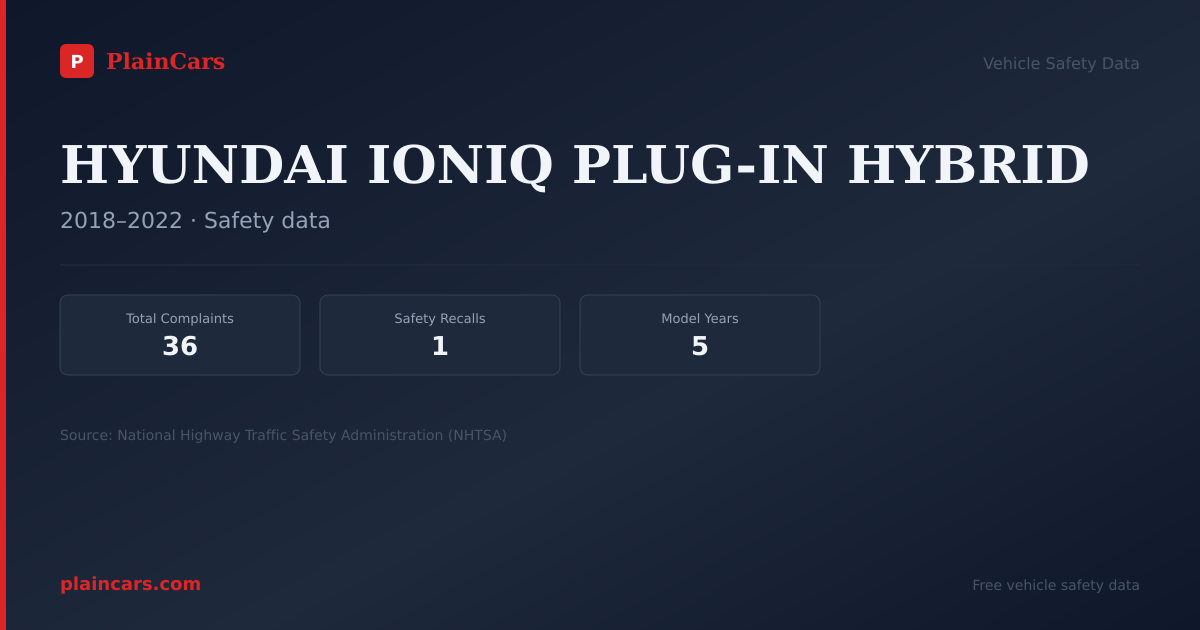
Total Complaints
8 filings
Hyundai Ioniq Plug-IN Hybrid · model year
8 NHTSA complaints. A VIN lookup is required to determine whether a specific vehicle has an unrepaired recall.
NHTSA overall rating
Not crash-tested
New Car Assessment Program
The verdict
The 2021 Hyundai Ioniq Plug-IN Hybrid posts above-average complaint volume among its own model-year siblings.
The 2021HyundaiIoniq Plug-IN Hybrid carries 8 consumer safety complaints in NHTSA's Office of Defects Investigation database for this specific model-year cohort. Within that volume, owners reported 0 crashes, 0 fires, 0 injuries, and 0 fatalities. For crash performance, NHTSA's New Car Assessment Program gave this cohort an overall Not Rated/5 rating, with Not Rated/5 front crash, Not Rated/5 side crash, and Not Rated/5 rollover scores derived from standardized barrier and dynamic tests.
The most frequently selected component label in reports for the 2021 Ioniq Plug-IN Hybrid is electrical system with 2 filings, followed by forward collision avoidance: adaptive cruise control (2) and service brakes (2). Complaint categories reflect owner reports and intake categorization; they do not establish a defect pattern or cause.
NHTSA currently has 37 investigation files overlapping the 2021 Ioniq Plug-IN Hybrid, and 1 remain open. Owners comparing this cohort against neighboring years should read the complaint-by-year trend as report volume, not a causal diagnosis. Use the related-complaint feed and the official recall lookup when researching a specific vehicle.
PlainCars' own composite of NHTSA NCAP crash-test ratings and rollover-risk assessment, each dimension normalized against the federal scale or the full national model-year corpus. Not an official NHTSA figure, and not a substitute for a specific vehicle's VIN-level recall check.
Total Complaints
8 filings
Crashes Reported
0 reports
Source
NHTSA ODI
Federal complaints database
At or below the fleet median complaint volume.
| Component | Count |
|---|---|
| ELECTRICAL SYSTEM | 2 |
| FORWARD COLLISION AVOIDANCE: ADAPTIVE CRUISE CONTROL | 2 |
| SERVICE BRAKES | 2 |
| VEHICLE SPEED CONTROL | 1 |
| UNKNOWN OR OTHER | 1 |
Auto Hold/EPB lights come one while driving. Deactivates cruise control of on. Turns off auto hold. Ongoing issue with many reports but no recall or dealership knowledge. Ongoing issue since purchase.
Auto Hold/EPB lights come one while driving. Deactivates cruise control of on. Turns off auto hold. Ongoing issue with many reports but no recall or dealership knowledge. Ongoing issue since purchase.
The "Auto Hold" feature on my Hyundai Ioniq malfunctioned, displaying a dashboard warning: "AUTO HOLD conditions not met. Press brake pedal." This message randomly appears while driving or stopping, and it deactivates the Auto Hold and Electronic Parking Brake (EPB) functions. In some cases, the car rolls after stopping because the system fails to hold the vehicle. This issue compromises vehicle safety, especially on inclines or during stop-and-go traffic. It puts me, passengers, and other drivers at risk. The problem has occurred multiple times and is unpredictable. It appears to be linked to a faulty brake switch or sensor, as noted in Hyundai’s TSB 23-BR-001H. I discovered this issue is affecting many other Hyundai Ioniq owners, as seen in this discussion: [XXX] The dealer has not yet inspected the vehicle, but the symptoms match the TSB. No accident has occurred, but the safety risk is serious due to brake failure behavior. There were no visible warning lights before the iss
The "Auto Hold" feature on my Hyundai Ioniq malfunctioned, displaying a dashboard warning: "AUTO HOLD conditions not met. Press brake pedal." This message randomly appears while driving or stopping, and it deactivates the Auto Hold and Electronic Parking Brake (EPB) functions. In some cases, the car rolls after stopping because the system fails to hold the vehicle. This issue compromises vehicle safety, especially on inclines or during stop-and-go traffic. It puts me, passengers, and other drivers at risk. The problem has occurred multiple times and is unpredictable. It appears to be linked to a faulty brake switch or sensor, as noted in Hyundai’s TSB 23-BR-001H. I discovered this issue is affecting many other Hyundai Ioniq owners, as seen in this discussion: [XXX] The dealer has not yet inspected the vehicle, but the symptoms match the TSB. No accident has occurred, but the safety risk is serious due to brake failure behavior. There were no visible warning lights before the iss
The "Auto Hold" feature on my Hyundai Ioniq malfunctioned, displaying a dashboard warning: "AUTO HOLD conditions not met. Press brake pedal." This message randomly appears while driving or stopping, and it deactivates the Auto Hold and Electronic Parking Brake (EPB) functions. In some cases, the car rolls after stopping because the system fails to hold the vehicle. This issue compromises vehicle safety, especially on inclines or during stop-and-go traffic. It puts me, passengers, and other drivers at risk. The problem has occurred multiple times and is unpredictable. It appears to be linked to a faulty brake switch or sensor, as noted in Hyundai’s TSB 23-BR-001H. I discovered this issue is affecting many other Hyundai Ioniq owners, as seen in this discussion: [XXX] The dealer has not yet inspected the vehicle, but the symptoms match the TSB. No accident has occurred, but the safety risk is serious due to brake failure behavior. There were no visible warning lights before the iss
During a highway trip that was bumper to bumper traffic at approximately 15mph, the car suddenly would not accelerate while operating on gasoline (not electric). The engine revs would increase to maximum without movement from the car (as if the car was in neutral). After checking the gear lever to make sure it was still in D, tried to accelerate again and engine rev high without movement. Eventually car came to stop with brakes, and the car could move on electric power (in hybrid mode), pulled over and turned off the car to visually inspect. After not identifying anything, turned on car and operation resumed to normal and would accelerate on gas power.
During a highway trip that was bumper to bumper traffic at approximately 15mph, the car suddenly would not accelerate while operating on gasoline (not electric). The engine revs would increase to maximum without movement from the car (as if the car was in neutral). After checking the gear lever to make sure it was still in D, tried to accelerate again and engine rev high without movement. Eventually car came to stop with brakes, and the car could move on electric power (in hybrid mode), pulled over and turned off the car to visually inspect. After not identifying anything, turned on car and operation resumed to normal and would accelerate on gas power.
The contact leased a 2021 Hyundai Ioniq Electric The contact stated that while the vehicle was parked, he attempted to open the driver’s side door using the key fob; however, the door would not open. The contact contacted Hyundai roadside assistance who assisted him in jumpstarting and recharging the batteries. The contact was still able to drive the vehicle. The contact stated that a couple of days later, the vehicle failed to start after several attempts. The vehicle was towed to the dealer where it was diagnosed that the mechanic switch that applied the emergency brake was not completely closed and kept the electrical circuit for the emergency brake activated causing the two batteries to drain. The vehicle was repaired. The manufacturer was notified of the failure and advised the contact that they would reimburse him for the vehicle rental expenses under the condition that he surrendered his rights to pursue reimbursement for the vehicle repair expenses. The failure mileage was ap
Mileage: 3,400
Data vintage: August 2026. Sources: NHTSA Office of Defects Investigation (ODI) complaints database, NHTSA recall campaign API, NHTSA NCAP crash-test ratings, and NHTSA FARS for fatality cross-reference.
Every figure on PlainCars is rendered directly from NHTSA complaint and safety data, no number is typed in by an editor. This year-specific record is rendered from NHTSA ODI, recall, and NCAP rows for the 2021 Hyundai Ioniq Plug-IN Hybrid; no figure is typed in by an editor. See our editorial standards & corrections policy, the methodology behind these numbers, or report a data error. Data current as of August 2026.
Read our methodology - how this data is sourced, computed, and verified.