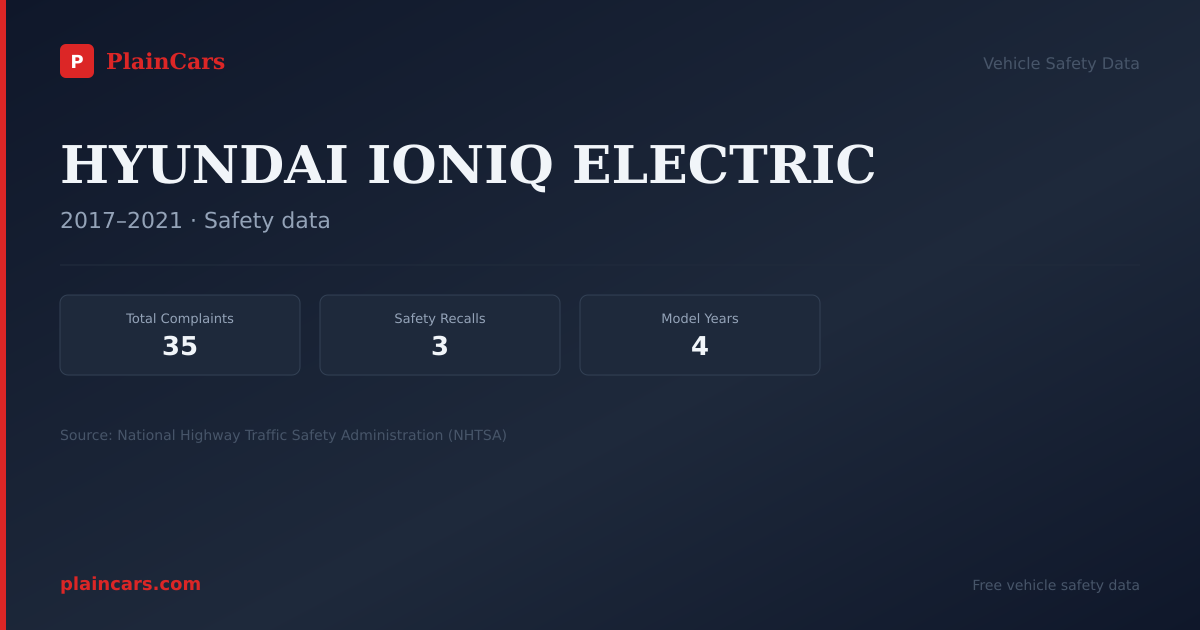
Total Complaints
9 filings
Hyundai Ioniq Electric · model year
9 NHTSA complaints, 3 crash reports, and 1 recall campaign listed for this cohort. A VIN lookup is required to determine whether a specific vehicle has an unrepaired recall.
NHTSA overall rating
Not crash-tested
New Car Assessment Program
The verdict
The 2020 Hyundai Ioniq Electric posts top-quartile complaint standing among its own model-year siblings.
The 2020HyundaiIoniq Electric carries 9 consumer safety complaints in NHTSA's Office of Defects Investigation database for this specific model-year cohort. Within that volume, owners reported 3 crashes, 0 fires, 0 injuries, and 0 fatalities. For crash performance, NHTSA's New Car Assessment Program gave this cohort an overall Not Rated/5 rating, with Not Rated/5 front crash, Not Rated/5 side crash, and Not Rated/5 rollover scores derived from standardized barrier and dynamic tests.
The most frequently selected component label in reports for the 2020 Ioniq Electric is service brakes with 3 filings, followed by unknown or other (1) and electrical system (1). Complaint categories reflect owner reports and intake categorization; they do not establish a defect pattern or cause. This cohort has 1 NHTSA recall campaign listed below. Enter a VIN in NHTSA's official recall lookup to determine whether a specific vehicle has an unrepaired recall.
NHTSA currently has 37 investigation files overlapping the 2020 Ioniq Electric, and 1 remain open. Owners comparing this cohort against neighboring years should read the complaint-by-year trend as report volume, not a causal diagnosis. Use the related-complaint feed and the official recall lookup when researching a specific vehicle.
PlainCars' own composite of NHTSA NCAP crash-test ratings and rollover-risk assessment, each dimension normalized against the federal scale or the full national model-year corpus. Not an official NHTSA figure, and not a substitute for a specific vehicle's VIN-level recall check.
Total Complaints
9 filings
Crashes Reported
3 reports
Source
NHTSA ODI
Federal complaints database
At or below the fleet median complaint volume.
| Component | Count |
|---|---|
| SERVICE BRAKES | 3 |
| UNKNOWN OR OTHER | 1 |
| ELECTRICAL SYSTEM | 1 |
| ENGINE | 1 |
| FUEL/PROPULSION SYSTEM | 1 |
| VEHICLE SPEED CONTROL | 1 |
| FORWARD COLLISION AVOIDANCE: AUTOMATIC EMERGENCY BRAKING | 1 |
ELECTRICAL SYSTEM:PROPULSION SYSTEM:TRACTION BATTERY
Hyundai Motor America (Hyundai) is recalling certain 2019-2020 Kona Electric and 2020 Ioniq Electric vehicles. The lithium-ion (Li-ion) battery may short-circuit.
When approaching a turn, I let off the accelerator but the car didn’t stop accelerating. Instead, it gently kept accelerating. I applied the brakes and the car started slowing down but not at the same rate I was applying brake pressure. Therefore I floored the brakes to try coming to a complete stop. Sadly, the cars ABS system did not engage, half of the car hopped over the curb at about 20 mph. I was able to steer the car back onto the road where it finally came to a stop but acted like it wanted to keep going until full blackout power loss happened. The car was deemed a total loss by my insurance company American Family. Essentially, the vehicle malfunctioned causing the accelerator to stick which caused the car to be harder to control than designed. The car malfunctioned by not engaging the ABS system as well. There is a recall on this exact problem for the 2017-2019 model but not for my 2020 even though it was manufactured during that campaign. It all happened very quickly and I
When approaching a turn, I let off the accelerator but the car didn’t stop accelerating. Instead, it gently kept accelerating. I applied the brakes and the car started slowing down but not at the same rate I was applying brake pressure. Therefore I floored the brakes to try coming to a complete stop. Sadly, the cars ABS system did not engage, half of the car hopped over the curb at about 20 mph. I was able to steer the car back onto the road where it finally came to a stop but acted like it wanted to keep going until full blackout power loss happened. The car was deemed a total loss by my insurance company American Family. Essentially, the vehicle malfunctioned causing the accelerator to stick which caused the car to be harder to control than designed. The car malfunctioned by not engaging the ABS system as well. There is a recall on this exact problem for the 2017-2019 model but not for my 2020 even though it was manufactured during that campaign. It all happened very quickly and I
When approaching a turn, I let off the accelerator but the car didn’t stop accelerating. Instead, it gently kept accelerating. I applied the brakes and the car started slowing down but not at the same rate I was applying brake pressure. Therefore I floored the brakes to try coming to a complete stop. Sadly, the cars ABS system did not engage, half of the car hopped over the curb at about 20 mph. I was able to steer the car back onto the road where it finally came to a stop but acted like it wanted to keep going until full blackout power loss happened. The car was deemed a total loss by my insurance company American Family. Essentially, the vehicle malfunctioned causing the accelerator to stick which caused the car to be harder to control than designed. The car malfunctioned by not engaging the ABS system as well. There is a recall on this exact problem for the 2017-2019 model but not for my 2020 even though it was manufactured during that campaign. It all happened very quickly and I
Refill Coolant warning light intermittently signals EV battery coolant problem. Hyundai dealer in Fort Wayne, IN, topped off coolant. Andrew service representative was informed of two YouTube videos explaining recall due to defective coolant ASC1 that crystalizes and/or becomes sludgy. Video reported dealer changed old coolant with an upgraded coolant ASC2 number in a Hyundai Ioniq Limited 2020 Electric Vehicle 38 kw like my vehicle. Fort Wayne, Glenbrook Hyundai dealer has very little experience or training with EV vehicles, since they offered to change the engine oil. https://www.youtube.com/watch?v=CUs-YoGTMlw https://www.youtube.com/watch?v=cCt6MEbaXCI are video links apparently from England due to British accent and Chippenham city mentioned in video. USA NHTSA should add this recall to USA Hyundai Ioniq 2020 38 kv EV's. Defective coolant could cause EV battery failure and potential fire due to overheating and electrical short circuits. The Refill Coolant warning light g
the Hyundai ioniq 5 doesn't turn on its brake lights when you're using single-pedal driving, as shown in this youtube video: https://youtu.be/U0YW7x9U5TQ?t=97 these should be recalled because you can bring the vehicle to a complete stop without the brakes turning on
The regenerative brake system failed to operate as it normally does, and no indicator lights came on on the dashboard. This unexpected loss of braking force nearly caused me to hit the car in front of me. I had recently disengaged cruise control and was approaching a red light. I pressed my foot on the brake pedal and felt no response from the car. I lifted my foot and pressed again two or three times with no response, neither deceleration nor any change in the regenerative braking meter on the dashboard. I had to press the brake all the way to the floor before the mechanical brakes were activated. This loss of braking power greatly increased my stopping distance and I narrowly avoided hitting the car in front of me. Once the light turned green, I accelerated and tested the brakes again and everything seemed to be working fine, including the regeneration meter. No indicator lights of any kind came on during this incident. This occurred approximately a week ago. I have owned the car f
This issue is easily repeatable, when braking if you hit a bump (pot hole, etc.) the braking power is greatly reduced & the brake pedal becomes almost impossible to push down to stop the car, making it very hard to stop even when not coming to an abrupt stop.
The traction battery on my Ioniq 2020 went bad after 3 months. The diagnostic panel warned me of an electric issue and the range dropped drastically. The dealer changed the battery no questions asked. My vin wasn't part of the recall. I wonder if the recall should have included a broader range of vehicles.
8-1-2020 HYUNDAI MOTOR AMERICA LETTER RECEIVED THAT ORIGINAL WINDOW STICKER HAD INCORRECT INFORMATION AND IS NOT EQUIPPED WITH BLIND SPOT AND REAR CROSS TRAFFIC COLLISION AVOIDANCE ASSIST SYSTEMS; HOWEVER THESE VEHCLES ARE EQUIPPED WITH BLIND SPOT AND REAR CROSS TRAFFIC COLLISION WARNING SYSTEMS. HOW MANY OTHER BUYERS WERE MISLED BY THE WINDOW STICKER AND SOLD A CAR WITH MORE EXTENSIVE SAFETY EQUIPMENT THAN WHAT THEY ACTUALLY RECEIVED? SHOULD HYUNDAI RECALL THE VEHICLE TO INSTALL THE DEVICES AS ADVERTISED AND SOLD OR REIMBURSE THE BUYERS FOR THE DIFFERENCE AND THE LESSER VALUE CAR SOLD? MY CAR WAS STATIONARY AND NO MALFUNCTION KNOWN YET, BUT LACK OF ASSIST FUNCTION MAKES THE CAR LESS SAFE THAN REPRESENTED WHEN SOLD TO ME. THE DEFICIENCY, ERROR NOTICE LETTER IS NOT DATED AND DOES NOT OFFER TO CORRECT THE MISREPRESENTATION OR REFUND THE COST OF INSTALLING THIS SYSTEM, AND DOES NOT OFFER TO INSTALL IT AFTER THEIR ERROR.
Mileage: 6,800
Data vintage: August 2026. Sources: NHTSA Office of Defects Investigation (ODI) complaints database, NHTSA recall campaign API, NHTSA NCAP crash-test ratings, and NHTSA FARS for fatality cross-reference.
Every figure on PlainCars is rendered directly from NHTSA complaint and safety data, no number is typed in by an editor. This year-specific record is rendered from NHTSA ODI, recall, and NCAP rows for the 2020 Hyundai Ioniq Electric; no figure is typed in by an editor. See our editorial standards & corrections policy, the methodology behind these numbers, or report a data error. Data current as of August 2026.
Read our methodology - how this data is sourced, computed, and verified.