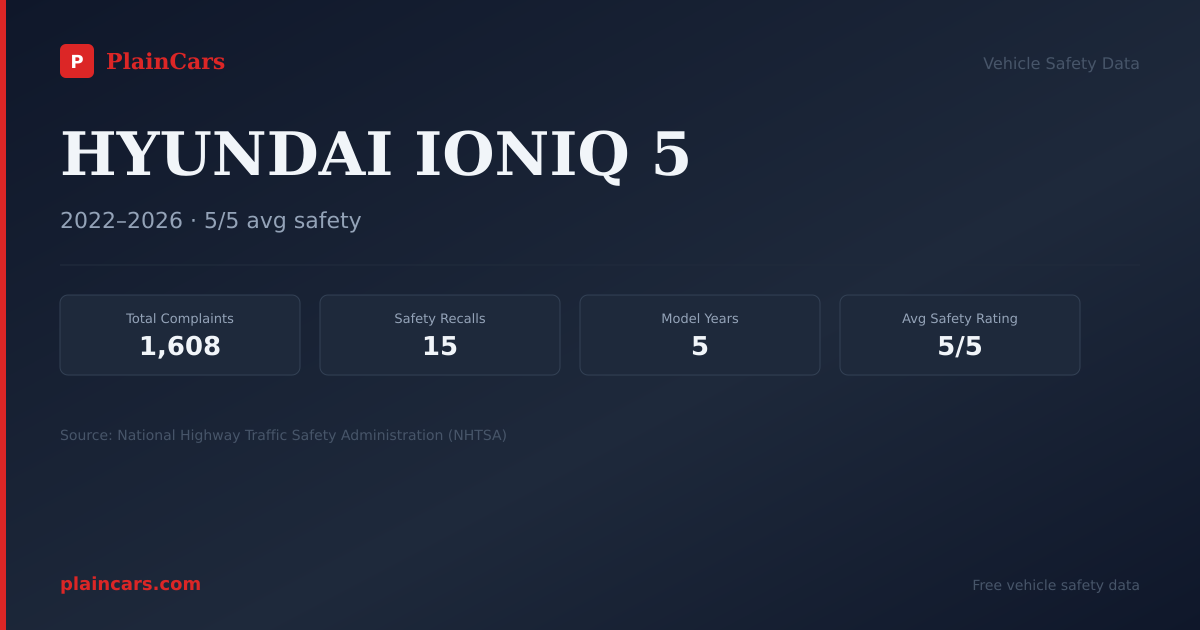
Total Complaints
6 filings
Hyundai Ioniq 5 · model year
6 NHTSA complaints, and 2 recall campaigns listed for this cohort. A VIN lookup is required to determine whether a specific vehicle has an unrepaired recall.
NHTSA overall rating
Not crash-tested
New Car Assessment Program
The verdict
The 2026 Hyundai Ioniq 5 posts top-1% complaint standing (fewest filings) among its own model-year siblings.
The 2026HyundaiIoniq 5 carries 6 consumer safety complaints in NHTSA's Office of Defects Investigation database for this specific model-year cohort. Within that volume, owners reported 0 crashes, 0 fires, 0 injuries, and 0 fatalities. No NCAP 5-star crash-test rating is available for this model year in the federal database.
The most frequently selected component label in reports for the 2026 Ioniq 5 is wheels with 1 filings, followed by electrical system (1) and vehicle speed control (1). Complaint categories reflect owner reports and intake categorization; they do not establish a defect pattern or cause. This cohort has 2 NHTSA recall campaigns listed below. Enter a VIN in NHTSA's official recall lookup to determine whether a specific vehicle has an unrepaired recall.
NHTSA currently has 37 investigation files overlapping the 2026 Ioniq 5, and 1 remain open. Owners comparing this cohort against neighboring years should read the complaint-by-year trend as report volume, not a causal diagnosis. Use the related-complaint feed and the official recall lookup when researching a specific vehicle.
PlainCars' own composite of NHTSA NCAP crash-test ratings and rollover-risk assessment, each dimension normalized against the federal scale or the full national model-year corpus. Not an official NHTSA figure, and not a substitute for a specific vehicle's VIN-level recall check.
Total Complaints
6 filings
Crashes Reported
0 reports
Source
NHTSA ODI
Federal complaints database
At or below the fleet median complaint volume.
| Component | Count |
|---|---|
| WHEELS | 1 |
| ELECTRICAL SYSTEM | 1 |
| VEHICLE SPEED CONTROL | 1 |
| LANE DEPARTURE: ASSIST | 1 |
| FORWARD COLLISION AVOIDANCE: ADAPTIVE CRUISE CONTROL | 1 |
| ENGINE | 1 |
ELECTRICAL SYSTEM: INSTRUMENT CLUSTER/PANEL
Hyundai Motor America (Hyundai) is recalling certain 2025-2026 Tucson Hybrid, Tucson Plug-In Hybrid Electric (PHEV), 2026 IONIQ 5, Santa Cruz, Kona, Palisade, Palisade Hybrid, Santa Fe, Santa Fe Hybrid, Sonata, Sonata Hybrid, and Tucson vehicles. Due to a software error, the instrument panel display
ELECTRICAL SYSTEM:PROPULSION SYSTEM:TRACTION BATTERY
Hyundai Motor America (Hyundai) is recalling certain 2025-2026 IONIQ 5 and 2026 IONIQ 9 vehicles. The high voltage battery system may contain an improperly tightened bus bar, which can cause a short-circuit.
The vehicle cannot initiate a level 2 charging session due to a ground fault error. Multiple charging stations were attempted with different charging connectors and adapters. Only DC fast charging works on the vehicle now. This vehicle has been leased for less than 60 days.
While driving at highway speeds (approximately 70 MPH) with the vehicle's Assistive Driving functions engaged, the Driver Monitoring System (DMS) malfunctioned. Despite maintaining constant visual attention on the road ahead, the system issued repeated, erroneous audio warnings claiming driver inattention. I attempted to adjust my head and eye position to satisfy the sensors, but the system failed to register my compliance and continued to cycle through warnings. Consequently, the vehicle initiated an unwarranted "fail-safe" maneuver and suddenly applied the brakes while traveling in the flow of traffic. This uncommanded, rapid deceleration created an immediate and severe risk of a high-speed rear-end collision with following vehicles. The failure appears to be a false-positive defect in the eye-tracking software logic and its integration with the braking system. The vehicle is available for inspection to analyze the system data logs.
While driving at highway speeds (approximately 70 MPH) with the vehicle's Assistive Driving functions engaged, the Driver Monitoring System (DMS) malfunctioned. Despite maintaining constant visual attention on the road ahead, the system issued repeated, erroneous audio warnings claiming driver inattention. I attempted to adjust my head and eye position to satisfy the sensors, but the system failed to register my compliance and continued to cycle through warnings. Consequently, the vehicle initiated an unwarranted "fail-safe" maneuver and suddenly applied the brakes while traveling in the flow of traffic. This uncommanded, rapid deceleration created an immediate and severe risk of a high-speed rear-end collision with following vehicles. The failure appears to be a false-positive defect in the eye-tracking software logic and its integration with the braking system. The vehicle is available for inspection to analyze the system data logs.
While driving at highway speeds (approximately 70 MPH) with the vehicle's Assistive Driving functions engaged, the Driver Monitoring System (DMS) malfunctioned. Despite maintaining constant visual attention on the road ahead, the system issued repeated, erroneous audio warnings claiming driver inattention. I attempted to adjust my head and eye position to satisfy the sensors, but the system failed to register my compliance and continued to cycle through warnings. Consequently, the vehicle initiated an unwarranted "fail-safe" maneuver and suddenly applied the brakes while traveling in the flow of traffic. This uncommanded, rapid deceleration created an immediate and severe risk of a high-speed rear-end collision with following vehicles. The failure appears to be a false-positive defect in the eye-tracking software logic and its integration with the braking system. The vehicle is available for inspection to analyze the system data logs.
My BRAND NEW car is suffering an ICCU issue. I first noticed the screens going completely black while driving. I then noticed that I can’t charge at all on Lvl 1 and Lvl2 chargers (AC), but I went to the dealership and the helped me charge on lvl 3 DC fast charging. This is an incredibly dangerous problem, if this results in my 12V battery dying, I could be stranded while driving.
The right front tire pressure sensor (TPS) indicates low inflation when the tire is inflated properly. The sensor will not reset on its own even when the tire is filled to manufacturer standards. Social media forums discuss this as a reoccurring problem in previous and current models.
Data vintage: August 2026. Sources: NHTSA Office of Defects Investigation (ODI) complaints database, NHTSA recall campaign API, NHTSA NCAP crash-test ratings, and NHTSA FARS for fatality cross-reference.
Every figure on PlainCars is rendered directly from NHTSA complaint and safety data, no number is typed in by an editor. This year-specific record is rendered from NHTSA ODI, recall, and NCAP rows for the 2026 Hyundai Ioniq 5; no figure is typed in by an editor. See our editorial standards & corrections policy, the methodology behind these numbers, or report a data error. Data current as of August 2026.
Read our methodology - how this data is sourced, computed, and verified.