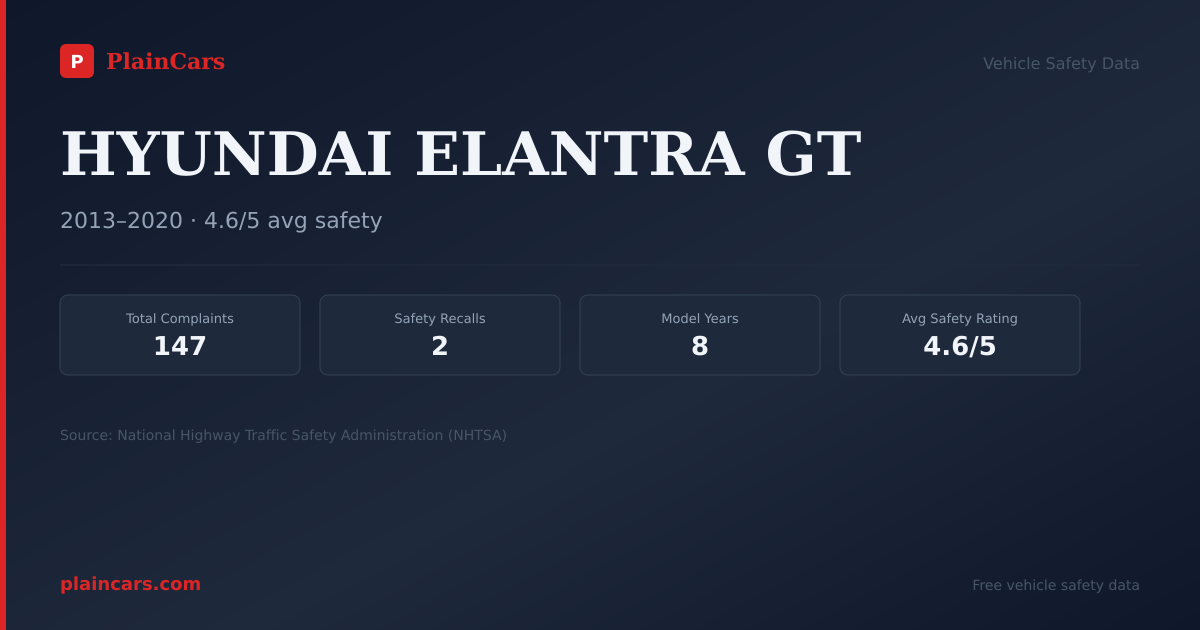
Total Complaints
9 filings
Hyundai Elantra GT · model year
9 NHTSA complaints, and 1 recall campaign listed for this cohort. A VIN lookup is required to determine whether a specific vehicle has an unrepaired recall.
NHTSA overall rating
5 / 5 ★
New Car Assessment Program
The verdict
The 2016 Hyundai Elantra GT pairs below-average complaint volume with a top NHTSA safety rating.
The 2016HyundaiElantra GT carries 9 consumer safety complaints in NHTSA's Office of Defects Investigation database for this specific model-year cohort. Within that volume, owners reported 0 crashes, 0 fires, 0 injuries, and 0 fatalities. For crash performance, NHTSA's New Car Assessment Program gave this cohort an overall 5/5 rating, with 4/5 front crash, 5/5 side crash, and 4/5 rollover scores derived from standardized barrier and dynamic tests.
The most frequently selected component label in reports for the 2016 Elantra GT is engine with 5 filings, followed by seats (1) and engine and engine cooling:engine:oil/lubrication: oil cooler (1). Complaint categories reflect owner reports and intake categorization; they do not establish a defect pattern or cause. This cohort has 1 NHTSA recall campaign listed below. Enter a VIN in NHTSA's official recall lookup to determine whether a specific vehicle has an unrepaired recall.
NHTSA currently has 37 investigation files overlapping the 2016 Elantra GT, and 1 remain open. Owners comparing this cohort against neighboring years should read the complaint-by-year trend as report volume, not a causal diagnosis. Use the related-complaint feed and the official recall lookup when researching a specific vehicle.
PlainCars' own composite of NHTSA NCAP crash-test ratings and rollover-risk assessment, each dimension normalized against the federal scale or the full national model-year corpus. Not an official NHTSA figure, and not a substitute for a specific vehicle's VIN-level recall check.
Total Complaints
9 filings
Crashes Reported
0 reports
Source
NHTSA ODI
Federal complaints database
At or below the fleet median complaint volume.
| Component | Count |
|---|---|
| ENGINE | 5 |
| SEATS | 1 |
| ENGINE AND ENGINE COOLING:ENGINE:OIL/LUBRICATION: OIL COOLER | 1 |
| ELECTRICAL SYSTEM: INSTRUMENT CLUSTER/PANEL | 1 |
| SERVICE BRAKES | 1 |
AIR BAGS:FRONTAL:DRIVER SIDE:INFLATOR MODULE
Hyundai Motor America (Hyundai) is recalling certain 2015-2016 Elantra and 2016 Elantra GT vehicles. The driver's air bag inflator may rupture during deployment.
The contact owns a 2016 Hyundai Elantra GT. The contact stated that while driving approximately 55 MPH, the vehicle stalled without warning. The contact stated that there was an abnormal burning odor inside and outside the vehicle. The vehicle failed to restart. The vehicle was later towed to the residence where an independent mechanic was unable to determine the cause of the failure. The local dealer and manufacturer were not yet notified of the failure. The failure mileage was 140,000.
Mileage: 140,000
The contact owns a 2016 Hyundai Elantra GT. The contact stated while driving approximately 30 MPH, the check engine warning light illuminated, and the vehicle started losing motive power. The contact drove the vehicle to an independent mechanic who diagnosed and determined that the vehicle had a experienced a failure with the piston rings related to NHTSA Campaign Number: 21V301000 (Engine). The vehicle had not been repaired. The manufacturer had been informed of the failure. The failure mileage was approximately 57,000.
Mileage: 57,000
The contact owns a 2016 Hyundai Elantra GT. The contact stated that while driving approximately 50 MPH and depressing the brake pedal to stop the vehicle, the braked malfunctioned, and the vehicle failed to slow down. The contact shifted to park and turned off the vehicle to avoid crashing into the rear of a truck. After restarting the vehicle, the brakes operated normally. The vehicle was later taken to the local dealer who was unable to duplicate the failure. The vehicle was not repaired. The cause of the failure was not yet determined. The manufacturer was notified of the failure. The failure mileage was 69,000. The VIN was not available.
Mileage: 69,000
The contact owns a 2016 Hyundai Elantra GT. The contact stated that the instrument panel software was previously replaced by an independent mechanic as the instrument cluster lights were inoperative. The contact stated while her daughter was driving 35 MPH, the vehicle stalled inadvertently. There was no warning light illuminated. The contact's daughter was able to veer to the side of the road. The vehicle failed to restart after several attempts. The vehicle was towed to an independent mechanic where it was diagnosed that the engine had failed and needed to be replaced. The vehicle was not repaired. The manufacturer was notified of the failure but provided no assistance. The failure mileage was approximately 40,000.
Mileage: 40,000
The contact owns a 2016 Hyundai Elantra GT. The contact stated that the instrument panel software was previously replaced by an independent mechanic as the instrument cluster lights were inoperative. The contact stated while her daughter was driving 35 MPH, the vehicle stalled inadvertently. There was no warning light illuminated. The contact's daughter was able to veer to the side of the road. The vehicle failed to restart after several attempts. The vehicle was towed to an independent mechanic where it was diagnosed that the engine had failed and needed to be replaced. The vehicle was not repaired. The manufacturer was notified of the failure but provided no assistance. The failure mileage was approximately 40,000.
Mileage: 40,000
The contact owns a 2016 Hyundai Elantra GT. The contact stated that while her wife was driving 30 MPH, the vehicle stalled inadvertently. There were no warning lights illuminated. The contact's wife was able to veer to the side of the road. The contact's wife was unable to restart the vehicle after several attempts. The co-workers of the contact's wife inspected under the hood and noticed that there was no engine oil in the vehicle. However, the contact stated that she had recently completed an oil change. The contact's wife added engine oil in the vehicle with assistance. The contact stated that upon attempting to restart the vehicle, the vehicle emitted an abnormally loud sound. The vehicle was towed to the dealer. The dealer identified the failure as excessive oil consumption that had damaged the engine. The vehicle was not diagnosed or repaired. The dealer informed the contact that the failure was a known failure. The manufacturer was not notified of the failure. The failure mileag
Mileage: 82,623
The contact owns a 2016 Hyundai Elantra GT. The contact stated that while her wife was driving 30 MPH, the vehicle stalled inadvertently. There were no warning lights illuminated. The contact's wife was able to veer to the side of the road. The contact's wife was unable to restart the vehicle after several attempts. The co-workers of the contact's wife inspected under the hood and noticed that there was no engine oil in the vehicle. However, the contact stated that she had recently completed an oil change. The contact's wife added engine oil in the vehicle with assistance. The contact stated that upon attempting to restart the vehicle, the vehicle emitted an abnormally loud sound. The vehicle was towed to the dealer. The dealer identified the failure as excessive oil consumption that had damaged the engine. The vehicle was not diagnosed or repaired. The dealer informed the contact that the failure was a known failure. The manufacturer was not notified of the failure. The failure mileag
Mileage: 82,623
The contact's wife owns a 2016 Hyundai Elantra GT. The contact stated that while attempting to install a safety seat, he noticed that the rear seat hinge assembly pin had detached and the rear seats were not attached to the frame of the vehicle. The dealer was made aware of the failure and the contact purchased the hinge assembly pin to replace it himself. The vehicle was not diagnosed nor repaired by an independent mechanic or dealer. The manufacturer was not made aware of the failure. The failure mileage was approximately 115,000. The VIN was unavailable.
Mileage: 115,000
The contact owns a 2016 Hyundai Elantra GT. The contact stated that while driving at 35 MPH, the engine made abnormal loud knocking sounds. There were no warning lights illuminated. The contact stated that he veered to the side of the road. The vehicle was towed to the dealer who diagnosed that the engine threw a rod through the engine block and destroyed the engine. The manufacturer was notified of the failure and advised the contact that they would cover a percentage of the repair. The vehicle was not repaired. The approximate failure mileage was 77,170.
Mileage: 77,170
Data vintage: August 2026. Sources: NHTSA Office of Defects Investigation (ODI) complaints database, NHTSA recall campaign API, NHTSA NCAP crash-test ratings, and NHTSA FARS for fatality cross-reference.
Every figure on PlainCars is rendered directly from NHTSA complaint and safety data, no number is typed in by an editor. This year-specific record is rendered from NHTSA ODI, recall, and NCAP rows for the 2016 Hyundai Elantra GT; no figure is typed in by an editor. See our editorial standards & corrections policy, the methodology behind these numbers, or report a data error. Data current as of August 2026.
Read our methodology - how this data is sourced, computed, and verified.