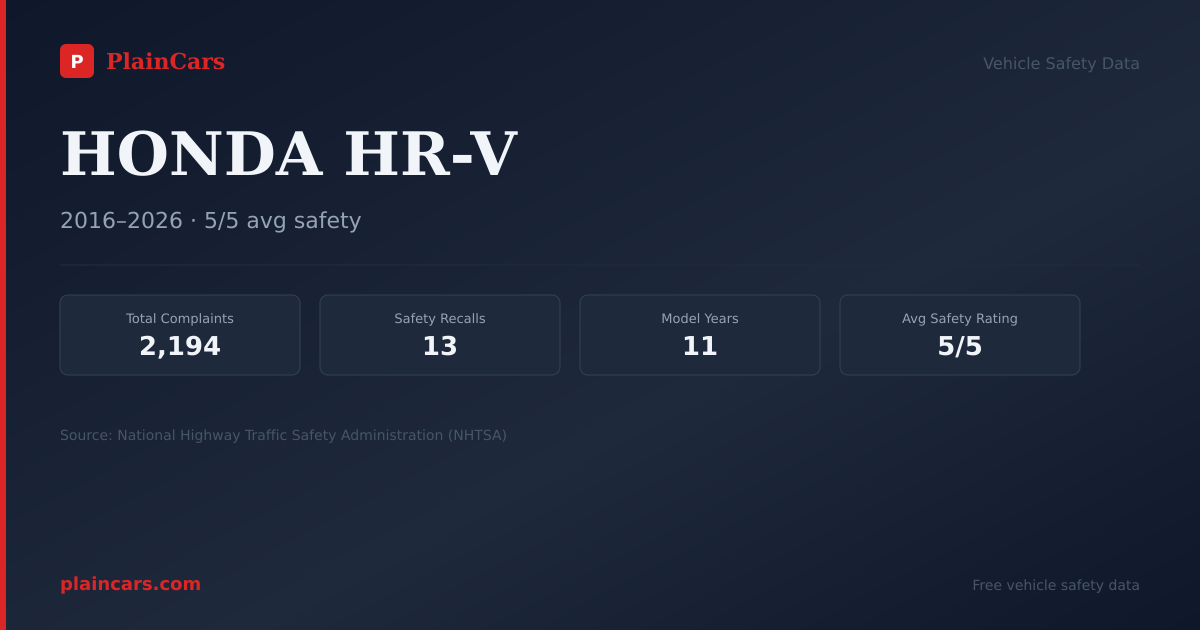
Total Complaints
309 filings
Honda HR-V · model year
309 NHTSA complaints, 19 crash reports, and 2 recall campaigns listed for this cohort. A VIN lookup is required to determine whether a specific vehicle has an unrepaired recall.
NHTSA overall rating
5 / 5 ★
New Car Assessment Program
The verdict
The 2016 Honda HR-V pairs above-average complaint volume with a top NHTSA safety rating.
The 2016HondaHR-V carries 309 consumer safety complaints in NHTSA's Office of Defects Investigation database for this specific model-year cohort. Within that volume, owners reported 19 crashes, 1 fire, 17 injuries, and 0 fatalities. For crash performance, NHTSA's New Car Assessment Program gave this cohort an overall 5/5 rating, with 4/5 front crash, 5/5 side crash, and 4/5 rollover scores derived from standardized barrier and dynamic tests.
The most frequently selected component label in reports for the 2016 HR-V is power train with 71 filings, followed by electrical system (55) and unknown or other (41). Complaint categories reflect owner reports and intake categorization; they do not establish a defect pattern or cause. This cohort has 2 NHTSA recall campaigns listed below. Enter a VIN in NHTSA's official recall lookup to determine whether a specific vehicle has an unrepaired recall.
NHTSA currently has 79 investigation files overlapping the 2016 HR-V, and 9 remain open. Owners comparing this cohort against neighboring years should read the complaint-by-year trend as report volume, not a causal diagnosis. Use the related-complaint feed and the official recall lookup when researching a specific vehicle.
PlainCars' own composite of NHTSA NCAP crash-test ratings and rollover-risk assessment, each dimension normalized against the federal scale or the full national model-year corpus. Not an official NHTSA figure, and not a substitute for a specific vehicle's VIN-level recall check.
Total Complaints
309 filings
Crashes Reported
19 reports
Source
NHTSA ODI
Federal complaints database
Above median complaint volume, review patterns below.
| Component | Count |
|---|---|
| POWER TRAIN | 71 |
| ELECTRICAL SYSTEM | 55 |
| UNKNOWN OR OTHER | 41 |
| SERVICE BRAKES | 23 |
| ENGINE | 22 |
| STRUCTURE:BODY | 20 |
| AIR BAGS | 13 |
| VEHICLE SPEED CONTROL | 13 |
| EXTERIOR LIGHTING | 9 |
| SEATS | 8 |
| SUSPENSION | 6 |
| WHEELS | 5 |
| VISIBILITY/WIPER | 4 |
| FUEL/PROPULSION SYSTEM | 3 |
| STEERING | 3 |
EQUIPMENT:OTHER:LABELS
Honda (American Honda Motor Co.) is recalling certain model year 2016 HR-V vehicles manufactured January 12, 2015, to May 20, 2015. The affected vehicles may be missing the required tire placard indicating "Tire and Loading Information." These vehicles fail to comply with the requirements of Federal
SERVICE BRAKES, HYDRAULIC:FOUNDATION COMPONENTS:DISC:CALIPER
Honda (American Honda Motor Co.) is recalling certain 2017-2019 Acura MDX, 2017-2018 Acura MDX Sport Hybrid, 2018-2019 Honda HR-V and Honda Odyssey, and 2016 Honda HR-V vehicles. The rear brake caliper pistons may have an insufficient coating, causing gas pockets to form, reducing brake performance
My vehicle suddenly developed electrical problems and would not start. Before it completely failed, I began seeing warning lights on the dashboard, including a PARK warning and an engine oil light. The vehicle had been operating normally earlier that day, but later became totally unresponsive. The doors would not unlock electronically and the car would not start. This happened after a period of heavy rain. When the vehicle was inspected by a Honda dealership, they found signs of long-term water intrusion and corrosion affecting electrical components and wiring. I later learned that the vehicle had previously been repaired for water intrusion through the rear hatch/tailgate area, which may have allowed moisture into the vehicle over time. The car is now inoperable. This raises safety concerns because electrical failures like this can lead to sudden loss of reliability, inability to start the vehicle when needed, or potential failure while driving. The issue has been confirmed by a dea
My vehicle suddenly developed electrical problems and would not start. Before it completely failed, I began seeing warning lights on the dashboard, including a PARK warning and an engine oil light. The vehicle had been operating normally earlier that day, but later became totally unresponsive. The doors would not unlock electronically and the car would not start. This happened after a period of heavy rain. When the vehicle was inspected by a Honda dealership, they found signs of long-term water intrusion and corrosion affecting electrical components and wiring. I later learned that the vehicle had previously been repaired for water intrusion through the rear hatch/tailgate area, which may have allowed moisture into the vehicle over time. The car is now inoperable. This raises safety concerns because electrical failures like this can lead to sudden loss of reliability, inability to start the vehicle when needed, or potential failure while driving. The issue has been confirmed by a dea
As the vehicle begins to pull away via creeping the user places foot on accelerator pedal and gently pushes it to accelerate the vehicle from a stop. The car loses power intermittently and jerks aggressively trying to accelerate but somehow unable to, if you’re really careful you can avoid this danger by accelerating slower than a Walmart electric mobility scooter. A clear danger on the road. It’s exponentially worse at high speeds trying to merge onto highway.
The transmission seized while driving no lights no warnings. I could have been killed so could other people! when no lights no check engine light or service lights are on. And your car is properly maintained there should be no reason the transmission should just seize while Driving with no warning shame on Honda shame on everyone who lets them get away with putting peoples life’s endanger. CVT transmission are not safe or the engineers have failed my lights all work too and still have no check engine light on. Car is totally underivable no lights nothing.
The CVT transmission, which is part of the vehicle’s powertrain system, experienced a premature failure. The vehicle became inoperable and was in an unsafe location, so the police had to tow it. I am not sure if a police report was issued. The tow resulted in extensive impound fees. The transmission is available for inspection upon request. The failure caused loss of power and unpredictable operation, making the vehicle unsafe to drive, especially in traffic. This created a risk of collision to myself, my passengers, and other motorists. The problem has been diagnosed and confirmed by a Honda dealership, which determined the transmission has failed and that the vehicle is not safe to operate. The vehicle has been inspected by a Honda dealership, and the manufacturer has been notified through Honda Customer Relations. There were no warning lights or messages prior to the failure. The transmission failed suddenly and without warning. The exact date of the failure is 01/15/2026 and i
I am submitting this complaint regarding a sudden and unsafe CVT transmission failure on my Honda vehicle. While driving, the vehicle began shaking violently, lost the ability to accelerate, and multiple warning indicators illuminated, including the check engine light. The vehicle was unable to be driven safely and had to be towed. A diagnostic inspection performed by an authorized Honda dealership confirmed CVT failure consistent with Honda Service Bulletin #21-047, including the presence of transmission belt material in the fluid. This failure mode is documented by Honda as a known manufacturing defect that can cause loss of power and drivability. I contacted Honda Corporate Customer Relations and opened a case on 12/3. Despite multiple communications, Honda has denied goodwill or warranty assistance solely based on warranty expiration, without addressing the documented defect or the safety implications. I specifically requested that Honda provide a written explanation detailing
Driving on interstate when vehicle suddenly downshifted resulting in lurch slowdown and high engine rpms. Pulled to median. Shift indicator light flashes, dash Brake System warning light flashes, Parking system warning lights, check engine light on. Attempted to drive to nearby dealer for troubleshooting. Vehicle drives when put into gear, but must paddle shift into higher gears. After couple seconds automatically downshifts again. Paddle shifting will shift into higher gear, but returns to lower gears automatically. Shop says transmission test shows P271E, 83-16 warning error so transmission must have failed.
The white orchid paint is peeling off on top of car and sides
Transmission belt failure at ~100k+ miles. This incident occurred after the recall repair for the software update related to the transmission. Most hazard indicators switched on, vehicle could not go over 50 miles per hour. Took vehicle into honda service center. They determined it to be a transmission failure.
Belt inside CVT transmission has failed. Numerous broken shards of metal in fluid and surrounding parts. Cost to replace $7,500 avg.
Extensive and widespread peeling and de-lamination of paint across entire vehicle beginning in 2025 (two years after extended warranty expired). About $6000 to repair and Honda refusing to assist/contribute to repairs.
Extensive and widespread peeling and de-lamination of paint across entire vehicle beginning in 2025 (two years after extended warranty expired). About $6000 to repair and Honda refusing to assist/contribute to repairs.
My daughters 2016 Honda HRV (59k) has continual electrical issues. First it's the battery sensor $617. Then the keyless access control module $1100 but given a discount. Something is also wrong with the heated seat it burned a hole in the seat. Honda says it's 10 years old it's gonna start falling apart. Numerous complaints online with all of the electrical issues mentioned and the service manager says Honda doesn't have to issue recalls until there's class action lawsuit filed for vehicles. All of this stuff has happened in the last 8 months.
The car is a 2016 Honda HRV. The car is orchid pearl (white) and has developed extensive paint issues where the paint is peeling on the doors and potentially places on the roof. The car is an excellent overall condition with no history of auto accidents. This paint issue is common for this color HRV and impacts the value of the vehicle and will lead to body surface rust and the problem continues to worsen each month.
While driving on a highway the vehicle with no warning seemed to lose all power and multiple warning dashboard lights came on. We were able to pull to the side of the highway which did not have a full size break down lane. The vehicle was towed to a nearby dealer who reported that the transmission had failed completely. There were no noticeable signs or warnings of transmission failure or any other problem prior to this incident with the vehicle. We were on a single lane highway at the time and we were able to pull to the side but on the same trip had been on multiple lane highways and it would have been difficult to navigate multiple lanes to pull to the side of the road with the loss of power.
The contact owns a 2016 Honda HR-V. The contact stated that water had accumulated in the tail lights, causing the lights to become inoperable. The contact stated that he had noticed an abnormal water sound while driving the vehicle. There was no warning light illuminated. The local dealer was not contacted. The vehicle was not diagnosed or repaired. The manufacturer was notified of the failure. The failure mileage was approximately 80,000.
Mileage: 80,000
Faulty seams and gaskets in the rear cause water to leak into spare tire well. This causes mold & mildew issues to occur. From online research, this is an extremeley common issue for the 2016 Honda HR-V. There is evidence that the water is coming in through the rear tail lights. This has been a common failure point for many others online, which is why I think this is worthy of recall. I first had mold issues about 18 months ago. I thought it may have been from a spilled drink, so I sanitized the upholstery and moved on. Now a few weeks after some rainy weather, I found mold on the upholstery again and felt increased interior humidity in the car. My point is that this issue could remain benign for a long time and manifest as mold during heavy/rainy weather.
Transmission failure. It is available for inspection upon request. While driving on major highways, I could have been at risk of a crash. I took the vehicle to Honda to confirm the transmission belt stretched. The insurance refused to inspect it. No warning lamps, messages, or other. I went over a railroad crossing and suddenly heard the transmission grinding gears.
I am writing to formally file a complaint regarding a serious safety issue affecting Honda vehicles — specifically the widespread failure of the Anti-lock Braking System (ABS) module — and Honda's failure to issue a recall despite extensive evidence and customer reports. A recent YouTube video titled "Why Honda Hasn’t Recalled This Dangerous Problem" [XXX] ) highlights that many Honda owners are experiencing identical issues: ABS warning lights appearing on the dashboard, inconsistent braking behavior, and in some cases, total brake failure. This is a major safety hazard, especially in emergency braking scenarios or on wet or slippery roads. I personally experienced this issue with my own Honda vehicle. After taking it to a Honda dealership, I was quoted $3,000 to replace the defective ABS module — a steep and unfair out-of-pocket expense for what clearly appears to be a design or manufacturing defect. The dealership acknowledged that this is a common problem, yet I was told
I am writing to formally file a complaint regarding a serious safety issue affecting Honda vehicles — specifically the widespread failure of the Anti-lock Braking System (ABS) module — and Honda's failure to issue a recall despite extensive evidence and customer reports. A recent YouTube video titled "Why Honda Hasn’t Recalled This Dangerous Problem" [XXX] ) highlights that many Honda owners are experiencing identical issues: ABS warning lights appearing on the dashboard, inconsistent braking behavior, and in some cases, total brake failure. This is a major safety hazard, especially in emergency braking scenarios or on wet or slippery roads. I personally experienced this issue with my own Honda vehicle. After taking it to a Honda dealership, I was quoted $3,000 to replace the defective ABS module — a steep and unfair out-of-pocket expense for what clearly appears to be a design or manufacturing defect. The dealership acknowledged that this is a common problem, yet I was told
Inadvertent Deployment of Air Bags
Inaccurate Rear Passenger Seat Belt Warning Status
Loss of Motive Power
Inadvertent Deployment of Side Air Bags
Loss of braking force
Data vintage: August 2026. Sources: NHTSA Office of Defects Investigation (ODI) complaints database, NHTSA recall campaign API, NHTSA NCAP crash-test ratings, and NHTSA FARS for fatality cross-reference.
Every figure on PlainCars is rendered directly from NHTSA complaint and safety data, no number is typed in by an editor. This year-specific record is rendered from NHTSA ODI, recall, and NCAP rows for the 2016 Honda HR-V; no figure is typed in by an editor. See our editorial standards & corrections policy, the methodology behind these numbers, or report a data error. Data current as of August 2026.
Read our methodology - how this data is sourced, computed, and verified.