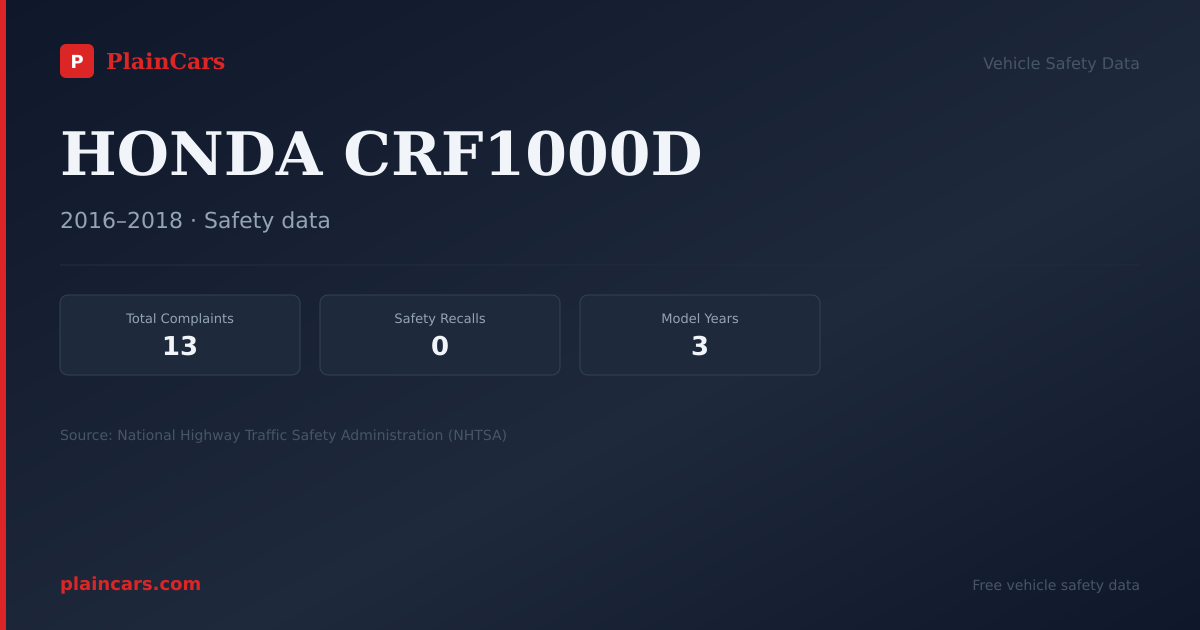
Total Complaints
4 filings
Honda Crf1000d · model year
4 NHTSA complaints. A VIN lookup is required to determine whether a specific vehicle has an unrepaired recall.
NHTSA overall rating
Not crash-tested
New Car Assessment Program
The 2017HondaCrf1000d carries 4 consumer safety complaints in NHTSA's Office of Defects Investigation database for this specific model-year cohort. Within that volume, owners reported 0 crashes, 0 fires, 0 injuries, and 0 fatalities. No NCAP 5-star crash-test rating is available for this model year in the federal database.
The most frequently selected component label in reports for the 2017 Crf1000d is service brakes with 1 filings, followed by electronic stability control (esc) (1) and engine (1). Complaint categories reflect owner reports and intake categorization; they do not establish a defect pattern or cause.
NHTSA currently has 79 investigation files overlapping the 2017 Crf1000d, and 9 remain open. Owners comparing this cohort against neighboring years should read the complaint-by-year trend as report volume, not a causal diagnosis. Use the related-complaint feed and the official recall lookup when researching a specific vehicle.
PlainCars' own composite of NHTSA NCAP crash-test ratings and rollover-risk assessment, each dimension normalized against the federal scale or the full national model-year corpus. Not an official NHTSA figure, and not a substitute for a specific vehicle's VIN-level recall check.
Total Complaints
4 filings
Crashes Reported
0 reports
Source
NHTSA ODI
Federal complaints database
At or below the fleet median complaint volume.
| Component | Count |
|---|---|
| SERVICE BRAKES | 1 |
| ELECTRONIC STABILITY CONTROL (ESC) | 1 |
| ENGINE | 1 |
| FUEL/PROPULSION SYSTEM | 1 |
Vehicle stalls. Vehicle is equipped with a DCT which stalls at roadway speed. When decelerating from ~25 mph to 0 mph at traffic, most commonly while coming to a stop for a red light, the motorcycle will stall. The engine turns off. The engine will often refuse to turn back on. Use of the start switch produces a clicking noise and requires several tries to restart motorcycle. The bike then starts in Neutral and needs to be shifted back into Drive, Sport, or a manual mode to return to movement. This is dangerous when it happens in traffic, because cars and trucks that are not paying attention may not notice the motorcycle has stopped. This also happens when idling at a red light or if manually shifting, when shifting into drive to accelerate forward when the light turns to green. Dozens of instances of the behavoir have been observed over the last 6 months (Jan to June, 2025).
STALLING WITHIN THE FIRST 5 MINUTES OF OPERATION. THE BIKE HAD DIED IN TRAFFIC TWICE AND ONCE AT A STOP LIGHT NEARLY LEADING TO A VEHICLE REAR END ME. IT HAS ALSO DIED AFTER STARTUP BEFORE GETTING ON THE ROAD AND NEARLY STALLED MANY TIMES. DEALER AND HONDA WILL NOT RECOGNIZE IT AS A PROBLEM.
Mileage: 4,700
THE HONDA AT WITH DCT TRANSMISSION: WHEN HITTING THE FRONT BRAKE (RIGHT GRIP) THE RIGHT HAND IS STILL ON THE THROTTLE. A SLIGHT HAND SHIFT WHEN GRABBING THE BRAKE (ESPECIALLY UNDER EMERGENCY BRAKING) WILL CAUSE THE THROTTLE TO ENGAGE FORCING THE BIKE TO LOOSE CONTROL. THIS IS A DESIGN FLAW. THE THROTTLE SHOULD AUTOMATICALLY DISENGAGE WHEN THE THE FRONT LEVER/BRAKE IS A APPLIED. WITH A CLUTCH OPERATION THIS CAN BE CONTROLLED VIA THE LEFT HAND, BUT WITH THE DCT (AUTOMATIC) THE CLUTCH DOES NOT DISENGAGE. THE REAR BRAKE (RIGHT FOOT) SHOULD BE SETUP NORMALLY, AS IT IS ROUTINELY USED TO MANAGE THE BIKE UNDER SLOW CONDITIONS WITH THROTTLE APPLICATION. THIS DANGEROUS SITUATION HAS HAPPENED TO ME. APPLIED BOTH BRAKES WHICH IS VERY INTUITIVE UNDER DURESS. AS RIGHT HAND WAS GRABBING BRAKE, THE SHIFTING OF THE RIGHT HAND ALSO ENGAGED THE THROTTLE, CAUSING THE BIKE TO LURCH FORWARD IN AN UNANTICIPATED AND UNNATURAL REACTION.
Mileage: 1,200
THE HONDA AT WITH DCT TRANSMISSION: WHEN HITTING THE FRONT BRAKE (RIGHT GRIP) THE RIGHT HAND IS STILL ON THE THROTTLE. A SLIGHT HAND SHIFT WHEN GRABBING THE BRAKE (ESPECIALLY UNDER EMERGENCY BRAKING) WILL CAUSE THE THROTTLE TO ENGAGE FORCING THE BIKE TO LOOSE CONTROL. THIS IS A DESIGN FLAW. THE THROTTLE SHOULD AUTOMATICALLY DISENGAGE WHEN THE THE FRONT LEVER/BRAKE IS A APPLIED. WITH A CLUTCH OPERATION THIS CAN BE CONTROLLED VIA THE LEFT HAND, BUT WITH THE DCT (AUTOMATIC) THE CLUTCH DOES NOT DISENGAGE. THE REAR BRAKE (RIGHT FOOT) SHOULD BE SETUP NORMALLY, AS IT IS ROUTINELY USED TO MANAGE THE BIKE UNDER SLOW CONDITIONS WITH THROTTLE APPLICATION. THIS DANGEROUS SITUATION HAS HAPPENED TO ME. APPLIED BOTH BRAKES WHICH IS VERY INTUITIVE UNDER DURESS. AS RIGHT HAND WAS GRABBING BRAKE, THE SHIFTING OF THE RIGHT HAND ALSO ENGAGED THE THROTTLE, CAUSING THE BIKE TO LURCH FORWARD IN AN UNANTICIPATED AND UNNATURAL REACTION.
Mileage: 1,200
Inadvertent Deployment of Air Bags
Inaccurate Rear Passenger Seat Belt Warning Status
Loss of Motive Power
Inadvertent Deployment of Side Air Bags
Loss of braking force
Data vintage: August 2026. Sources: NHTSA Office of Defects Investigation (ODI) complaints database, NHTSA recall campaign API, NHTSA NCAP crash-test ratings, and NHTSA FARS for fatality cross-reference.
Every figure on PlainCars is rendered directly from NHTSA complaint and safety data, no number is typed in by an editor. This year-specific record is rendered from NHTSA ODI, recall, and NCAP rows for the 2017 Honda Crf1000d; no figure is typed in by an editor. See our editorial standards & corrections policy, the methodology behind these numbers, or report a data error. Data current as of August 2026.
Read our methodology - how this data is sourced, computed, and verified.