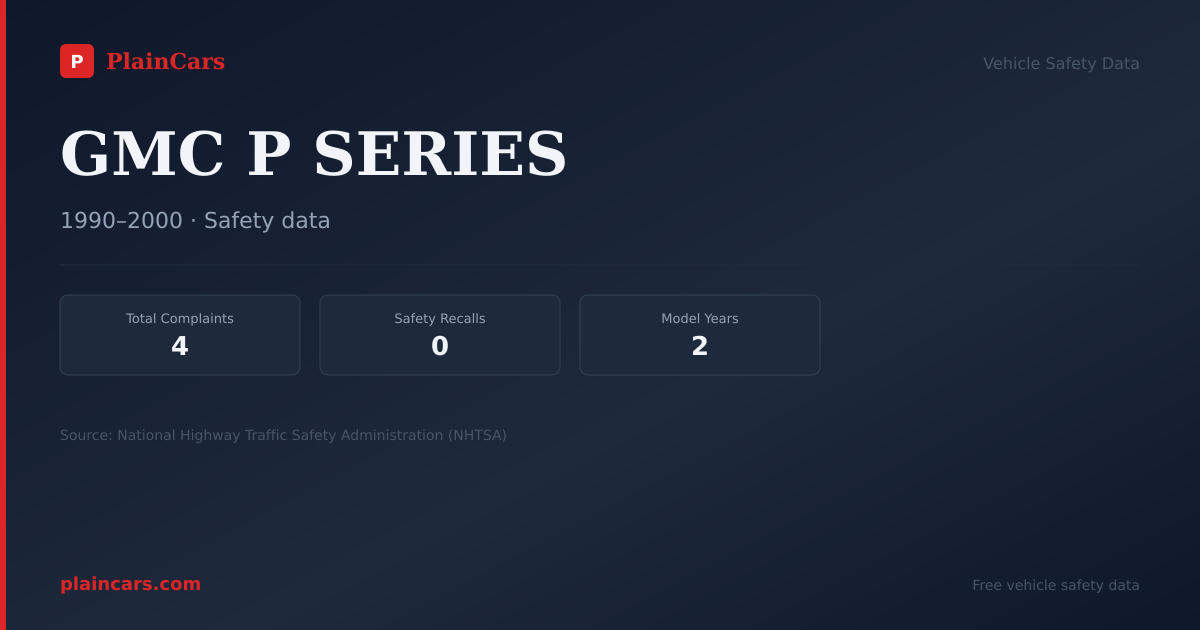
Total Complaints
3 filings
GMC P Series · model year
3 NHTSA complaints. A VIN lookup is required to determine whether a specific vehicle has an unrepaired recall.
NHTSA overall rating
Not crash-tested
New Car Assessment Program
The 2000GMCP Series carries 3 consumer safety complaints in NHTSA's Office of Defects Investigation database for this specific model-year cohort. Within that volume, owners reported 0 crashes, 0 fires, 0 injuries, and 0 fatalities. No NCAP 5-star crash-test rating is available for this model year in the federal database.
The most frequently selected component label in reports for the 2000 P Series is electronic stability control (esc) with 1 filings, followed by electrical system (1) and engine (1). Complaint categories reflect owner reports and intake categorization; they do not establish a defect pattern or cause.
NHTSA currently has 2 investigation files overlapping the 2000 P Series. Owners comparing this cohort against neighboring years should read the complaint-by-year trend as report volume, not a causal diagnosis. Use the related-complaint feed and the official recall lookup when researching a specific vehicle.
PlainCars' own composite of NHTSA NCAP crash-test ratings and rollover-risk assessment, each dimension normalized against the federal scale or the full national model-year corpus. Not an official NHTSA figure, and not a substitute for a specific vehicle's VIN-level recall check.
Total Complaints
3 filings
Crashes Reported
0 reports
Source
NHTSA ODI
Federal complaints database
At or below the fleet median complaint volume.
| Component | Count |
|---|---|
| ELECTRONIC STABILITY CONTROL (ESC) | 1 |
| ELECTRICAL SYSTEM | 1 |
| ENGINE | 1 |
THE VEHICLE HAS HAD COMPLICATIONS RELATING TO THE ITEMS I CHECKED OFF SINCE I PURCHASED IT. EVERY YEAR IT BRAKES DOWN AND VERY OTHER YEAR I STRUGGLE WITH SMOG TEST PASSING DUE TO THE ONGOING FAILURES RELATED IN THESE AREAS. IT'S BEEN VERY EXPENSIVE TO REPAIR FAILURE AFTER FAILURE AND IT'S A NEVER ENDING PROBLEM IN THESE SPECIFIC AREAS. THE ISSUES ARE PRESENTS WHEN I'M DRIVING IT AND WHEN I DON'T DRIVE IT THE VEHICLE DOESN'T TURN ON UNTIL I CHANGE SYSTEM FAILURE SENSORS.
THE VEHICLE HAS HAD COMPLICATIONS RELATING TO THE ITEMS I CHECKED OFF SINCE I PURCHASED IT. EVERY YEAR IT BRAKES DOWN AND VERY OTHER YEAR I STRUGGLE WITH SMOG TEST PASSING DUE TO THE ONGOING FAILURES RELATED IN THESE AREAS. IT'S BEEN VERY EXPENSIVE TO REPAIR FAILURE AFTER FAILURE AND IT'S A NEVER ENDING PROBLEM IN THESE SPECIFIC AREAS. THE ISSUES ARE PRESENTS WHEN I'M DRIVING IT AND WHEN I DON'T DRIVE IT THE VEHICLE DOESN'T TURN ON UNTIL I CHANGE SYSTEM FAILURE SENSORS.
THE VEHICLE HAS HAD COMPLICATIONS RELATING TO THE ITEMS I CHECKED OFF SINCE I PURCHASED IT. EVERY YEAR IT BRAKES DOWN AND VERY OTHER YEAR I STRUGGLE WITH SMOG TEST PASSING DUE TO THE ONGOING FAILURES RELATED IN THESE AREAS. IT'S BEEN VERY EXPENSIVE TO REPAIR FAILURE AFTER FAILURE AND IT'S A NEVER ENDING PROBLEM IN THESE SPECIFIC AREAS. THE ISSUES ARE PRESENTS WHEN I'M DRIVING IT AND WHEN I DON'T DRIVE IT THE VEHICLE DOESN'T TURN ON UNTIL I CHANGE SYSTEM FAILURE SENSORS.
Data vintage: August 2026. Sources: NHTSA Office of Defects Investigation (ODI) complaints database, NHTSA recall campaign API, NHTSA NCAP crash-test ratings, and NHTSA FARS for fatality cross-reference.
Every figure on PlainCars is rendered directly from NHTSA complaint and safety data, no number is typed in by an editor. This year-specific record is rendered from NHTSA ODI, recall, and NCAP rows for the 2000 GMC P Series; no figure is typed in by an editor. See our editorial standards & corrections policy, the methodology behind these numbers, or report a data error. Data current as of August 2026.
Read our methodology - how this data is sourced, computed, and verified.