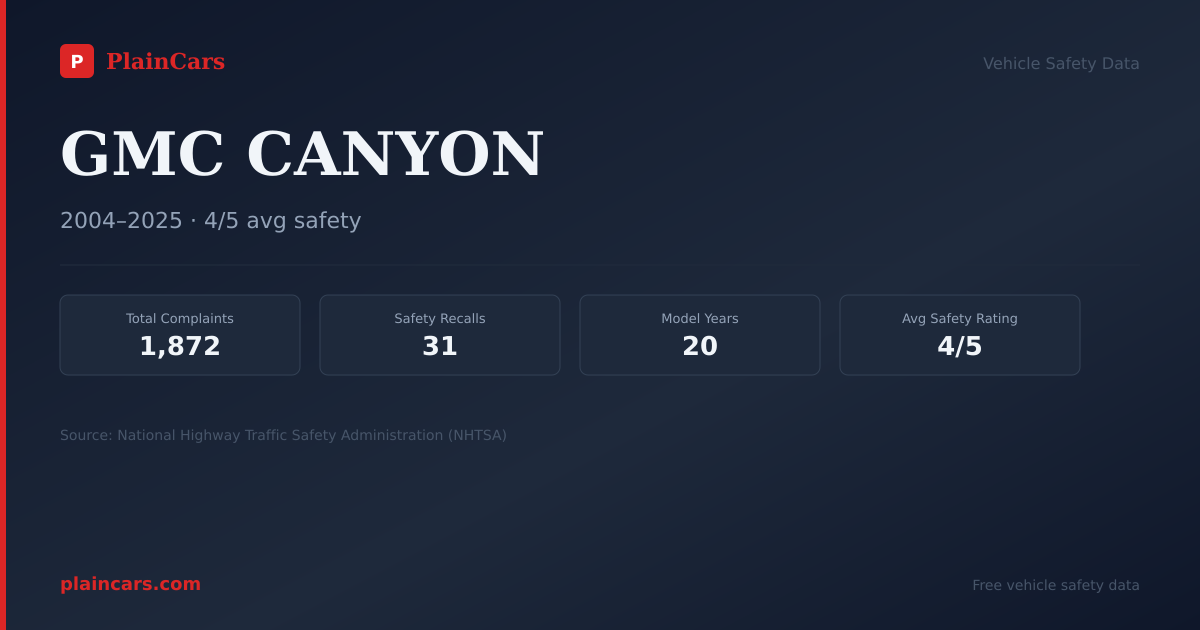
Total Complaints
87 filings
GMC Canyon · model year
87 NHTSA complaints, and 3 recall campaigns listed for this cohort. A VIN lookup is required to determine whether a specific vehicle has an unrepaired recall.
NHTSA overall rating
4 / 5 ★
New Car Assessment Program
The verdict
The 2023 GMC Canyon pairs above-average complaint volume with a strong NHTSA safety rating.
The 2023GMCCanyon carries 87 consumer safety complaints in NHTSA's Office of Defects Investigation database for this specific model-year cohort. Within that volume, owners reported 0 crashes, 0 fires, 3 injuries, and 0 fatalities. For crash performance, NHTSA's New Car Assessment Program gave this cohort an overall 4/5 rating, with 4/5 front crash, 5/5 side crash, and 3/5 rollover scores derived from standardized barrier and dynamic tests.
The most frequently selected component label in reports for the 2023 Canyon is electrical system with 16 filings, followed by forward collision avoidance: automatic emergency braking (11) and engine (8). Complaint categories reflect owner reports and intake categorization; they do not establish a defect pattern or cause. This cohort has 3 NHTSA recall campaigns listed below. Enter a VIN in NHTSA's official recall lookup to determine whether a specific vehicle has an unrepaired recall.
NHTSA currently has 2 investigation files overlapping the 2023 Canyon. Owners comparing this cohort against neighboring years should read the complaint-by-year trend as report volume, not a causal diagnosis. Use the related-complaint feed and the official recall lookup when researching a specific vehicle.
PlainCars' own composite of NHTSA NCAP crash-test ratings and rollover-risk assessment, each dimension normalized against the federal scale or the full national model-year corpus. Not an official NHTSA figure, and not a substitute for a specific vehicle's VIN-level recall check.
Total Complaints
87 filings
Crashes Reported
0 reports
Source
NHTSA ODI
Federal complaints database
At or below the fleet median complaint volume.
| Component | Count |
|---|---|
| ELECTRICAL SYSTEM | 16 |
| FORWARD COLLISION AVOIDANCE: AUTOMATIC EMERGENCY BRAKING | 11 |
| ENGINE | 8 |
| FORWARD COLLISION AVOIDANCE: WARNINGS | 7 |
| SERVICE BRAKES | 6 |
| UNKNOWN OR OTHER | 5 |
| LANE DEPARTURE: BLIND SPOT DETECTION | 5 |
| STEERING | 3 |
| EXTERIOR LIGHTING | 3 |
| VISIBILITY/WIPER | 3 |
| POWER TRAIN | 3 |
| FORWARD COLLISION AVOIDANCE | 3 |
| STRUCTURE:BODY | 2 |
| VEHICLE SPEED CONTROL | 2 |
| FORWARD COLLISION AVOIDANCE: ADAPTIVE CRUISE CONTROL | 1 |
WHEELS:LUGS/NUTS/BOLTS/STUDS
General Motors, LLC (GM) is recalling certain 2023 Chevrolet Colorado and GMC Canyon vehicles. The front wheel hub bolts may have been over-tightened and damaged during installation.
ELECTRICAL SYSTEM:ADAS:DRIVER MONITORING:CAMERA/SENSOR
General Motors, LLC (GM) is recalling certain 2023 Chevrolet Colorado and GMC Canyon vehicles. The front camera module (FCM) system may falsely detect an obstacle, causing the automatic emergency braking (AEB) to engage unexpectedly.
SEAT BELTS:CRITICAL FASTENERS
General Motors, LLC (GM) is recalling certain 2023-2024 Chevrolet Colorado and 2023 GMC Canyon vehicles. The left or right front seat may have a seat belt buckle attachment bolt that was not tightened properly.
Upper radiator hose gasket leaks at connection point to radiator and no gasket replacement part. GMC forces you to buy entire hose
Top radiator hose is leaking coolant. Radiator hose O ring appears to be faulty.
Top radiator hose is leaking coolant. Radiator hose O ring appears to be faulty.
Upper radiator hose is leaking
Upper radiator hose is leaking
Noticed a coolant leak on drivers side and took to dealership was told was the upper radiator hose but was unable to make repairs due to national backorder and only suggestion was to drive until parts come in and keep a check on the coolant level, My truck only has 28,708 miles and shouldn't have to keep an eye on coolant level I feel that is very unsafe
The upper radiator hose on a significant number of these trucks is failing prematurely. In my case, the failure occurred at just over 35,000 miles. Numerous reports on owner forums (such as the Colorado Chevy / GMC Canyon forum), YouTube, and other platforms document the same issue, indicating this is not an isolated incident but a widespread defect. Because this hose is part of the cooling system, its failure can quickly lead to engine overheating and potentially catastrophic engine damage. The root cause appears to be an engineering flaw in the sealing method: GM uses a rubber seal instead of a durable, high-quality o‑ring to connect the upper hose to the radiator. Despite the seriousness of this defect, my local GMC dealer informed me that—since it is not currently a recall item—they could only schedule service for the following week, requiring me to leave the truck with them for 7–10 days before repairs would be completed. This is unreasonable for consumers who rely on th
The whole radio screen and dashboard have gone completely black and will not come on. Can not see anything. Took it to GMC dealership mechanic. Mechanic did diagnostic and said he didnt know what was wrong with it. Update did not work.
While driving at 70–75 mph on an interstate, my vehicle suddenly displayed a “Brake Failure” warning and limited speed to 62 mph. Power steering failed completely, and braking became ineffective despite hard pedal pressure. Multiple warnings followed: ABS, engine, and others. I was in heavy traffic with vehicles at full speed. Loss of braking and steering control forced me to coast across lanes to the shoulder, narrowly avoiding collision. My safety and that of others was at extreme risk. After stopping, I turned the vehicle off for ~30 seconds. Upon restart, all systems returned to normal—no warnings or issues. This indicates a transient software malfunction, not mechanical failure. No prior warnings or symptoms occurred. The problem has not been reproduced or confirmed by a dealer/service center. I have not scanned or inspected the vehicle. It has not been examined by the manufacturer, police, or insurance. The vehicle is in my possession and available for inspection upon req
While driving at 70–75 mph on an interstate, my vehicle suddenly displayed a “Brake Failure” warning and limited speed to 62 mph. Power steering failed completely, and braking became ineffective despite hard pedal pressure. Multiple warnings followed: ABS, engine, and others. I was in heavy traffic with vehicles at full speed. Loss of braking and steering control forced me to coast across lanes to the shoulder, narrowly avoiding collision. My safety and that of others was at extreme risk. After stopping, I turned the vehicle off for ~30 seconds. Upon restart, all systems returned to normal—no warnings or issues. This indicates a transient software malfunction, not mechanical failure. No prior warnings or symptoms occurred. The problem has not been reproduced or confirmed by a dealer/service center. I have not scanned or inspected the vehicle. It has not been examined by the manufacturer, police, or insurance. The vehicle is in my possession and available for inspection upon req
While driving at 70–75 mph on an interstate, my vehicle suddenly displayed a “Brake Failure” warning and limited speed to 62 mph. Power steering failed completely, and braking became ineffective despite hard pedal pressure. Multiple warnings followed: ABS, engine, and others. I was in heavy traffic with vehicles at full speed. Loss of braking and steering control forced me to coast across lanes to the shoulder, narrowly avoiding collision. My safety and that of others was at extreme risk. After stopping, I turned the vehicle off for ~30 seconds. Upon restart, all systems returned to normal—no warnings or issues. This indicates a transient software malfunction, not mechanical failure. No prior warnings or symptoms occurred. The problem has not been reproduced or confirmed by a dealer/service center. I have not scanned or inspected the vehicle. It has not been examined by the manufacturer, police, or insurance. The vehicle is in my possession and available for inspection upon req
While driving at 70–75 mph on an interstate, my vehicle suddenly displayed a “Brake Failure” warning and limited speed to 62 mph. Power steering failed completely, and braking became ineffective despite hard pedal pressure. Multiple warnings followed: ABS, engine, and others. I was in heavy traffic with vehicles at full speed. Loss of braking and steering control forced me to coast across lanes to the shoulder, narrowly avoiding collision. My safety and that of others was at extreme risk. After stopping, I turned the vehicle off for ~30 seconds. Upon restart, all systems returned to normal—no warnings or issues. This indicates a transient software malfunction, not mechanical failure. No prior warnings or symptoms occurred. The problem has not been reproduced or confirmed by a dealer/service center. I have not scanned or inspected the vehicle. It has not been examined by the manufacturer, police, or insurance. The vehicle is in my possession and available for inspection upon req
While driving at 70–75 mph on an interstate, my vehicle suddenly displayed a “Brake Failure” warning and limited speed to 62 mph. Power steering failed completely, and braking became ineffective despite hard pedal pressure. Multiple warnings followed: ABS, engine, and others. I was in heavy traffic with vehicles at full speed. Loss of braking and steering control forced me to coast across lanes to the shoulder, narrowly avoiding collision. My safety and that of others was at extreme risk. After stopping, I turned the vehicle off for ~30 seconds. Upon restart, all systems returned to normal—no warnings or issues. This indicates a transient software malfunction, not mechanical failure. No prior warnings or symptoms occurred. The problem has not been reproduced or confirmed by a dealer/service center. I have not scanned or inspected the vehicle. It has not been examined by the manufacturer, police, or insurance. The vehicle is in my possession and available for inspection upon req
While driving at 70–75 mph on an interstate, my vehicle suddenly displayed a “Brake Failure” warning and limited speed to 62 mph. Power steering failed completely, and braking became ineffective despite hard pedal pressure. Multiple warnings followed: ABS, engine, and others. I was in heavy traffic with vehicles at full speed. Loss of braking and steering control forced me to coast across lanes to the shoulder, narrowly avoiding collision. My safety and that of others was at extreme risk. After stopping, I turned the vehicle off for ~30 seconds. Upon restart, all systems returned to normal—no warnings or issues. This indicates a transient software malfunction, not mechanical failure. No prior warnings or symptoms occurred. The problem has not been reproduced or confirmed by a dealer/service center. I have not scanned or inspected the vehicle. It has not been examined by the manufacturer, police, or insurance. The vehicle is in my possession and available for inspection upon req
Upper Radiator hose O ring defect Causing all 2023+ Chevorlet Colorados and 2023+ GMC to leak coolant in a brand new truck
After each rain or hand car washing, the OEM sunroof has a gurgling sound when driving at speeds above 25 mph. This does not clear for miles, or over time (at least 1 day without water). Water appears to be passing through the seal into the drainage gutter, but not completely draining out through the drains. Its been in service twice to have the drain lines cleared, and the issue remains. This has been present on other car manufacturers as a "wind pressure issue" where the force of driving causes wind pressure to push what water hasn't drained back up into the sunroof. Fix was extending the drain lines at output. GMC unable to repair.
The contact owns a 2023 GMC Canyon. The contact stated that while driving 20 MPH, the vehicle came to an abrupt stop without warning. The contact waited for several minutes before resuming normal driving. The contact stated that the failure was caused by the rear brakes. The vehicle was not diagnosed or repaired. Neither the manufacturer nor the dealer was notified of the failure. The failure mileage was 14,129.
Mileage: 14,129
The contact owns a 2023 GMC Canyon. The contact stated that while driving at an undisclosed speed, the Forward Collision Avoidance, distance indicator, and the Front Pedestrian and Bicyclist Braking failed to work as intended. The vehicle was taken to the local dealer. The vehicle was not diagnosed; however, a software update was performed; however, the failure persisted. The vehicle was taken to the local dealer where the system was updated. The contact stated that the failure persisted. The manufacturer was notified of the failure and referred the contact to the NHSTA Hotline for assistance. The contact related the failure to NHTSA Campaign Number: 24V133000 (ELECTRICAL SYSTEM, FORWARD COLLISION AVOIDANCE); however, the VIN was not included. The failure mileage was unknown.
The contact owns a 2023 GMC Canyon. The contact stated that while driving at an undisclosed speed, the Forward Collision Avoidance, distance indicator, and the Front Pedestrian and Bicyclist Braking failed to work as intended. The vehicle was taken to the local dealer. The vehicle was not diagnosed; however, a software update was performed; however, the failure persisted. The vehicle was taken to the local dealer where the system was updated. The contact stated that the failure persisted. The manufacturer was notified of the failure and referred the contact to the NHSTA Hotline for assistance. The contact related the failure to NHTSA Campaign Number: 24V133000 (ELECTRICAL SYSTEM, FORWARD COLLISION AVOIDANCE); however, the VIN was not included. The failure mileage was unknown.
Vehicle lurches forward extremely strong when almost stopped, shifting from 2nd to 1st. Common issue with all of these trucks with the 8L80 transmission. Also - this transmission slams into 2nd from 1st when first starting out under light acelleration or drifting down hill.
Data vintage: August 2026. Sources: NHTSA Office of Defects Investigation (ODI) complaints database, NHTSA recall campaign API, NHTSA NCAP crash-test ratings, and NHTSA FARS for fatality cross-reference.
Every figure on PlainCars is rendered directly from NHTSA complaint and safety data, no number is typed in by an editor. This year-specific record is rendered from NHTSA ODI, recall, and NCAP rows for the 2023 GMC Canyon; no figure is typed in by an editor. See our editorial standards & corrections policy, the methodology behind these numbers, or report a data error. Data current as of August 2026.
Read our methodology - how this data is sourced, computed, and verified.