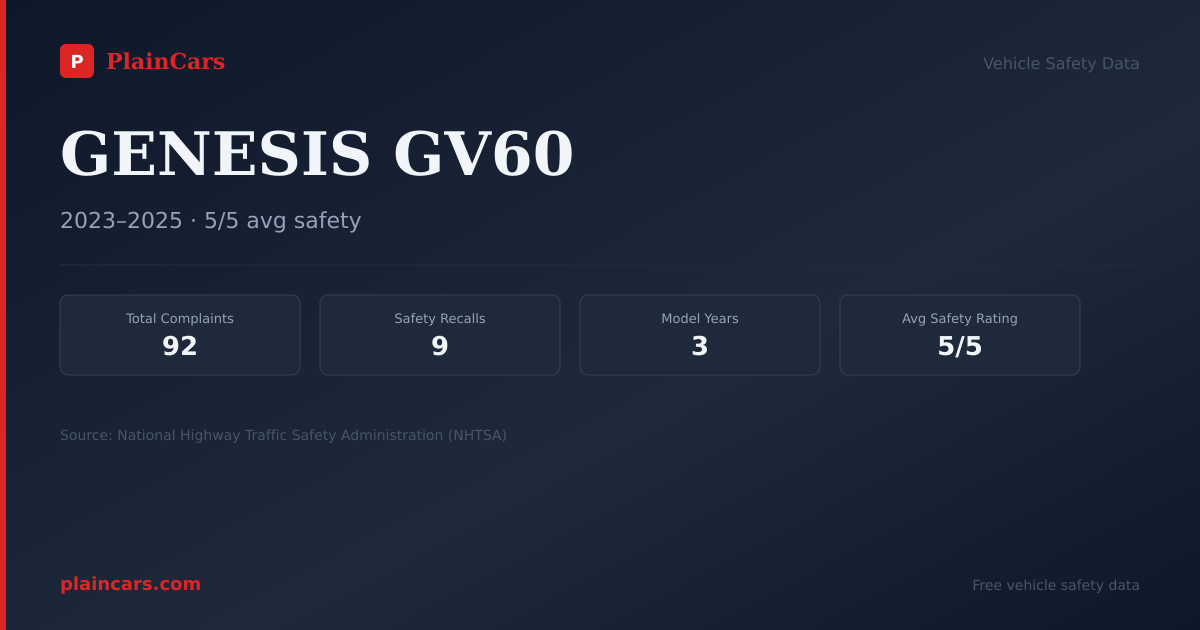
Total Complaints
2 filings
Genesis Gv60 · model year
2 NHTSA complaints, and 4 recall campaigns listed for this cohort. A VIN lookup is required to determine whether a specific vehicle has an unrepaired recall.
NHTSA overall rating
5 / 5 ★
New Car Assessment Program
The verdict
The 2025 Genesis Gv60 carries a top NHTSA safety rating.
The 2025GenesisGv60 carries 2 consumer safety complaints in NHTSA's Office of Defects Investigation database for this specific model-year cohort. Within that volume, owners reported 0 crashes, 0 fires, 0 injuries, and 0 fatalities. For crash performance, NHTSA's New Car Assessment Program gave this cohort an overall 5/5 rating, with 4/5 front crash, 5/5 side crash, and 5/5 rollover scores derived from standardized barrier and dynamic tests.
The most frequently selected component label in reports for the 2025 Gv60 is electrical system with 2 filings. Complaint categories reflect owner reports and intake categorization; they do not establish a defect pattern or cause. This cohort has 4 NHTSA recall campaigns listed below. Enter a VIN in NHTSA's official recall lookup to determine whether a specific vehicle has an unrepaired recall.
No open NHTSA investigation overlaps the 2025 Gv60 in the current dataset. Owners comparing this cohort against neighboring years should read the complaint-by-year trend as report volume, not a causal diagnosis. Use the related-complaint feed and the official recall lookup when researching a specific vehicle.
PlainCars' own composite of NHTSA NCAP crash-test ratings and rollover-risk assessment, each dimension normalized against the federal scale or the full national model-year corpus. Not an official NHTSA figure, and not a substitute for a specific vehicle's VIN-level recall check.
Total Complaints
2 filings
Crashes Reported
0 reports
Source
NHTSA ODI
Federal complaints database
At or below the fleet median complaint volume.
| Component | Count |
|---|---|
| ELECTRICAL SYSTEM | 2 |
STRUCTURE:EXTERIOR TRIM
Hyundai Motor America (Hyundai) is recalling certain 2023-2025 Genesis GV60 electric vehicles. The stainless-steel molding at the top of the windshield assembly may detach.
ELECTRICAL SYSTEM:12V/24V/48V BATTERY
Hyundai Motor America (Hyundai) is recalling certain 2022-2024 IONIQ 5, 2023-2025 IONIQ 6, Genesis GV60, Genesis GV70 "Electrified," and Genesis G80 "Electrified" vehicles. The Integrated Charging Control Unit (ICCU) may become damaged and stop charging the 12-volt battery, which can result in a lo
ELECTRICAL SYSTEM: INSTRUMENT CLUSTER/PANEL
Hyundai Motor America (Hyundai) is recalling certain Genesis 2023-2025 G90 and GV60 vehicles. Due to a software error, the instrument panel display may fail. As such, these vehicles fail to comply with the requirements of Federal Motor Vehicle Safety Standard (FMVSS) number 101, "Controls and Displa
BACK OVER PREVENTION: SENSING SYSTEM: CAMERA
Hyundai Motor America (Hyundai) is recalling certain Genesis 2024-2025 GV60 hybrid and 2025 GV80 vehicles. The rearview camera display may shut off when the vehicle is driven in reverse. As such, these vehicles fail to comply with the requirements of Federal Motor Vehicle Safety Standard number 11
The 12 volt battery does not recharge resulting in the car going dead. All instruments are blank. The car has been in the dealer's service department since April 28 and they not been able to fix the problem.
The 12 volt battery on the EV car has gone dead twice since I took delivery on the new car in January 2025. When that happens the car is completely dead and must be manually accessed to open the hood and jump start the car. The first time the car would function once jump started. The second time the car would not stay "running" and the battery had to be recharged for the car to function. This problem seems to be the same as the issue that prompted the recall of this car and others in the fall of 2024. It appears that the problem was not corrected in new cars produced.
Data vintage: August 2026. Sources: NHTSA Office of Defects Investigation (ODI) complaints database, NHTSA recall campaign API, NHTSA NCAP crash-test ratings, and NHTSA FARS for fatality cross-reference.
Every figure on PlainCars is rendered directly from NHTSA complaint and safety data, no number is typed in by an editor. This year-specific record is rendered from NHTSA ODI, recall, and NCAP rows for the 2025 Genesis Gv60; no figure is typed in by an editor. See our editorial standards & corrections policy, the methodology behind these numbers, or report a data error. Data current as of August 2026.
Read our methodology - how this data is sourced, computed, and verified.