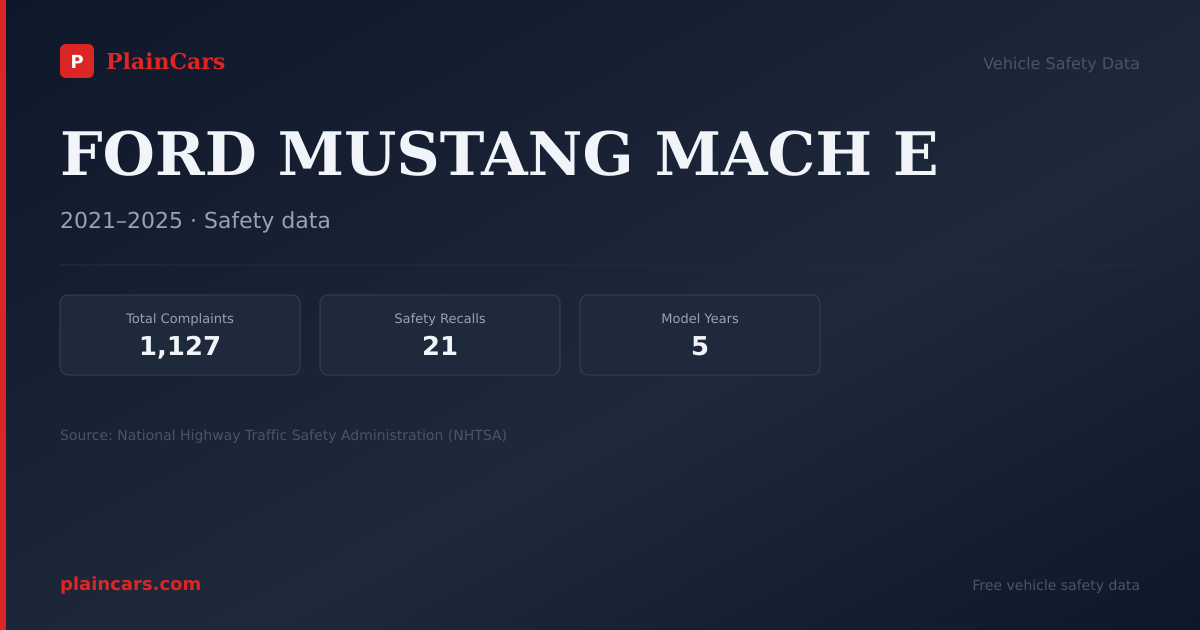
Total Complaints
189 filings
Ford Mustang Mach E · model year
189 NHTSA complaints, 15 crash reports, and 5 recall campaigns listed for this cohort. A VIN lookup is required to determine whether a specific vehicle has an unrepaired recall.
NHTSA overall rating
Not crash-tested
New Car Assessment Program
The verdict
The 2023 Ford Mustang Mach E posts below-average complaint volume among its own model-year siblings.
The 2023FordMustang Mach E carries 189 consumer safety complaints in NHTSA's Office of Defects Investigation database for this specific model-year cohort. Within that volume, owners reported 15 crashes, 1 fire, 2 injuries, and 0 fatalities. No NCAP 5-star crash-test rating is available for this model year in the federal database.
The most frequently selected component label in reports for the 2023 Mustang Mach E is electrical system with 44 filings, followed by unknown or other (23) and power train (20). Complaint categories reflect owner reports and intake categorization; they do not establish a defect pattern or cause. This cohort has 5 NHTSA recall campaigns listed below. Enter a VIN in NHTSA's official recall lookup to determine whether a specific vehicle has an unrepaired recall.
NHTSA currently has 179 investigation files overlapping the 2023 Mustang Mach E, and 6 remain open. Owners comparing this cohort against neighboring years should read the complaint-by-year trend as report volume, not a causal diagnosis. Use the related-complaint feed and the official recall lookup when researching a specific vehicle.
PlainCars' own composite of NHTSA NCAP crash-test ratings and rollover-risk assessment, each dimension normalized against the federal scale or the full national model-year corpus. Not an official NHTSA figure, and not a substitute for a specific vehicle's VIN-level recall check.
Total Complaints
189 filings
Crashes Reported
15 reports
Source
NHTSA ODI
Federal complaints database
At or below the fleet median complaint volume.
| Component | Count |
|---|---|
| ELECTRICAL SYSTEM | 44 |
| UNKNOWN OR OTHER | 23 |
| POWER TRAIN | 20 |
| SERVICE BRAKES | 13 |
| FUEL/PROPULSION SYSTEM | 12 |
| VEHICLE SPEED CONTROL | 11 |
| FORWARD COLLISION AVOIDANCE: AUTOMATIC EMERGENCY BRAKING | 10 |
| ENGINE | 7 |
| AIR BAGS | 5 |
| STEERING | 5 |
| FORWARD COLLISION AVOIDANCE: ADAPTIVE CRUISE CONTROL | 4 |
| FORWARD COLLISION AVOIDANCE: WARNINGS | 4 |
| STRUCTURE:BODY | 3 |
| LATCHES/LOCKS/LINKAGES | 3 |
| BACK OVER PREVENTION: REARVIEW SYSTEM BRAKING | 2 |
POWER TRAIN:DRIVELINE:DIFFERENTIAL UNIT
Ford Motor Company (Ford) is recalling certain 2021-2023 Mustang Mach E vehicles. The rear differential pinion shaft may fracture.
STRUCTURE:EXTERIOR TRIM
Ford Motor Company (Ford) is recalling certain 2023-2025 Mustang Mach E vehicles. The rear side quarter window glass trim may be improperly secured, which can allow it to detach.
ELECTRICAL SYSTEM:BODY CONTROL MODULE:SOFTWARE
Ford Motor Company (Ford) is recalling certain 2021-2025 Mustang Mach E vehicles. In the event of a low battery charge, the electronic door latches may remain locked once the driver or front passenger exits and shuts the door, possibly trapping someone who is unable to use the inside door release ha
VISIBILITY:WINDSHIELD WIPER/WASHER:MOTOR
Ford Motor Company (Ford) is recalling certain 2023-2024 Maverick, Ford Bronco Sport, and Mustang Mach-E vehicles. The front windshield wiper motor may become inoperative, causing the wipers to fail.
BACK OVER PREVENTION:SOFTWARE
Ford Motor Company (Ford) is recalling certain 2021-2024 Bronco, F-150, 2021-2024 Edge, 2022-2025 Escape, F-250, F-350, F-450, F-550, F-600, 2022-2024 Expedition, 2022-2025 Transit, 2021-2023 Mach-E, 2024 Ranger, Mustang, 2021-2023 Lincoln Nautilus, 2022-2024 Navigator, and 2023-2024 Corsair vehicle
"Parking Brake Fault - Service Now" warning appeared. Parking brakes locked after stopping vehicle. Dealer diagnosed problem as corroded wiring connector to left rear wheel parking brake motor. Vehicle has 41,000 miles. Vehicle was stuck and could not be moved. If this had occurred in traffic situation a crash could have resulted. Charge to repair was $600 because dealer claimed brake parts are a "wear item".
Diag and replace left rear parking brake actuator pigtail. Corrosion and breaking of the wire, causing the parking brake to be stuck. This was a recall on the earlier models (2022), and seems to be an ongoing issue. It is not covered under warranty over 36k miles.
Parking break fault message appeared on the vehicle and the parking break was stuck on, making it impossible to release the break and therefore move the car.
Vehicle: 2023 Ford Mustang Mach-E (leased) The issue involves the cruise control system and steering wheel control layout (human-machine interface). Cruise control is unintentionally activated when attempting to use the turn signal due to the placement of the cruise control buttons. The vehicle is available for inspection upon request. On two separate occasions while using one-pedal driving, unintended cruise control activation caused sudden acceleration during low-speed turning maneuvers. The first incident occurred while signaling to turn into a parking spot. The second occurred while entering a left-turn pocket. In both cases, the unexpected acceleration created an immediate risk of collision with surrounding vehicles and required sudden panic braking to avoid an accident. The issue has occurred multiple times during normal driving but has not yet been formally reproduced or confirmed by a dealer or independent service center, and the vehicle has not yet been inspected by the man
Vehicle: 2023 Ford Mustang Mach-E (leased) The issue involves the cruise control system and steering wheel control layout (human-machine interface). Cruise control is unintentionally activated when attempting to use the turn signal due to the placement of the cruise control buttons. The vehicle is available for inspection upon request. On two separate occasions while using one-pedal driving, unintended cruise control activation caused sudden acceleration during low-speed turning maneuvers. The first incident occurred while signaling to turn into a parking spot. The second occurred while entering a left-turn pocket. In both cases, the unexpected acceleration created an immediate risk of collision with surrounding vehicles and required sudden panic braking to avoid an accident. The issue has occurred multiple times during normal driving but has not yet been formally reproduced or confirmed by a dealer or independent service center, and the vehicle has not yet been inspected by the man
Vehicle: 2023 Ford Mustang Mach-E (leased) The issue involves the cruise control system and steering wheel control layout (human-machine interface). Cruise control is unintentionally activated when attempting to use the turn signal due to the placement of the cruise control buttons. The vehicle is available for inspection upon request. On two separate occasions while using one-pedal driving, unintended cruise control activation caused sudden acceleration during low-speed turning maneuvers. The first incident occurred while signaling to turn into a parking spot. The second occurred while entering a left-turn pocket. In both cases, the unexpected acceleration created an immediate risk of collision with surrounding vehicles and required sudden panic braking to avoid an accident. The issue has occurred multiple times during normal driving but has not yet been formally reproduced or confirmed by a dealer or independent service center, and the vehicle has not yet been inspected by the man
After stopping the vehicle to run an errand, the vehicle locked up. The steering wheel would not turn. The vehicle would not shift into any gear. The vehicle was inoperable and I found myself stranded 25 miles from home. The vehicle was towed to our local Ford dealership where it has been for the past two weeks. This failure could just as occurred on the road causing a dangerous situation.
After stopping the vehicle to run an errand, the vehicle locked up. The steering wheel would not turn. The vehicle would not shift into any gear. The vehicle was inoperable and I found myself stranded 25 miles from home. The vehicle was towed to our local Ford dealership where it has been for the past two weeks. This failure could just as occurred on the road causing a dangerous situation.
After stopping the vehicle to run an errand, the vehicle locked up. The steering wheel would not turn. The vehicle would not shift into any gear. The vehicle was inoperable and I found myself stranded 25 miles from home. The vehicle was towed to our local Ford dealership where it has been for the past two weeks. This failure could just as occurred on the road causing a dangerous situation.
Description of Incident: On August 3, 2025, while driving my 2023 Ford Mustang Mach-E, smoke began rising from the front of the vehicle. Within moments, flames erupted. I pulled over and evacuated. The fire quickly engulfed the cabin, resulting in a total loss. Component/System Involved: UNKNOWN. Based on the location and nature of the fire, a failure in the high-voltage battery system or related electrical components is suspected. Documentation and photos are available upon request. Safety Risk: This posed a serious threat to my safety and others on the road. Had it occurred in traffic or at higher speeds, the outcome could have been far worse. Reproduction/Confirmation: The issue has not been reproduced. The fire was investigated by my insurance company and the local fire department. Ford was notified and took possession of the vehicle on August 5. Inspection History: Ford left the vehicle uncovered outdoors for over two months. In October, they sent an engineer who spent 15–3
Dear NHTSA Team, I am writing to urgently raise concern and seek answers regarding what appears to be a systemic safety issue affecting vehicles equipped with Advanced Driver Assistance Systems (ADAS) and self-driving technologies. I have personally experienced repeated and dangerous incidents of phantom braking, overcorrection, and loss of control while driving a 2019 Toyota Prius. The car suddenly brakes, swerves, or pulls sharply when it detects shadows, road inclinations, or mild curves — making it unsafe to drive, especially at highway speeds. These events occur without any driver error. To make things worse, this issue is not limited to one brand or vehicle. Over the past year, I have driven and rented multiple cars from different brands and models through rental companies, and many of them presented the exact same unsafe behavior — unpredictable braking, steering correction, and traction instability. This clearly indicates that the issue is industry-wide, not isolated
Dear NHTSA Team, I am writing to urgently raise concern and seek answers regarding what appears to be a systemic safety issue affecting vehicles equipped with Advanced Driver Assistance Systems (ADAS) and self-driving technologies. I have personally experienced repeated and dangerous incidents of phantom braking, overcorrection, and loss of control while driving a 2019 Toyota Prius. The car suddenly brakes, swerves, or pulls sharply when it detects shadows, road inclinations, or mild curves — making it unsafe to drive, especially at highway speeds. These events occur without any driver error. To make things worse, this issue is not limited to one brand or vehicle. Over the past year, I have driven and rented multiple cars from different brands and models through rental companies, and many of them presented the exact same unsafe behavior — unpredictable braking, steering correction, and traction instability. This clearly indicates that the issue is industry-wide, not isolated
Dear NHTSA Team, I am writing to urgently raise concern and seek answers regarding what appears to be a systemic safety issue affecting vehicles equipped with Advanced Driver Assistance Systems (ADAS) and self-driving technologies. I have personally experienced repeated and dangerous incidents of phantom braking, overcorrection, and loss of control while driving a 2019 Toyota Prius. The car suddenly brakes, swerves, or pulls sharply when it detects shadows, road inclinations, or mild curves — making it unsafe to drive, especially at highway speeds. These events occur without any driver error. To make things worse, this issue is not limited to one brand or vehicle. Over the past year, I have driven and rented multiple cars from different brands and models through rental companies, and many of them presented the exact same unsafe behavior — unpredictable braking, steering correction, and traction instability. This clearly indicates that the issue is industry-wide, not isolated
Rear hatch on my 2023 Ford Mustang Mach-E (VIN: [XXX] , mileage: 31,751 km) opens spontaneously without user input. Occurs while parked and locked, sometimes when approaching with Phone As A Key (PAAK). Incident Details: One incident caused property damage when the hatch opened in a garage. No buttons were pressed, and foot-activated liftgate was not used. Issue is intermittent and unpredictable. Safety Concerns: Risk of property damage Potential injury if someone is near the hatch Risk of theft if hatch opens unattended Ford dealer unable to replicate or resolve. Other owners report similar issues. Request NHTSA investigation for possible recall or fix. INFORMATION REDACTED PURSUANT TO THE FREEDOM OF INFORMATION ACT (FOIA), 5 U.S.C. 552(B)(6)
I’m writing this message out of frustration, exhaustion, and genuine concern for public safety. Over the past months, I’ve been renting and driving multiple cars from different brands and models — Toyota, Subaru, Nissan, and now a 2023 Ford Mustang Mach-E — and all of them show the same dangerous behavior: •sudden phantom braking for no reason, •traction control malfunctioning, throwing the car from side to side, •unstable handling, especially on highways or during light rain. This is not an isolated case — it’s happening across several brands and systems, which makes me question what is really going on. Why are drivers being forced to deal with unreliable technology that clearly isn’t ready for real-world conditions? Are these systems being tested using real drivers as data sources to “teach” self-driving cars how to handle special situations? Because that’s what it feels like — we are being used without consent, forced to correct constant software mistak
I’m writing this message out of frustration, exhaustion, and genuine concern for public safety. Over the past months, I’ve been renting and driving multiple cars from different brands and models — Toyota, Subaru, Nissan, and now a 2023 Ford Mustang Mach-E — and all of them show the same dangerous behavior: •sudden phantom braking for no reason, •traction control malfunctioning, throwing the car from side to side, •unstable handling, especially on highways or during light rain. This is not an isolated case — it’s happening across several brands and systems, which makes me question what is really going on. Why are drivers being forced to deal with unreliable technology that clearly isn’t ready for real-world conditions? Are these systems being tested using real drivers as data sources to “teach” self-driving cars how to handle special situations? Because that’s what it feels like — we are being used without consent, forced to correct constant software mistak
I’m writing this message out of frustration, exhaustion, and genuine concern for public safety. Over the past months, I’ve been renting and driving multiple cars from different brands and models — Toyota, Subaru, Nissan, and now a 2023 Ford Mustang Mach-E — and all of them show the same dangerous behavior: •sudden phantom braking for no reason, •traction control malfunctioning, throwing the car from side to side, •unstable handling, especially on highways or during light rain. This is not an isolated case — it’s happening across several brands and systems, which makes me question what is really going on. Why are drivers being forced to deal with unreliable technology that clearly isn’t ready for real-world conditions? Are these systems being tested using real drivers as data sources to “teach” self-driving cars how to handle special situations? Because that’s what it feels like — we are being used without consent, forced to correct constant software mistak
I’m writing this message out of frustration, exhaustion, and genuine concern for public safety. Over the past months, I’ve been renting and driving multiple cars from different brands and models — Toyota, Subaru, Nissan, and now a 2023 Ford Mustang Mach-E and all of them show the same dangerous behavior: sudden phantom braking for no reason, traction control malfunctioning, throwing the car from side to side, unstable handling, especially on highways or during light rain. This is not an isolated case it’s happening across several brands and systems, which makes me question what is really going on. Why are drivers being forced to deal with unreliable technology that clearly isn’t ready for real-world conditions? Are these systems being tested using real drivers as data sources to “teach” self-driving cars how to handle special situations? Because that’s what it feels like we are being used without consent, forced to correct constant software mistakes that could cost
I’m writing this message out of frustration, exhaustion, and genuine concern for public safety. Over the past months, I’ve been renting and driving multiple cars from different brands and models — Toyota, Subaru, Nissan, and now a 2023 Ford Mustang Mach-E and all of them show the same dangerous behavior: sudden phantom braking for no reason, traction control malfunctioning, throwing the car from side to side, unstable handling, especially on highways or during light rain. This is not an isolated case it’s happening across several brands and systems, which makes me question what is really going on. Why are drivers being forced to deal with unreliable technology that clearly isn’t ready for real-world conditions? Are these systems being tested using real drivers as data sources to “teach” self-driving cars how to handle special situations? Because that’s what it feels like we are being used without consent, forced to correct constant software mistakes that could cost
I’m writing this message out of frustration, exhaustion, and genuine concern for public safety. Over the past months, I’ve been renting and driving multiple cars from different brands and models — Toyota, Subaru, Nissan, and now a 2023 Ford Mustang Mach-E and all of them show the same dangerous behavior: sudden phantom braking for no reason, traction control malfunctioning, throwing the car from side to side, unstable handling, especially on highways or during light rain. This is not an isolated case it’s happening across several brands and systems, which makes me question what is really going on. Why are drivers being forced to deal with unreliable technology that clearly isn’t ready for real-world conditions? Are these systems being tested using real drivers as data sources to “teach” self-driving cars how to handle special situations? Because that’s what it feels like we are being used without consent, forced to correct constant software mistakes that could cost
Timing Belt Failure
Anti-lock brake system (ABS) Malfunction Indicator Lamp (MIL) illuminated
Unintended Transmission Downshift and Rear Wheel Lock-up
Timing Belt Failure
Underbody shields detachment
Data vintage: August 2026. Sources: NHTSA Office of Defects Investigation (ODI) complaints database, NHTSA recall campaign API, NHTSA NCAP crash-test ratings, and NHTSA FARS for fatality cross-reference.
Every figure on PlainCars is rendered directly from NHTSA complaint and safety data, no number is typed in by an editor. This year-specific record is rendered from NHTSA ODI, recall, and NCAP rows for the 2023 Ford Mustang Mach E; no figure is typed in by an editor. See our editorial standards & corrections policy, the methodology behind these numbers, or report a data error. Data current as of August 2026.
Read our methodology - how this data is sourced, computed, and verified.