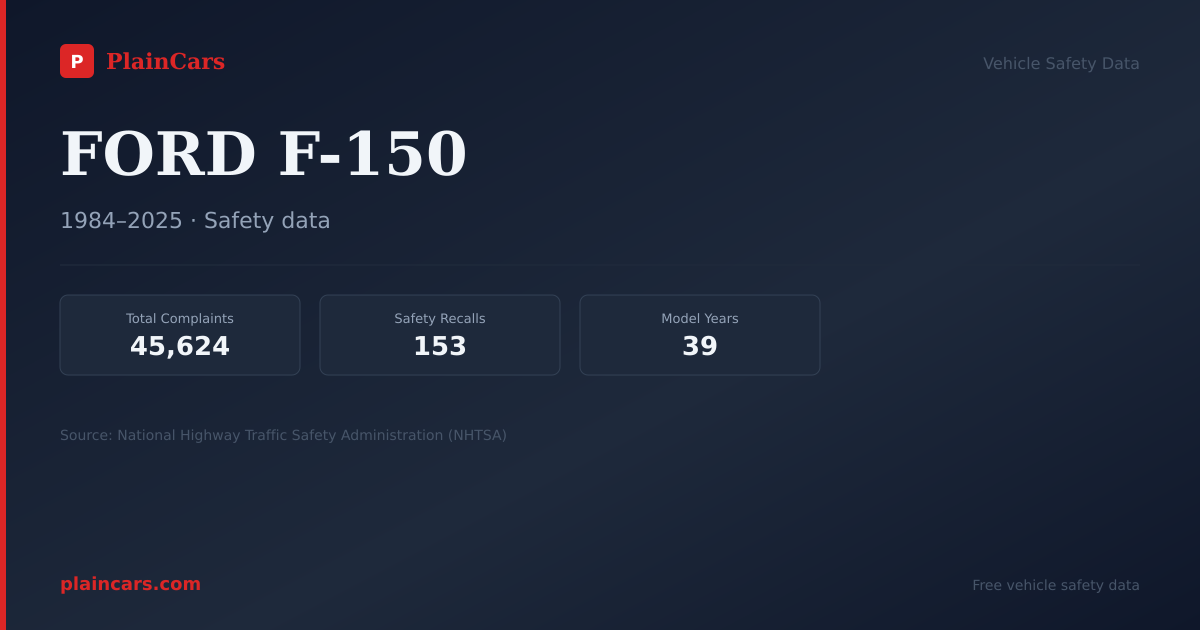
Total Complaints
101 filings
Ford F-150 · model year
101 NHTSA complaints, 2 crash reports, and 12 recall campaigns listed for this cohort. A VIN lookup is required to determine whether a specific vehicle has an unrepaired recall.
NHTSA overall rating
Not crash-tested
New Car Assessment Program
The verdict
The 2025 Ford F-150 posts top-quartile complaint standing among its own model-year siblings.
The 2025FordF-150 carries 101 consumer safety complaints in NHTSA's Office of Defects Investigation database for this specific model-year cohort. Within that volume, owners reported 2 crashes, 1 fire, 1 injury, and 0 fatalities. No NCAP 5-star crash-test rating is available for this model year in the federal database.
The most frequently selected component label in reports for the 2025 F-150 is electrical system with 15 filings, followed by forward collision avoidance: adaptive cruise control (12) and power train (11). Complaint categories reflect owner reports and intake categorization; they do not establish a defect pattern or cause. This cohort has 12 NHTSA recall campaigns listed below. Enter a VIN in NHTSA's official recall lookup to determine whether a specific vehicle has an unrepaired recall.
NHTSA currently has 11 investigation files overlapping the 2025 F-150, and 1 remain open. Owners comparing this cohort against neighboring years should read the complaint-by-year trend as report volume, not a causal diagnosis. Use the related-complaint feed and the official recall lookup when researching a specific vehicle.
PlainCars' own composite of NHTSA NCAP crash-test ratings and rollover-risk assessment, each dimension normalized against the federal scale or the full national model-year corpus. Not an official NHTSA figure, and not a substitute for a specific vehicle's VIN-level recall check.
Total Complaints
101 filings
Crashes Reported
2 reports
Source
NHTSA ODI
Federal complaints database
At or below the fleet median complaint volume.
| Component | Count |
|---|---|
| ELECTRICAL SYSTEM | 15 |
| FORWARD COLLISION AVOIDANCE: ADAPTIVE CRUISE CONTROL | 12 |
| POWER TRAIN | 11 |
| SERVICE BRAKES | 11 |
| UNKNOWN OR OTHER | 10 |
| VEHICLE SPEED CONTROL | 5 |
| LANE DEPARTURE: ASSIST | 5 |
| LANE DEPARTURE: WARNING | 4 |
| VISIBILITY/WIPER | 3 |
| STEERING | 3 |
| FORWARD COLLISION AVOIDANCE: WARNINGS | 3 |
| FORWARD COLLISION AVOIDANCE: AUTOMATIC EMERGENCY BRAKING | 3 |
| EXTERIOR LIGHTING | 2 |
| SERVICE BRAKES, HYDRAULIC | 2 |
| WHEELS | 1 |
ENGINE AND ENGINE COOLING:ENGINE:OIL/LUBRICATION
Ford Motor Company (Ford) is recalling certain 2024-2025 F-150, Expedition, and 2024 Lincoln Navigator vehicles equipped with 3.5L GTDI engines. The engine may have a misaligned engine cup plug, which can result in a rapid oil leak.
SERVICE BRAKES, HYDRAULIC:POWER ASSIST:ELECTRIC:CONTROL MODULE:SOFTWARE
Ford Motor Company (Ford) is recalling certain 2025 Lincoln Navigator, F-150, Expedition, Bronco, and Ranger vehicles. The Electronic Brake Booster (EBB) module may malfunction while driving or when the driver is utilizing an Advanced Driver Assistance System (ADAS) feature, resulting in a loss of p
EQUIPMENT:OTHER:LABELS
Ford Motor Company (Ford) is recalling certain 2025 F-150 vehicles. The air bag warning label may be missing from the dashboard. As such, these vehicles fail to comply with the requirements of Federal Motor Vehicle Safety Standard number 208, "Occupant Crash Protection."
ELECTRICAL SYSTEM: INSTRUMENT CLUSTER/PANEL
Ford Motor Company (Ford) is recalling certain 2025-2026 F-550 SD, F-450 SD, F-350 SD, F-250 SD, and 2025 F-150 vehicles. The Instrument Panel Cluster (IPC) may fail at startup.
ENGINE AND ENGINE COOLING:ENGINE:OIL/LUBRICATION
Ford Motor Company (Ford) is recalling certain 2024-2025 F-150, 2024 Expedition and 2024 Lincoln Navigator vehicles equipped with a 3.5L GTDI engine. The engines may have a misaligned engine cup plug, which can result in a rapid oil leak.
ELECTRICAL SYSTEM: INTEGRATED TRAILER BRAKE CONTROL
Ford Motor Company (Ford) is recalling certain 2021-2026 F-150, 2022-2026 F-250 SD, F-350 SD, F-450 SD, F-550 SD, Maverick, 2024-2026 Ranger, 2023-2026 F-600 SD, 2022-2027 Lincoln Navigator, Expedition, and 2026 E-Transit vehicles. When towing a trailer, the integrated trailer module (ITRM) may lose
POWER TRAIN:AUTOMATIC TRANSMISSION:FLUID/LUBRICANT:VALVES/VALVE BODY
Ford Motor Company (Ford) is recalling certain 2024-2025 F-150, Bronco, 2024 Ranger, 2025 Mustang, Explorer, and Aviator vehicles. The transmission valve body may have been machined incorrectly, which can cause reverse gear failure, or unexpected forward movement in reverse or neutral gear.
ENGINE AND ENGINE COOLING:ENGINE:HARD PARTS INTERNAL/MECHANICAL
Ford Motor Company (Ford) is recalling certain 2025 Transit, F-150, and Explorer vehicles. The connecting rod and rod bearing components may have manufacturing defects that can lead to engine damage and engine failure.
ELECTRICAL SYSTEM:WIRING
Ford Motor Company (Ford) is recalling certain 2025 F-150 trucks. Contact with the engine coolant hose may chafe the engine wire harness or cause a pull out of the Powertrain Control Module (PCM) connector pins, causing the engine to stall.
STEERING
Ford Motor Company (Ford) is recalling certain 2025 F-150 vehicles. The lower intermediate shaft fasteners may be improperly attached to the steering gear, allowing the shaft to come loose or detach.
POWER TRAIN:AXLE HUBS
Ford Motor Company (Ford) is recalling certain 2023-2025 F-150 vehicles equipped with the Trailer Tow Max Duty package and a 9.75-inch heavy duty axle with a 3/4 float axle design. The rear axle hub bolt may fatigue and break, which can result in damage to the axle hub splines.
SERVICE BRAKES, HYDRAULIC:POWER ASSIST:ELECTRIC:CONTROL MODULE
Ford Motor Company (Ford) is recalling certain 2025 Lincoln Navigator, F-150, Expedition, Bronco, and Ranger vehicles. The Electronic Brake Booster (EBB) module may malfunction while driving or when the driver is utilizing an Advanced Driver Assistance System (ADAS) feature, resulting in a loss of p
Electronic brake booster replaced. Issue with braking on the ecoboost hybrid engine.
Electronic brake booster replaced. Issue with braking on the ecoboost hybrid engine.
Electronic brake booster replaced. Issue with braking on the ecoboost hybrid engine.
The contact owns a 2025 Ford F-150. The contact received notification of NHTSA Campaign Number: 25V512000 (POWER TRAIN). The local dealer was contacted and informed that the part to do the recall repair was not yet available. The contact stated that the manufacturer had sent a letter indicating that the part was available. The manufacturer was made aware of the issue and confirmed that the part to do the recall repair was not yet available. The contact had not experienced a failure. The contact parked the vehicle due to a safety concern.
When you’re stopped and have the Auto Hold feature on, and open your door, the gear selector will automatically shift to park and engage the e-brake. Off and on, this will cause the brake system to fault and will tell you to service immediately. A couple other times it triggered randomly with just having the Auto Hold feature activated. it’s happened on and off since i got the truck new. i have a video of me trying to engage and disengage the parking brake and nothing happens. i have to start and restart the truck multiple times to fix it
When you’re stopped and have the Auto Hold feature on, and open your door, the gear selector will automatically shift to park and engage the e-brake. Off and on, this will cause the brake system to fault and will tell you to service immediately. A couple other times it triggered randomly with just having the Auto Hold feature activated. it’s happened on and off since i got the truck new. i have a video of me trying to engage and disengage the parking brake and nothing happens. i have to start and restart the truck multiple times to fix it
Driver window was recalibrated a couple of months ago and now it’s back to rolling down half way automatically. I had to kinda manually roll the window up.
The truck has approximately 5,000 miles. When adaptive cruise control is engaged, the vehicle accelerates on its own to 85 mph whenever the posted speed limit changes, and there are no available settings to prevent this. For example, if the speed limit is 55 mph and adaptive cruise control is set to 55 mph, when the limit changes to 65 mph the truck automatically increases speed to 85 mph without driver input. Additionally, Apple CarPlay does not connect or function in the vehicle. The truck was taken to the dealership for this issue on 11/21/25 and has since been in and out of service multiple times, often remaining there for weeks at a time, for the same unresolved problems.
The truck has approximately 5,000 miles. When adaptive cruise control is engaged, the vehicle accelerates on its own to 85 mph whenever the posted speed limit changes, and there are no available settings to prevent this. For example, if the speed limit is 55 mph and adaptive cruise control is set to 55 mph, when the limit changes to 65 mph the truck automatically increases speed to 85 mph without driver input. Additionally, Apple CarPlay does not connect or function in the vehicle. The truck was taken to the dealership for this issue on 11/21/25 and has since been in and out of service multiple times, often remaining there for weeks at a time, for the same unresolved problems.
The automatic forward collision warning slammed on the breaks whe. There were no other vehicles or obstacles in the road
The contact owns a 2025 Ford F-150. The contact stated while driving approximately 80 MPH with the Adaptive Cruise Control activated, the vehicle unexpectedly veered toward an 18-wheeler while passing. The driver’s hands were not on the steering wheel during the failure, and the driver was attentive and was not distracted, and was actively monitoring the roadway. The Adaptive Cruise Control system independently disengaged. The driver was able to regain control of the vehicle and later reactivated the Adaptive Cruise Control and the vehicle operated normally. There were no warning lights illuminated. The local dealer was not contacted. The vehicle was not diagnosed or repaired. The manufacturer was not notified of the failure. The failure mileage was approximately 19,000.
Mileage: 19,000
The contact owns a 2025 Ford F-150. The contact stated while driving approximately 80 MPH with the Adaptive Cruise Control activated, the vehicle unexpectedly veered toward an 18-wheeler while passing. The driver’s hands were not on the steering wheel during the failure, and the driver was attentive and was not distracted, and was actively monitoring the roadway. The Adaptive Cruise Control system independently disengaged. The driver was able to regain control of the vehicle and later reactivated the Adaptive Cruise Control and the vehicle operated normally. There were no warning lights illuminated. The local dealer was not contacted. The vehicle was not diagnosed or repaired. The manufacturer was not notified of the failure. The failure mileage was approximately 19,000.
Mileage: 19,000
Wednesday [XXX]/Phantom Braking Proceeding northbound on [XXX] at estimated speed of 35 mph. Road was clear with no oncoming traffic. Suddenly the brakes locked up and a collision notice appeared on dash. Brakes released and continued northbound with no further issues. INFORMATION REDACTED PURSUANT TO THE FREEDOM OF INFORMATION ACT (FOIA), 5 U.S.C. 552(B)(6)
Wednesday [XXX]/Phantom Braking Proceeding northbound on [XXX] at estimated speed of 35 mph. Road was clear with no oncoming traffic. Suddenly the brakes locked up and a collision notice appeared on dash. Brakes released and continued northbound with no further issues. INFORMATION REDACTED PURSUANT TO THE FREEDOM OF INFORMATION ACT (FOIA), 5 U.S.C. 552(B)(6)
The contact owns a 2025 Ford F-150. The contact received notification of NHTSA Campaign Number: 25V512000 (Power Train); however, the part to do the recall repair was not yet available. The local dealer was contacted. The contact stated that the manufacturer had exceeded a reasonable amount of time for the recall repair. The manufacturer was made aware of the issue. The contact had not experienced a failure.
The contact owns a 2025 Ford F-150. The contact received notification of NHTSA Campaign Number: 25V512000 (Power Train). The contact stated that the letter indicated that the remedy was available; however, when the vehicle was taken to several dealers, the contact was informed that parts were not available for the recall repair. The contact stated that the manufacturer had exceeded a reasonable amount of time for the recall repair. The manufacturer was informed that the part was not yet available. The contact had not experienced a failure.
The contact owns a 2025 Ford F-150. The contact received notification of NHTSA Campaign Number: 25V512000 (POWER TRAIN); however, the part to do the recall repair was not yet available. The local dealer was contacted and informed the contact that parts were not yet available. The contact stated that the manufacturer had exceeded a reasonable amount of time for the recall repair. The manufacturer was not made aware of the issue. The contact had not experienced a failure.
Parking break fault warning light service now light comes on intermittently when the parking break was set. The ford dealer I bought the truck from found a leaking rear left break line and replaced the left rear parking break motor assembly. The Warning light kept coming on intermittently when setting the parking break after this repair. I took it to my local ford dealer who said nothing was wrong. I’m now on a trip and the warning light continues to intermittently come on. Took it to another ford dealer who reconnected a wire and said if that didn’t work it needed a new ABS module. I continued on my trip and the warning light kept coming on. Stopped at another ford dealer who cleaned up some connectors. The warning light kept coming on and I took it back. Now they think it needs a new ABS module and said it is back ordered for 2 months and I’m a 1000+ miles from home.
Parking break fault warning light service now light comes on intermittently when the parking break was set. The ford dealer I bought the truck from found a leaking rear left break line and replaced the left rear parking break motor assembly. The Warning light kept coming on intermittently when setting the parking break after this repair. I took it to my local ford dealer who said nothing was wrong. I’m now on a trip and the warning light continues to intermittently come on. Took it to another ford dealer who reconnected a wire and said if that didn’t work it needed a new ABS module. I continued on my trip and the warning light kept coming on. Stopped at another ford dealer who cleaned up some connectors. The warning light kept coming on and I took it back. Now they think it needs a new ABS module and said it is back ordered for 2 months and I’m a 1000+ miles from home.
While using the vehicle’s BlueCruise driver assistance system, the driver monitoring system generates frequent false driver-attention alerts despite normal posture and active attention to the roadway. The system often fails to recognize attentive driving unless the driver deliberately exaggerates head position or facial expression. Routine and unavoidable behaviors—including briefly touching the face, wiping the nose, or checking side-view mirrors for traffic—frequently trigger alerts, even though these actions are part of safe driving. These false positives create alert fatigue and increased cognitive load, forcing the driver to divert attention from driving to manage the monitoring system itself. The intrusiveness of the alerts becomes distracting and undermines the intended safety benefit of the system. Due to the frequency of false alerts, the driver is often compelled to disengage BlueCruise entirely. I am concerned the current driver-monitoring calibration may inadvertently
Unintended Transmission Downshift and Rear Wheel Lock-up
Unintended Transmission Downshift and Rear Wheel Lock-up
Unintended Transmission Downshift
Seatbelt Pretensioner Fire
Brake Master Cylinder Failure
Data vintage: August 2026. Sources: NHTSA Office of Defects Investigation (ODI) complaints database, NHTSA recall campaign API, NHTSA NCAP crash-test ratings, and NHTSA FARS for fatality cross-reference.
Every figure on PlainCars is rendered directly from NHTSA complaint and safety data, no number is typed in by an editor. This year-specific record is rendered from NHTSA ODI, recall, and NCAP rows for the 2025 Ford F-150; no figure is typed in by an editor. See our editorial standards & corrections policy, the methodology behind these numbers, or report a data error. Data current as of August 2026.
Read our methodology - how this data is sourced, computed, and verified.