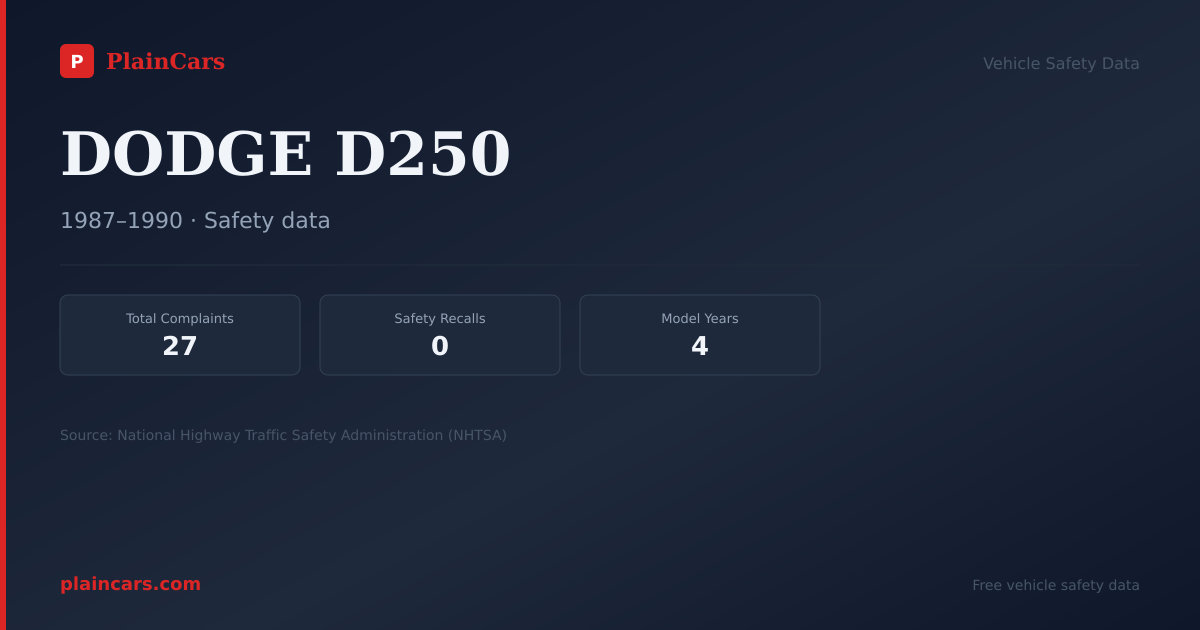
Total Complaints
11 filings
Dodge D250 · model year
11 NHTSA complaints. A VIN lookup is required to determine whether a specific vehicle has an unrepaired recall.
NHTSA overall rating
Not crash-tested
New Car Assessment Program
The verdict
The 1989 Dodge D250 posts above-average complaint volume among its own model-year siblings.
The 1989DodgeD250 carries 11 consumer safety complaints in NHTSA's Office of Defects Investigation database for this specific model-year cohort. Within that volume, owners reported 0 crashes, 1 fire, 0 injuries, and 0 fatalities. No NCAP 5-star crash-test rating is available for this model year in the federal database.
The most frequently selected component label in reports for the 1989 D250 is engine and engine cooling:cooling system:radiator assembly with 3 filings, followed by service brakes, hydraulic:antilock/traction control/electronic limited slip (2) and seat belts:front:buckle assembly (1). Complaint categories reflect owner reports and intake categorization; they do not establish a defect pattern or cause.
NHTSA currently has 20 investigation files overlapping the 1989 D250, and 1 remain open. Owners comparing this cohort against neighboring years should read the complaint-by-year trend as report volume, not a causal diagnosis. Use the related-complaint feed and the official recall lookup when researching a specific vehicle.
PlainCars' own composite of NHTSA NCAP crash-test ratings and rollover-risk assessment, each dimension normalized against the federal scale or the full national model-year corpus. Not an official NHTSA figure, and not a substitute for a specific vehicle's VIN-level recall check.
Total Complaints
11 filings
Crashes Reported
0 reports
Source
NHTSA ODI
Federal complaints database
At or below the fleet median complaint volume.
| Component | Count |
|---|---|
| ENGINE AND ENGINE COOLING:COOLING SYSTEM:RADIATOR ASSEMBLY | 3 |
| SERVICE BRAKES, HYDRAULIC:ANTILOCK/TRACTION CONTROL/ELECTRONIC LIMITED SLIP | 2 |
| SEAT BELTS:FRONT:BUCKLE ASSEMBLY | 1 |
| FUEL SYSTEM, GASOLINE:DELIVERY | 1 |
| POWER TRAIN:MANUAL TRANSMISSION | 1 |
| SERVICE BRAKES, HYDRAULIC:FOUNDATION COMPONENTS:MASTER CYLINDER | 1 |
| STRUCTURE:FRAME AND MEMBERS | 1 |
| SERVICE BRAKES, HYDRAULIC:FOUNDATION COMPONENTS | 1 |
MY TRUCK HAD 2 CORE RADIATOR WHEN PURCHASED. IT OVERHEATED CONSTANTLY WHILE PULLING MY TRAVEL TRAILER. I PUT A 3 CORE RADIATOR IN IT AND IT STILL OVERHEATS. THE TRAILER WEIGHS APPROXIMATELY 4500 POUNDS. PLEASE HELP ME. NOTE: THIS IS THE SECOND FORM I HAVE SUBMITTED. THE FIRST ODI NUMBER 707414 HAD A FEW INCORRECT ANSWERS TO VEHICLE INFORMATION. *AK
MY TRUCK HAD 2 CORE RADIATOR WHEN PURCHASED. IT OVERHEATED CONSTANTLY WHILE PULLING MY TRAVEL TRAILER. I PUT A 3 CORE RADIATOR IN IT AND IT STILL OVERHEATS. THE TRAILER WEIGHS APPROXIMATELY 4500 POUNDS. PLEASE HELP ME. NOTE: THIS IS THE SECOND FORM I HAVE SUBMITTED. THE FIRST ODI NUMBER 707414 HAD A FEW INCORRECT ANSWERS TO VEHICLE INFORMATION. *AK
MY TRUCK HAD 2 CORE RADIATOR WHEN PURCHASED. IT OVERHEATED CONSTANTLY WHILE PULLING MY TRAVEL TRAILER. I PUT A 3 CORE RADIATOR IN IT AND IT STILL OVERHEATS. PLEASE HELP ME.
WHENEVER THE ROADS ARE WET & THE BRAKES ARE APPLIED, VEHICLE WOULD NOT STOP PROPERLY. FRONT BRAKES WOULD NOT HOLD. VEHICLE WOULD SKID. *AK
WHEN DRIVING ABOUT 10 TO 15 MPH CONSUMER NOTICED A SOUND FROM THE FRONT END, APPLIED BRAKES VEHICLE PULLED TO THE RIGHT, CONSUMER CHECKED THE VEHICLE NOTICED THE UPPER FRAME ON THE PASSENGER'S SIDE BROKE, THE UPPER A FRAME WAS REPLACED. *AK
WHEN DRIVING ABOUT 10 TO 15 MPH CONSUMER NOTICED A SOUND FROM THE FRONT END, APPLIED BRAKES VEHICLE PULLED TO THE RIGHT, CONSUMER CHECKED THE VEHICLE NOTICED THE UPPER FRAME ON THE PASSENGER'S SIDE BROKE, THE UPPER A FRAME WAS REPLACED. *AK
ANTILOCK BRAKES FAILED.
MASTER CYLINDER FAILED, CAUSING BRAKES TO LOCK UP/ACCIDENT.
MANUAL TRANSMISSION FAILURE IN DIESEL ENGINE TRUCK. TT
ENGINE COMPARTMENT FIRE DUE TO DETERIORATED FUEL LINE, CAUSING FUEL LEAKAGE/FIRE. TT
FRONT SEAT BELT BUCKLE FAILURE. TT
Data vintage: August 2026. Sources: NHTSA Office of Defects Investigation (ODI) complaints database, NHTSA recall campaign API, NHTSA NCAP crash-test ratings, and NHTSA FARS for fatality cross-reference.
Every figure on PlainCars is rendered directly from NHTSA complaint and safety data, no number is typed in by an editor. This year-specific record is rendered from NHTSA ODI, recall, and NCAP rows for the 1989 Dodge D250; no figure is typed in by an editor. See our editorial standards & corrections policy, the methodology behind these numbers, or report a data error. Data current as of August 2026.
Read our methodology - how this data is sourced, computed, and verified.