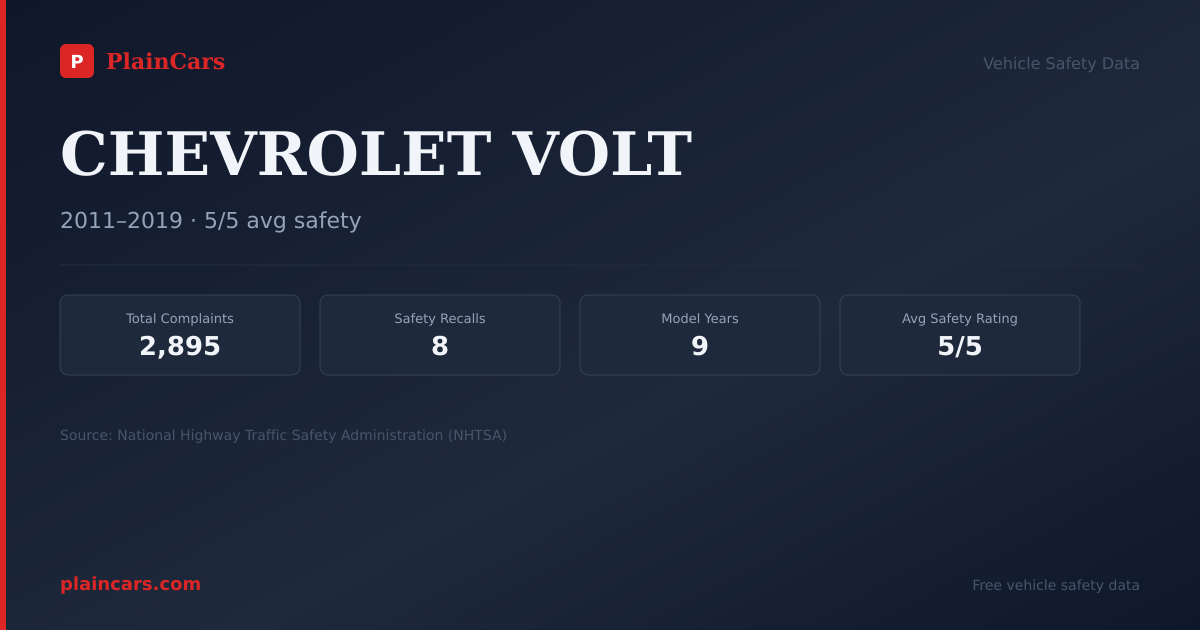
Total Complaints
1173 filings
Chevrolet Volt · model year
1173 NHTSA complaints, 18 crash reports. A VIN lookup is required to determine whether a specific vehicle has an unrepaired recall.
NHTSA overall rating
5 / 5 ★
New Car Assessment Program
The verdict
The 2017 Chevrolet Volt pairs above-average complaint volume with a top NHTSA safety rating.
The 2017ChevroletVolt carries 1173 consumer safety complaints in NHTSA's Office of Defects Investigation database for this specific model-year cohort. Within that volume, owners reported 18 crashes, 14 fires, 18 injuries, and 0 fatalities. For crash performance, NHTSA's New Car Assessment Program gave this cohort an overall 5/5 rating, with 5/5 front crash, 5/5 side crash, and 5/5 rollover scores derived from standardized barrier and dynamic tests.
The most frequently selected component label in reports for the 2017 Volt is electrical system with 290 filings, followed by fuel/propulsion system (224) and power train (209). Complaint categories reflect owner reports and intake categorization; they do not establish a defect pattern or cause.
NHTSA currently has 57 investigation files overlapping the 2017 Volt, and 2 remain open. Owners comparing this cohort against neighboring years should read the complaint-by-year trend as report volume, not a causal diagnosis. Use the related-complaint feed and the official recall lookup when researching a specific vehicle.
PlainCars' own composite of NHTSA NCAP crash-test ratings and rollover-risk assessment, each dimension normalized against the federal scale or the full national model-year corpus. Not an official NHTSA figure, and not a substitute for a specific vehicle's VIN-level recall check.
Total Complaints
1173 filings
Crashes Reported
18 reports
Source
NHTSA ODI
Federal complaints database
Above median complaint volume, review patterns below.
| Component | Count |
|---|---|
| ELECTRICAL SYSTEM | 290 |
| FUEL/PROPULSION SYSTEM | 224 |
| POWER TRAIN | 209 |
| ENGINE | 177 |
| UNKNOWN OR OTHER | 113 |
| VEHICLE SPEED CONTROL | 32 |
| SERVICE BRAKES | 27 |
| STEERING | 15 |
| AIR BAGS | 12 |
| ELECTRONIC STABILITY CONTROL (ESC) | 9 |
| FORWARD COLLISION AVOIDANCE: ADAPTIVE CRUISE CONTROL | 5 |
| POWER TRAIN:AUTOMATIC TRANSMISSION:LEVER AND LINKAGE:FLOOR SHIFT | 5 |
| VISIBILITY/WIPER | 4 |
| HYBRID PROPULSION SYSTEM | 4 |
| ENGINE AND ENGINE COOLING:EXHAUST SYSTEM:EMISSION CONTROL:GAS RECIRCULATION VALVE (EGR VALVE) | 4 |
I am reporting a series of safety concerns regarding my 2017 Chevy Volt, which have persisted despite multiple attempts to address them with the dealership. These issues pose significant risks to my safety and that of others on the road. On January 18th, 2024, I brought my vehicle to the dealer after experiencing reduced propulsion power while driving on the highway, coupled with the illumination of the check engine light. The mechanic performed a quick inspection and used a GM scan tool to diagnose the issue, revealing the code P1E00 for the Hybrid Powertrain Control Module 2, which was cleared without a thorough investigation. I was advised to return if the issue reoccurred. Despite the reset, the problem persisted, and on February 9th, 2024, I scheduled another appointment due to my Chevy Volt's High Voltage battery charging only to 65% capacity despite indicating a full charge. Subsequently, on February 11th, 2024, the check engine light illuminated again, and on February 12th, 202
I am reporting a series of safety concerns regarding my 2017 Chevy Volt, which have persisted despite multiple attempts to address them with the dealership. These issues pose significant risks to my safety and that of others on the road. On January 18th, 2024, I brought my vehicle to the dealer after experiencing reduced propulsion power while driving on the highway, coupled with the illumination of the check engine light. The mechanic performed a quick inspection and used a GM scan tool to diagnose the issue, revealing the code P1E00 for the Hybrid Powertrain Control Module 2, which was cleared without a thorough investigation. I was advised to return if the issue reoccurred. Despite the reset, the problem persisted, and on February 9th, 2024, I scheduled another appointment due to my Chevy Volt's High Voltage battery charging only to 65% capacity despite indicating a full charge. Subsequently, on February 11th, 2024, the check engine light illuminated again, and on February 12th, 202
I am reporting a series of safety concerns regarding my 2017 Chevy Volt, which have persisted despite multiple attempts to address them with the dealership. These issues pose significant risks to my safety and that of others on the road. On January 18th, 2024, I brought my vehicle to the dealer after experiencing reduced propulsion power while driving on the highway, coupled with the illumination of the check engine light. The mechanic performed a quick inspection and used a GM scan tool to diagnose the issue, revealing the code P1E00 for the Hybrid Powertrain Control Module 2, which was cleared without a thorough investigation. I was advised to return if the issue reoccurred. Despite the reset, the problem persisted, and on February 9th, 2024, I scheduled another appointment due to my Chevy Volt's High Voltage battery charging only to 65% capacity despite indicating a full charge. Subsequently, on February 11th, 2024, the check engine light illuminated again, and on February 12th, 202
Several years ago, when I was driving the vehicle, I got a sudden "reduced propulsion alert" and the onboard coolant temperature gauge showed a significant spike in temperature. To avoid overheating, I had to pull over on the side of the highway. In the onboard fuse box, there was a blown F3 fuse. I replaced the fuse and the same issue happened again last year. After some online research, it is clear that the EGR valve failed. Unplugging the valve and replacing the fuse has returned the vehicle to normal operations, but it's now out of compliance with local emissions regulations. GM has failed to properly produce replacement parts. As of Feb 11, 2026, a local GM dealer in Bloomington, IN quoted a backorder and unclear wait time on a replacement part and quoted me at $2,000+ just for the part. If not for my quick thinking, this part failure could have overheated my vehicle causing extensive damages. GM has failed to produce enough replacement parts and given the safety issues associa
Several years ago, when I was driving the vehicle, I got a sudden "reduced propulsion alert" and the onboard coolant temperature gauge showed a significant spike in temperature. To avoid overheating, I had to pull over on the side of the highway. In the onboard fuse box, there was a blown F3 fuse. I replaced the fuse and the same issue happened again last year. After some online research, it is clear that the EGR valve failed. Unplugging the valve and replacing the fuse has returned the vehicle to normal operations, but it's now out of compliance with local emissions regulations. GM has failed to properly produce replacement parts. As of Feb 11, 2026, a local GM dealer in Bloomington, IN quoted a backorder and unclear wait time on a replacement part and quoted me at $2,000+ just for the part. If not for my quick thinking, this part failure could have overheated my vehicle causing extensive damages. GM has failed to produce enough replacement parts and given the safety issues associa
The contact owns a 2017 Chevrolet Volt. The contact stated that while driving approximately 35 - 40 MPH, the message stating that the propulsion was reduced was displayed, and the check engine warning light was illuminated. The contact continued to drive the vehicle, and the vehicle unintendedly decelerated. The contact arrived at the destination and parked the vehicle, and the message “Shift to Park” was displayed even though the gear shifter was in park(P). The message “Charging Unavailable” was displayed. The contact stated that while charging the vehicle, the mileage was reduced from 72 miles to approximately 29 miles during the winter months, and 42 miles during the summer months, while still indicating a FULL charge. The “Shift to Park” failure had occurred twice the previous year, and the vehicle was turned off and restarted to correct the failure. The vehicle was taken to a certified mechanic, who diagnosed that the hybrid power train control module had failed. Th
Mileage: 26,500
The contact owns a 2017 Chevrolet Volt. The contact stated that while driving approximately 35 - 40 MPH, the message stating that the propulsion was reduced was displayed, and the check engine warning light was illuminated. The contact continued to drive the vehicle, and the vehicle unintendedly decelerated. The contact arrived at the destination and parked the vehicle, and the message “Shift to Park” was displayed even though the gear shifter was in park(P). The message “Charging Unavailable” was displayed. The contact stated that while charging the vehicle, the mileage was reduced from 72 miles to approximately 29 miles during the winter months, and 42 miles during the summer months, while still indicating a FULL charge. The “Shift to Park” failure had occurred twice the previous year, and the vehicle was turned off and restarted to correct the failure. The vehicle was taken to a certified mechanic, who diagnosed that the hybrid power train control module had failed. Th
Mileage: 26,500
There is a ongoing problem with the BECM on 2016-2018 volts. Mine is one of them. Contacted Chevrolet and they say my vin isn’t under the extended coverage. I believe it should be and can’t stand they won’t cover my car under warranty. Is there anything you can do?
There is a ongoing problem with the BECM on 2016-2018 volts. Mine is one of them. Contacted Chevrolet and they say my vin isn’t under the extended coverage. I believe it should be and can’t stand they won’t cover my car under warranty. Is there anything you can do?
My car started having issues with the hybrid system, with fault alerts related to the drive motor control module, hybrid powertrain control module, and battery energy control module in the transmission, and the vehicle is available for inspection if needed. The engine light had been on for about a week, and I was waiting for availability at work to take it to a mechanic. While driving around 70 mph on the highway, a “Propulsion Power Reduced” message suddenly came on and the car started limiting its speed. As I kept driving, the power continued to drop, making it unsafe to stay at highway speeds and putting both me and other drivers at risk since the car couldn’t keep up with traffic and could slow down unexpectedly. I took it to an independent mechanic who confirmed the issue and warned me it was dangerous to drive because the speed would keep decreasing as power dropped. So far, only an independent mechanic has inspected it. After doing some research, I found this is a very com
My car started having issues with the hybrid system, with fault alerts related to the drive motor control module, hybrid powertrain control module, and battery energy control module in the transmission, and the vehicle is available for inspection if needed. The engine light had been on for about a week, and I was waiting for availability at work to take it to a mechanic. While driving around 70 mph on the highway, a “Propulsion Power Reduced” message suddenly came on and the car started limiting its speed. As I kept driving, the power continued to drop, making it unsafe to stay at highway speeds and putting both me and other drivers at risk since the car couldn’t keep up with traffic and could slow down unexpectedly. I took it to an independent mechanic who confirmed the issue and warned me it was dangerous to drive because the speed would keep decreasing as power dropped. So far, only an independent mechanic has inspected it. After doing some research, I found this is a very com
My 2017 Chevy Volt stalled, wont charge, safely concerns. safety-related special coverage is being denied by local Chevy dealer. Check Engine light codes U2603-06, U2623, well known issue in chevy volt community, that points to Chevy faulty BECM. Chevy replace these to some selected 2016-2018 vehicles, but they wont cover mine, while I have same exact issue. Please help to push on Chevy to cover all 2016-2018 Chevy Volt by recalls repairs with no cost to owner. thanks
I am reporting a series of safety concerns regarding my 2017 Chevy Volt, which have persisted despite multiple attempts to address them with the dealership. These issues pose significant risks to my safety and that of others on the road. On January 18th, 2024, I brought my vehicle to the dealer after experiencing reduced propulsion power while driving on the highway, coupled with the illumination of the check engine light. The mechanic performed a quick inspection and used a GM scan tool to diagnose the issue, revealing the code P1E00 for the Hybrid Powertrain Control Module 2, which was cleared without a thorough investigation. I was advised to return if the issue reoccurred. Despite the reset, the problem persisted, and on February 9th, 2024, I scheduled another appointment due to my Chevy Volt's High Voltage battery charging only to 65% capacity despite indicating a full charge. Subsequently, on February 11th, 2024, the check engine light illuminated again, and on February 12th, 202
I am reporting a series of safety concerns regarding my 2017 Chevy Volt, which have persisted despite multiple attempts to address them with the dealership. These issues pose significant risks to my safety and that of others on the road. On January 18th, 2024, I brought my vehicle to the dealer after experiencing reduced propulsion power while driving on the highway, coupled with the illumination of the check engine light. The mechanic performed a quick inspection and used a GM scan tool to diagnose the issue, revealing the code P1E00 for the Hybrid Powertrain Control Module 2, which was cleared without a thorough investigation. I was advised to return if the issue reoccurred. Despite the reset, the problem persisted, and on February 9th, 2024, I scheduled another appointment due to my Chevy Volt's High Voltage battery charging only to 65% capacity despite indicating a full charge. Subsequently, on February 11th, 2024, the check engine light illuminated again, and on February 12th, 202
I am reporting a series of safety concerns regarding my 2017 Chevy Volt, which have persisted despite multiple attempts to address them with the dealership. These issues pose significant risks to my safety and that of others on the road. On January 18th, 2024, I brought my vehicle to the dealer after experiencing reduced propulsion power while driving on the highway, coupled with the illumination of the check engine light. The mechanic performed a quick inspection and used a GM scan tool to diagnose the issue, revealing the code P1E00 for the Hybrid Powertrain Control Module 2, which was cleared without a thorough investigation. I was advised to return if the issue reoccurred. Despite the reset, the problem persisted, and on February 9th, 2024, I scheduled another appointment due to my Chevy Volt's High Voltage battery charging only to 65% capacity despite indicating a full charge. Subsequently, on February 11th, 2024, the check engine light illuminated again, and on February 12th, 202
Experiencing intermittent propulsion system failure with multiple simultaneous warning messages on 2017 Chevrolet Volt at approximately 59,000 miles. WARNINGS DISPLAYED: - "Propulsion Power Reduced" message - "Check Tire Pressure Monitoring System" (false alert - all tires properly inflated and recently replaced) - Multiple dashboard warning lights including exclamation point indicators - Vehicle exhibits abnormal driving characteristics PATTERN: Issue occurs intermittently while driving. Vehicle can be restarted and may operate normally afterward, then fault returns unpredictably. SAFETY CONCERN: This matches documented Battery Energy Control Module (BECM) failure pattern referenced in GM investigation N232432680/PE23022 and Customer Satisfaction Program 17228 recall N172096420 for reduced propulsion power in 2016-2018 Volts. Review of owner complaints shows other 2017 Volt owners experiencing sudden complete loss of propulsion while driving at highway speeds, creating dangerous
Experiencing intermittent propulsion system failure with multiple simultaneous warning messages on 2017 Chevrolet Volt at approximately 59,000 miles. WARNINGS DISPLAYED: - "Propulsion Power Reduced" message - "Check Tire Pressure Monitoring System" (false alert - all tires properly inflated and recently replaced) - Multiple dashboard warning lights including exclamation point indicators - Vehicle exhibits abnormal driving characteristics PATTERN: Issue occurs intermittently while driving. Vehicle can be restarted and may operate normally afterward, then fault returns unpredictably. SAFETY CONCERN: This matches documented Battery Energy Control Module (BECM) failure pattern referenced in GM investigation N232432680/PE23022 and Customer Satisfaction Program 17228 recall N172096420 for reduced propulsion power in 2016-2018 Volts. Review of owner complaints shows other 2017 Volt owners experiencing sudden complete loss of propulsion while driving at highway speeds, creating dangerous
Experiencing intermittent propulsion system failure with multiple simultaneous warning messages on 2017 Chevrolet Volt at approximately 59,000 miles. WARNINGS DISPLAYED: - "Propulsion Power Reduced" message - "Check Tire Pressure Monitoring System" (false alert - all tires properly inflated and recently replaced) - Multiple dashboard warning lights including exclamation point indicators - Vehicle exhibits abnormal driving characteristics PATTERN: Issue occurs intermittently while driving. Vehicle can be restarted and may operate normally afterward, then fault returns unpredictably. SAFETY CONCERN: This matches documented Battery Energy Control Module (BECM) failure pattern referenced in GM investigation N232432680/PE23022 and Customer Satisfaction Program 17228 recall N172096420 for reduced propulsion power in 2016-2018 Volts. Review of owner complaints shows other 2017 Volt owners experiencing sudden complete loss of propulsion while driving at highway speeds, creating dangerous
Following a day trip involving sub-freezing temperatures and full depletion of the traction battery, the vehicle was plugged in at home and appeared to be charging. The following morning, I enable the preheat via the remote before leaving the house for work, and notice the CEL/MIL before starting the car. Car was cold, charging indicator was flashing green as if it was accepting charge. I went to investigate and was met with the following list of codes: P1E00, U2603, U2604-U2606, U2617-U2624, P1FD2, P1FD3, P3042, C326C, P0096. Car turns on but seems to only be accessories; no power steering. Seems like the state of charge indication kept transitioning from empty to full. I unplugged the car to see if it could still drive, but no luck. getting "Shift to Park" when I put it in drive. Switching to HOLD does not engage the engine. After plugging it in again, the car no longer receives charge and simply holds the orange charge indicator light. In an attempt to get the car into limp mode,
The BECM (Battery Energy Control Module) failed. The vehicle illuminated the MIL and the driver display to show a "Reduced power". When restarted, the display showed "shift to park", which I did several times. After a couple of restarts it displayed the "Reduced power" message, but would not go into drive. THE MIL was illuminated the entire time. Through numerous key cycles I got the VIN operable and took it to the dealer for repair. The BECM part is at the dealer or on its way back to GM as a core return. While this occurred while I was leaving my garage, it could have occurred in traffic, which would put me or others at risk. The problem was investigated by my local dealer (Currie Chevrolet in Forest Park, IL) and it was determined to be both a bad Battery Energy Control Module (BECM) and a bad shifter assembly. The shifter had been replaced (or repaired?) for an earlier Shift to Park failure per TSB 23-NA-119. The dealer kept the BECM as a core. I have pictures of the cor
Loss of motive power due to engine failure
Loss of Motive Power due to the Battery Energy Control Module
Electric Vehicle Battery Fires
Outboard Front Seat Belt Anchor Cable Failure
Fuel Line Leak
Data vintage: August 2026. Sources: NHTSA Office of Defects Investigation (ODI) complaints database, NHTSA recall campaign API, NHTSA NCAP crash-test ratings, and NHTSA FARS for fatality cross-reference.
Every figure on PlainCars is rendered directly from NHTSA complaint and safety data, no number is typed in by an editor. This year-specific record is rendered from NHTSA ODI, recall, and NCAP rows for the 2017 Chevrolet Volt; no figure is typed in by an editor. See our editorial standards & corrections policy, the methodology behind these numbers, or report a data error. Data current as of August 2026.
Read our methodology - how this data is sourced, computed, and verified.