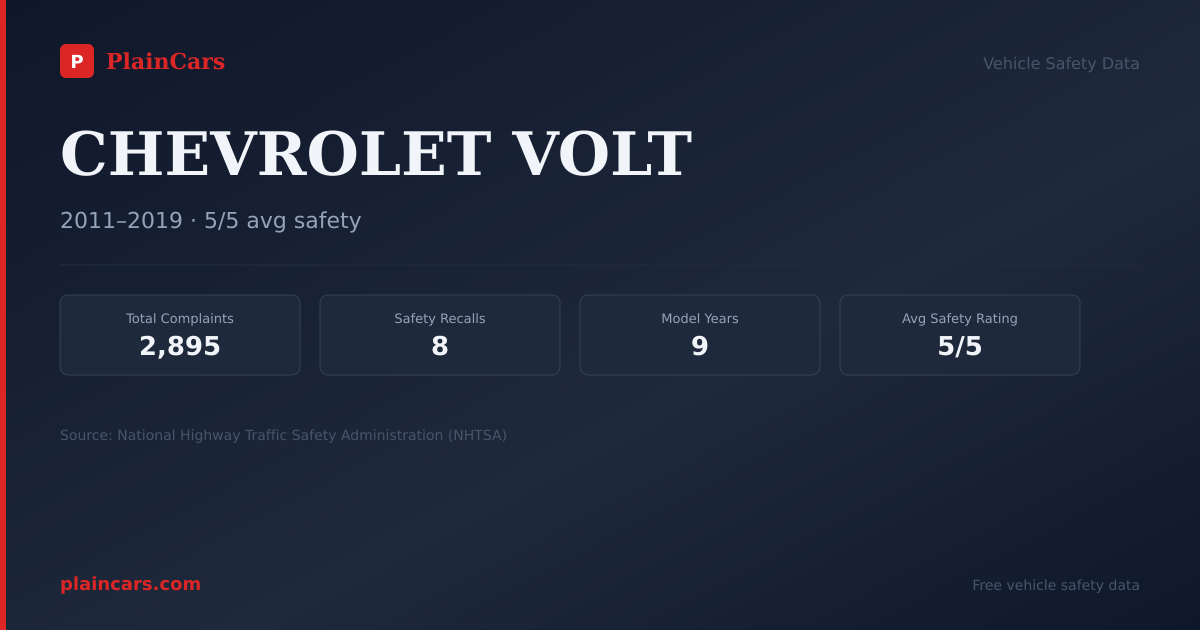
Total Complaints
70 filings
Chevrolet Volt · model year
70 NHTSA complaints, 1 crash report, and 1 recall campaign listed for this cohort. A VIN lookup is required to determine whether a specific vehicle has an unrepaired recall.
NHTSA overall rating
5 / 5 ★
New Car Assessment Program
The verdict
The 2015 Chevrolet Volt pairs top-quartile complaint standing with a top NHTSA safety rating.
The 2015ChevroletVolt carries 70 consumer safety complaints in NHTSA's Office of Defects Investigation database for this specific model-year cohort. Within that volume, owners reported 1 crash, 1 fire, 1 injury, and 0 fatalities. For crash performance, NHTSA's New Car Assessment Program gave this cohort an overall 5/5 rating, with 4/5 front crash, 5/5 side crash, and 5/5 rollover scores derived from standardized barrier and dynamic tests.
The most frequently selected component label in reports for the 2015 Volt is electrical system with 17 filings, followed by fuel/propulsion system (10) and engine (8). Complaint categories reflect owner reports and intake categorization; they do not establish a defect pattern or cause. This cohort has 1 NHTSA recall campaign listed below. Enter a VIN in NHTSA's official recall lookup to determine whether a specific vehicle has an unrepaired recall.
NHTSA currently has 57 investigation files overlapping the 2015 Volt, and 2 remain open. Owners comparing this cohort against neighboring years should read the complaint-by-year trend as report volume, not a causal diagnosis. Use the related-complaint feed and the official recall lookup when researching a specific vehicle.
PlainCars' own composite of NHTSA NCAP crash-test ratings and rollover-risk assessment, each dimension normalized against the federal scale or the full national model-year corpus. Not an official NHTSA figure, and not a substitute for a specific vehicle's VIN-level recall check.
Total Complaints
70 filings
Crashes Reported
1 reports
Source
NHTSA ODI
Federal complaints database
At or below the fleet median complaint volume.
| Component | Count |
|---|---|
| ELECTRICAL SYSTEM | 17 |
| FUEL/PROPULSION SYSTEM | 10 |
| ENGINE | 8 |
| AIR BAGS | 7 |
| POWER TRAIN | 6 |
| SERVICE BRAKES | 6 |
| VEHICLE SPEED CONTROL | 2 |
| UNKNOWN OR OTHER | 2 |
| TIRES | 2 |
| SEATS | 2 |
| STEERING | 1 |
| SUSPENSION | 1 |
| FORWARD COLLISION AVOIDANCE | 1 |
| ELECTRICAL SYSTEM:WIRING | 1 |
| STRUCTURE:BODY:HATCHBACK/LIFTGATE | 1 |
STEERING
General Motors LLC (GM) is recalling certain model year 2014-2015 Chevrolet Cruze vehicles manufactured November 8, 2013, to March 12, 2015, and 2015 Chevrolet Volt vehicles manufactured April 11, 2014. In the affected vehicles, the inner tie rod may not be tightened to specification allowing the t
A "service brakes" warning came up when I was parked in a parking lot and immediately afterwards the brakes stopped working when I was reversing in the parking lot and I almost backed up into another car. I had my car towed to Paradise Chevrolet and they diagnosed the problem as a faulty "brake pressure modulator valve" (BPMV) that needs to be replaced. I saw that there is a recall for the 2012 Chevy Volt for the same issue, faulty BPMV.
My 2015 Chevy Volt has been experiencing ongoing mechanical and electrical issues, including random power loss, reduced propulsion warnings, and sudden vehicle shutdowns with no prior indication. These problems pose a serious safety concern, as the car can lose power unexpectedly while driving. Despite these issues, GM has refused to service the vehicle or unlock necessary components because they no longer manufacture or support the required parts. As a result, I am left with an unsafe and unreliable vehicle with no available remedy from the manufacturer. This is forcing me to trade in the vehicle at a loss
My 2015 Chevy Volt has been experiencing ongoing mechanical and electrical issues, including random power loss, reduced propulsion warnings, and sudden vehicle shutdowns with no prior indication. These problems pose a serious safety concern, as the car can lose power unexpectedly while driving. Despite these issues, GM has refused to service the vehicle or unlock necessary components because they no longer manufacture or support the required parts. As a result, I am left with an unsafe and unreliable vehicle with no available remedy from the manufacturer. This is forcing me to trade in the vehicle at a loss
My 2015 Chevy Volt has been experiencing ongoing mechanical and electrical issues, including random power loss, reduced propulsion warnings, and sudden vehicle shutdowns with no prior indication. These problems pose a serious safety concern, as the car can lose power unexpectedly while driving. Despite these issues, GM has refused to service the vehicle or unlock necessary components because they no longer manufacture or support the required parts. As a result, I am left with an unsafe and unreliable vehicle with no available remedy from the manufacturer. This is forcing me to trade in the vehicle at a loss
On all (4) tires, there is cracking in the sidewalls in a line about 2 inches above the tire bead around each tire. Approximately 19K miles on these tires. Manufacture and supplier/seller (Priority Tire) both sent multiple photos of issue, tread depth, etc. and then denied any warranty on the tires due to 'Improper Usage' (reply below) I asked the supplier/seller and the manufacture what that means and no reply. Tires are consistently rotated by myself and tire pressures consistently maintained. I am [XXX] and don't race or off road my Volt. This could be a potential safety issue if one or more tires were to fail unexpectedly. Please see photos and thank you for your help. Hello, We are reaching out regarding your warranty request. Unfortunately, the manufacturer/supplier declined your warranty request, as they inspected the issue, and determined that the cause of damage on your tire is improper usage. We are sorry that we could not help you any further. Please let us know if
Service airbag alert popped up
The car has not been able to charge since April of last year. I have taken it to the dealer to diagnose but they want to charge $200 per hour to diagnose. They already suggested that the charge receptacle should be replaced. I purchased the part and replaced it myself. I have tried asking if it could be the BECM like with other model years and they said they could only determine that after testing and replacing parts. The P1EE6 error code suggests that the BECM might need to be replaced and/or reprogrammed. There have been several times that I have experienced a loss of propulsion error while driving. I know there is a safety bulletin for the 2016-2019 models year that I think should apply to other model years.
The car has not been able to charge since April of last year. I have taken it to the dealer to diagnose but they want to charge $200 per hour to diagnose. They already suggested that the charge receptacle should be replaced. I purchased the part and replaced it myself. I have tried asking if it could be the BECM like with other model years and they said they could only determine that after testing and replacing parts. The P1EE6 error code suggests that the BECM might need to be replaced and/or reprogrammed. There have been several times that I have experienced a loss of propulsion error while driving. I know there is a safety bulletin for the 2016-2019 models year that I think should apply to other model years.
I will be driving on the road and randomly my vehicle will give me a loss of propulsion warning. This has happened many times on the highway where I’ve lost acceleration power quickly and have almost been involved in a futile accident as a result. My vehicle also randomly switches from electric to gas sometimes causing my car to jolt
I will be driving on the road and randomly my vehicle will give me a loss of propulsion warning. This has happened many times on the highway where I’ve lost acceleration power quickly and have almost been involved in a futile accident as a result. My vehicle also randomly switches from electric to gas sometimes causing my car to jolt
This car is connected to Bouncie a device that detects when a car turns on and off, the speed, if break or acceletor are stepped on forcefully and any trips. Recently the device is detecting the engine is turned off but the car is showing no signs of struggling and its in full motion. This is new, I've tested the device in another car for two weeks hoping it was the device but I had no issues on the other vehicle. The images is just one of several occasions. The image shows green dot where car starts and red where car is turned off. However, I never turned off my car at the Demaree Rd that day. I feel like the car is losing power and starts back up while in motion.
This car is connected to Bouncie a device that detects when a car turns on and off, the speed, if break or acceletor are stepped on forcefully and any trips. Recently the device is detecting the engine is turned off but the car is showing no signs of struggling and its in full motion. This is new, I've tested the device in another car for two weeks hoping it was the device but I had no issues on the other vehicle. The images is just one of several occasions. The image shows green dot where car starts and red where car is turned off. However, I never turned off my car at the Demaree Rd that day. I feel like the car is losing power and starts back up while in motion.
This car is connected to Bouncie a device that detects when a car turns on and off, the speed, if break or acceletor are stepped on forcefully and any trips. Recently the device is detecting the engine is turned off but the car is showing no signs of struggling and its in full motion. This is new, I've tested the device in another car for two weeks hoping it was the device but I had no issues on the other vehicle. The images is just one of several occasions. The image shows green dot where car starts and red where car is turned off. However, I never turned off my car at the Demaree Rd that day. I feel like the car is losing power and starts back up while in motion.
I was driving on a road at roughly 50 mph when suddenly without warming, the screen and everything shut off and went black in the vehicle, and then immediately turned back on, this time with the engine light on. In the following seconds, the gas pedal completely stopped responding, and I had to coast to a stop at the side of the road. It was a dangerous spot on the road to have this happen. I was able to power the vehicle off, and then back on again, and the vehicle functioned normally immediately afterwards, with no engine light on.
I was driving on a road at roughly 50 mph when suddenly without warming, the screen and everything shut off and went black in the vehicle, and then immediately turned back on, this time with the engine light on. In the following seconds, the gas pedal completely stopped responding, and I had to coast to a stop at the side of the road. It was a dangerous spot on the road to have this happen. I was able to power the vehicle off, and then back on again, and the vehicle functioned normally immediately afterwards, with no engine light on.
I was driving on a road at roughly 50 mph when suddenly without warming, the screen and everything shut off and went black in the vehicle, and then immediately turned back on, this time with the engine light on. In the following seconds, the gas pedal completely stopped responding, and I had to coast to a stop at the side of the road. It was a dangerous spot on the road to have this happen. I was able to power the vehicle off, and then back on again, and the vehicle functioned normally immediately afterwards, with no engine light on.
Car experienced sudden loss of power while driving. Warning appeared 'Propulsion Power Reduced.' Was able to continue driving short distance home and parked. Attempted to recharge battery but it would not accept charge. I was able to restart car again with "Propulsion Power Reduced' and drove to dealer. Diagnosis: Body Control Module (BCM) failed. Unit was replaced. Vehicle drove normally for short period and issue repeated within one day. Returned to dealer. Issue resolved after second attempt.
Car experienced sudden loss of power while driving. Warning appeared 'Propulsion Power Reduced.' Was able to continue driving short distance home and parked. Attempted to recharge battery but it would not accept charge. I was able to restart car again with "Propulsion Power Reduced' and drove to dealer. Diagnosis: Body Control Module (BCM) failed. Unit was replaced. Vehicle drove normally for short period and issue repeated within one day. Returned to dealer. Issue resolved after second attempt.
Car experienced sudden loss of power while driving. Warning appeared 'Propulsion Power Reduced.' Was able to continue driving short distance home and parked. Attempted to recharge battery but it would not accept charge. I was able to restart car again with "Propulsion Power Reduced' and drove to dealer. Diagnosis: Body Control Module (BCM) failed. Unit was replaced. Vehicle drove normally for short period and issue repeated within one day. Returned to dealer. Issue resolved after second attempt.
The passenger presence sensor in the front passenger seat is malfunctioning and spare parts to replace it are not available from the manufacturer. The Chevrolet dealership has inspected and verified this issue, and the system is available for inspection upon request. This is the same issue that NHTSA investigated in the 2013 model described below. This sensor failure results in a check airbag signal and prevents the deployment of the passenger frontal and knee air bags, posing risk of serious injury to passengers. The PSS may develop a malfunction due to bunching of the sensor mat in the seat trench. The bunching of the sensor mat could cause the mat to repeatedly fold in the same location. Over time, the repeated folding can cause an increased resistance in the sensor mat. An increased resistance in the PSS sensor mat is detected as a fault in the air bag system diagnostic. If this fault is detected, a diagnostic trouble code will be stored in the air bag control unit and the air bag
Loss of motive power due to engine failure
Loss of Motive Power due to the Battery Energy Control Module
Electric Vehicle Battery Fires
Outboard Front Seat Belt Anchor Cable Failure
Fuel Line Leak
Data vintage: August 2026. Sources: NHTSA Office of Defects Investigation (ODI) complaints database, NHTSA recall campaign API, NHTSA NCAP crash-test ratings, and NHTSA FARS for fatality cross-reference.
Every figure on PlainCars is rendered directly from NHTSA complaint and safety data, no number is typed in by an editor. This year-specific record is rendered from NHTSA ODI, recall, and NCAP rows for the 2015 Chevrolet Volt; no figure is typed in by an editor. See our editorial standards & corrections policy, the methodology behind these numbers, or report a data error. Data current as of August 2026.
Read our methodology - how this data is sourced, computed, and verified.