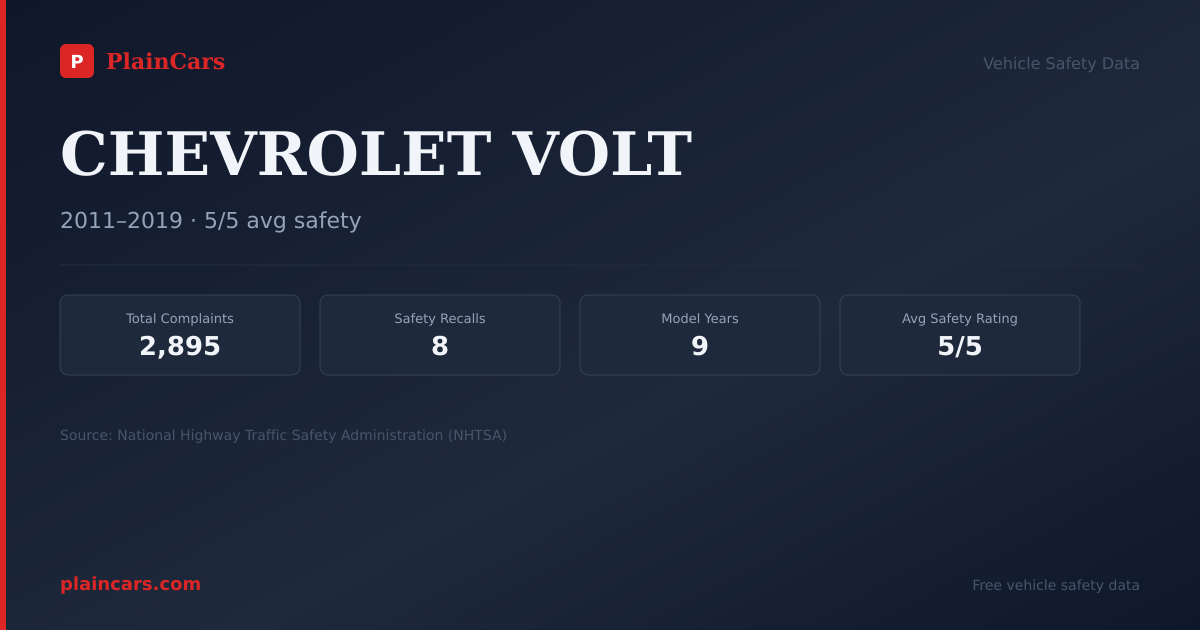
Total Complaints
442 filings
Chevrolet Volt · model year
442 NHTSA complaints, 17 crash reports, and 3 recall campaigns listed for this cohort. A VIN lookup is required to determine whether a specific vehicle has an unrepaired recall.
NHTSA overall rating
5 / 5 ★
New Car Assessment Program
The verdict
The 2013 Chevrolet Volt pairs above-average complaint volume with a top NHTSA safety rating.
The 2013ChevroletVolt carries 442 consumer safety complaints in NHTSA's Office of Defects Investigation database for this specific model-year cohort. Within that volume, owners reported 17 crashes, 2 fires, 18 injuries, and 0 fatalities. For crash performance, NHTSA's New Car Assessment Program gave this cohort an overall 5/5 rating, with 4/5 front crash, 5/5 side crash, and 5/5 rollover scores derived from standardized barrier and dynamic tests.
The most frequently selected component label in reports for the 2013 Volt is air bags with 159 filings, followed by fuel/propulsion system (52) and electrical system (50). Complaint categories reflect owner reports and intake categorization; they do not establish a defect pattern or cause. This cohort has 3 NHTSA recall campaigns listed below. Enter a VIN in NHTSA's official recall lookup to determine whether a specific vehicle has an unrepaired recall.
NHTSA currently has 57 investigation files overlapping the 2013 Volt, and 2 remain open. Owners comparing this cohort against neighboring years should read the complaint-by-year trend as report volume, not a causal diagnosis. Use the related-complaint feed and the official recall lookup when researching a specific vehicle.
PlainCars' own composite of NHTSA NCAP crash-test ratings and rollover-risk assessment, each dimension normalized against the federal scale or the full national model-year corpus. Not an official NHTSA figure, and not a substitute for a specific vehicle's VIN-level recall check.
Total Complaints
442 filings
Crashes Reported
17 reports
Source
NHTSA ODI
Federal complaints database
Above median complaint volume, review patterns below.
| Component | Count |
|---|---|
| AIR BAGS | 159 |
| FUEL/PROPULSION SYSTEM | 52 |
| ELECTRICAL SYSTEM | 50 |
| ENGINE | 36 |
| SEATS | 30 |
| POWER TRAIN | 24 |
| SERVICE BRAKES | 19 |
| UNKNOWN OR OTHER | 15 |
| VEHICLE SPEED CONTROL | 6 |
| STEERING | 5 |
| STRUCTURE:BODY | 5 |
| ELECTRICAL SYSTEM:PROPULSION SYSTEM | 5 |
| TIRES | 4 |
| ELECTRICAL SYSTEM:12V/24V/48V BATTERY | 4 |
| HYBRID PROPULSION SYSTEM | 4 |
AIR BAGS:FRONTAL:DRIVER SIDE:INFLATOR MODULE
General Motors, LLC (GM) is recalling certain 2013 Buick Verano, Chevrolet Camero, Sonic, and Volt vehicles. The driver-side air bag inflator may explode during deployment due to a manufacturing defect.
HYBRID PROPULSION SYSTEM
General Motors LLC (GM) is recalling certain 2013 Chevrolet Volt vehicles. An update to the Hybrid Powertrain Control Module 2 (HPCM2) may have disabled the cell balancing function causing a low-voltage condition.
ELECTRICAL SYSTEM:IGNITION
General Motors LLC (GM) is recalling certain model year 2011-2013 Volt vehicles manufactured August 25, 2010, to June 26, 2013. If the driver exits the vehicle without turning off the electrical system, the battery may drain low enough that the gasoline engine will automatically start itself to rec
I received the "Propulsion Power is Reduced" Alert engine light while driving in "Normal" mode on the freeway at around 60mph with 8-9 miles of Battery capacity, it showed 0 miles of Battery forcing the Gas Engine on and the vehicle hesitated upon applying the accelerator for the remainder of the drive. My safety and that was others was at risk because the acceleration dropped quickly and I was on a busy freeway at the time when the Alert happened causing further hesitation. Upon stopping I could not get the vehicle to take a charge nor would it start up until a mechanic arrived and was able to confirm the problem.
I received the "Propulsion Power is Reduced" Alert engine light while driving in "Normal" mode on the freeway at around 60mph with 8-9 miles of Battery capacity, it showed 0 miles of Battery forcing the Gas Engine on and the vehicle hesitated upon applying the accelerator for the remainder of the drive. My safety and that was others was at risk because the acceleration dropped quickly and I was on a busy freeway at the time when the Alert happened causing further hesitation. Upon stopping I could not get the vehicle to take a charge nor would it start up until a mechanic arrived and was able to confirm the problem.
I received the "Propulsion Power is Reduced" Alert engine light while driving in "Normal" mode on the freeway at around 60mph with 8-9 miles of Battery capacity, it showed 0 miles of Battery forcing the Gas Engine on and the vehicle hesitated upon applying the accelerator for the remainder of the drive. My safety and that was others was at risk because the acceleration dropped quickly and I was on a busy freeway at the time when the Alert happened causing further hesitation. Upon stopping I could not get the vehicle to take a charge nor would it start up until a mechanic arrived and was able to confirm the problem.
The contact owns a 2013 Chevrolet Volt. The contact stated that while driving at approximately 45 MPH, the vehicle stalled. The Check Engine warning light was flashing, and the messages "No Propulsion Power" and "No Power To Engine" were displayed. The contact stated that two individuals pulled over and assisted the contact in pushing the vehicle to the side of the road to prevent a crash. The vehicle was towed to an independent mechanic, who made the contact aware of an unknown NHTSA Campaign Number; however, the VIN was not included. The vehicle was towed to a dealer, but the vehicle was not diagnosed or repaired. The contact requested vehicle rental assistance, but the dealer was unable to provide assistance. The manufacturer was contacted and referred the contact to the NHTSA Hotline for assistance in initiating a recall. The failure mileage was approximately 141,323.
Mileage: 141,323
The contact owns a 2013 Chevrolet Volt. The contact stated that while driving at approximately 45 MPH, the vehicle stalled. The Check Engine warning light was flashing, and the messages "No Propulsion Power" and "No Power To Engine" were displayed. The contact stated that two individuals pulled over and assisted the contact in pushing the vehicle to the side of the road to prevent a crash. The vehicle was towed to an independent mechanic, who made the contact aware of an unknown NHTSA Campaign Number; however, the VIN was not included. The vehicle was towed to a dealer, but the vehicle was not diagnosed or repaired. The contact requested vehicle rental assistance, but the dealer was unable to provide assistance. The manufacturer was contacted and referred the contact to the NHTSA Hotline for assistance in initiating a recall. The failure mileage was approximately 141,323.
Mileage: 141,323
The passenger occupancy sensor gives a false positive. The only way I can get rid of the beeping is plug in the seatbelt. I have read on Reddit forums that this is a very common problem with 2013 volts, but for some reason there isn't a recall. This is a safety issue. Thank you!
Propulsion power reduced error has happened many times but the recall lookup shows that there are no active recalls on our car. There was a recall on this problem in 2018 so I think it may have been done my the last owner but it is still having this problem.
The drivers side front seatbelt pretensioner assembly contains a braided steel cable. The cable, through normal use, has become damaged to the point that individual wires have broken free from the crimped connector. The damaged wires of the cable have penetrated through the plastic sheath covering the cable causing a needle sharp poking hazard when reaching one’s hand toward the seat back adjustment lever. My wife had a minor laceration to her finger and I was also poked when trying to identify the cause. Upon further inspection I found that approximately 80 percent of the diameter of the pretensioner cable had broken free from the crimped connector. In the event of a collision, the cable would likely break free from the seatbelt, possibly causing serious injury to the driver. I tried to obtain a replacement part through the GM dealer parts network, but the part is listed as discontinued and unavailable. This leaves the vehicle unsafe in the event of an accident. The damaged compone
Fuel leaking from fuel tank at filler inlet. Defect in fuel tank assembly. Large puddle of gasoline formed under car after refueling causing buildup of fumes in closed garage. Vehicle has not been inspected by anyone other than owner. There were no warning lamps prior to failure.
Front passenger seat sensor intermittently fails, causing the Passenger Airbag indicator to switch to OFF (even if a passenger is present) with an accompanying "Service Airbag" message on the dashboard and illumination of the service airbag light. This occurs usually driving above 25mph, but can happen stationary, and lasts for anywhere from 5 seconds to a minute (more commonly shorter). The issue appears some weeks more than others, usually activating most days a week but sometimes have a week or two where it does not happen.
Front passenger seat sensor intermittently fails, causing the Passenger Airbag indicator to switch to OFF (even if a passenger is present) with an accompanying "Service Airbag" message on the dashboard and illumination of the service airbag light. This occurs usually driving above 25mph, but can happen stationary, and lasts for anywhere from 5 seconds to a minute (more commonly shorter). The issue appears some weeks more than others, usually activating most days a week but sometimes have a week or two where it does not happen.
The contact owns a 2013 Chevrolet Volt. The contact stated while driving approximately 76-77 MPH, the vehicle experienced reduced power. The message "Low Propulsion" was displayed, and the engine revved significantly. The contact moved over to the far-right lane to pull over to the side of the road as needed. The contact stated that the failure had been recurring temporarily. The contact had researched the failure online and became aware that the release of the accelerator pedal while the failure was occurring could temporarily correct the failure. The dealer and the manufacturer were not notified of the failure. The vehicle was not diagnosed or repaired. The failure mileage was approximately 61,000.
Mileage: 61,000
The contact owns a 2013 Chevrolet Volt. The contact stated while driving approximately 76-77 MPH, the vehicle experienced reduced power. The message "Low Propulsion" was displayed, and the engine revved significantly. The contact moved over to the far-right lane to pull over to the side of the road as needed. The contact stated that the failure had been recurring temporarily. The contact had researched the failure online and became aware that the release of the accelerator pedal while the failure was occurring could temporarily correct the failure. The dealer and the manufacturer were not notified of the failure. The vehicle was not diagnosed or repaired. The failure mileage was approximately 61,000.
Mileage: 61,000
Passenger presence does not detect people in it and makes it unsafe for passenger without airbags. This got closed and was state that there was a Chevy program to fix this as cited in the closing . I have called all over Chevy and there is no one who knows anything about this at all. If you know it or if they just started it to make it go away, please tell with with whom I can contact within Chevy to start the process
This is a reoccurring problem that is worsening. It is difficult to replicate (but becoming easier to replicate as the problem worsens). The problem conditions are as follows: -The car is fully charged The following drive conditions are required: - The beginning of a drive, with the car in the fully charged state, is driven in the “L” mode (aggressive regenerative braking), AND the beginning (first mile or two) of the trip includes some conditions that would NORMALLY engage regenerative breaking and redirect energy flow back to the high voltage battery. (E.g.: Beginning a drive by going up a small incline; then proceeding to drive down a decline.) OR - The beginning of a drive, with the car in the fully charged state, is driven in the “D” mode, AND the beginning (first mile or two) of the trip includes almost exclusively conditions that would NORMALLY trigger regenerative breaking and redirect flow back to the high voltage battery. IN BOTH cases: the instrument cluster,
Vehicle went into reduced propulsion mode and then shut-off while driving down the highway. Same issue as recall 18V397000 that was not applied to my VIN number as part of that recall. Please apply recall 18V39000 to my vehicle VIN. Chevy Volt owners also need the NHTSA to issue an edict to GM/ that the reset codes for the ECM/HPCM2 being given to the OBD2 bi-directional scanner companies so owners don't have to pay a ransom to the dealerships and GM to get there cars back up and running.
Engine shuts off randomly...message "Engine not available". Car shut off on freeway at 60 mph. Got to shoulder, cycled start button...Engine started then resumed driving. Has now happened a few times since. Also code related to reduced propulsion... Used OBDII to clear codes but makes no difference. Sometimes the car starts and drives without problem. Other times, Engine rpm very erratic.
Repeats constantly..."service airbag". Appears to stop for somewhat variable lengths of time with passenger in front seat. Seems to be related to presence sensor.
While driving, the car developed a brake malfunction. when the brake pedal is depressed you can feel the pedal pulsating and was not slowing down until you pressed harder then the brakes apply abruptly causing risk of rear ending. Upon pulling over to the hard shoulder the pedal pulsating/drumming continued to happen even though the car is completely stopped and is in parking gear. The symptom is similar to the service bulletin PIC5734A. [XXX] The car was driven to the nearest dealership 'Dublin Chevorlet' in Dublin CA and the car has been there for 4 weeks since GM is unable to help resolve the problem. I have reached out to GM and opened a support case. Case number [XXX] ]. INFORMATION REDACTED PURSUANT TO THE FREEDOM OF INFORMATION ACT (FOIA), 5 U.S.C. 552(B)(6)
The contact owns a 2013 Chevrolet Volt. The contact stated while driving 50 MPH, the vehicle lost motive power with the check engine warning light and low oil pressure warning light illuminated. The vehicle was towed to the dealer where a diagnostic test result was undisclosed; however, the contact was informed that the vehicle needed an ASC high-voltage battery to be replaced. The vehicle was not repaired after the ASC battery was replaced. The contact stated that the propulsion system warning light was illuminated. The vehicle was not repaired. The manufacturer was made aware of the failure. The failure mileage was approximately 100,000.
Mileage: 100,000
Loss of motive power due to engine failure
Loss of Motive Power due to the Battery Energy Control Module
Electric Vehicle Battery Fires
Outboard Front Seat Belt Anchor Cable Failure
Fuel Line Leak
Data vintage: August 2026. Sources: NHTSA Office of Defects Investigation (ODI) complaints database, NHTSA recall campaign API, NHTSA NCAP crash-test ratings, and NHTSA FARS for fatality cross-reference.
Every figure on PlainCars is rendered directly from NHTSA complaint and safety data, no number is typed in by an editor. This year-specific record is rendered from NHTSA ODI, recall, and NCAP rows for the 2013 Chevrolet Volt; no figure is typed in by an editor. See our editorial standards & corrections policy, the methodology behind these numbers, or report a data error. Data current as of August 2026.
Read our methodology - how this data is sourced, computed, and verified.