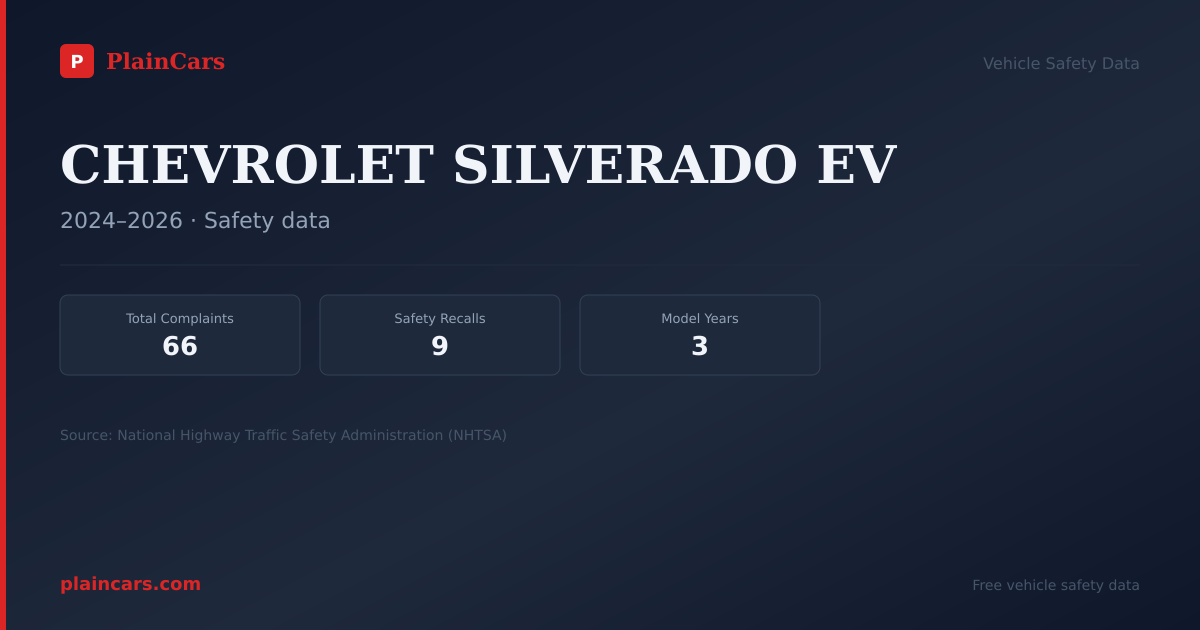
Total Complaints
4 filings
Chevrolet Silverado EV · model year
4 NHTSA complaints, and 4 recall campaigns listed for this cohort. A VIN lookup is required to determine whether a specific vehicle has an unrepaired recall.
NHTSA overall rating
Not crash-tested
New Car Assessment Program
The 2026ChevroletSilverado EV carries 4 consumer safety complaints in NHTSA's Office of Defects Investigation database for this specific model-year cohort. Within that volume, owners reported 0 crashes, 0 fires, 0 injuries, and 0 fatalities. No NCAP 5-star crash-test rating is available for this model year in the federal database.
The most frequently selected component label in reports for the 2026 Silverado EV is forward collision avoidance: adaptive cruise control:software with 1 filings, followed by service brakes (1) and electrical system (1). Complaint categories reflect owner reports and intake categorization; they do not establish a defect pattern or cause. This cohort has 4 NHTSA recall campaigns listed below. Enter a VIN in NHTSA's official recall lookup to determine whether a specific vehicle has an unrepaired recall.
NHTSA currently has 57 investigation files overlapping the 2026 Silverado EV, and 2 remain open. Owners comparing this cohort against neighboring years should read the complaint-by-year trend as report volume, not a causal diagnosis. Use the related-complaint feed and the official recall lookup when researching a specific vehicle.
PlainCars' own composite of NHTSA NCAP crash-test ratings and rollover-risk assessment, each dimension normalized against the federal scale or the full national model-year corpus. Not an official NHTSA figure, and not a substitute for a specific vehicle's VIN-level recall check.
Total Complaints
4 filings
Crashes Reported
0 reports
Source
NHTSA ODI
Federal complaints database
At or below the fleet median complaint volume.
| Component | Count |
|---|---|
| FORWARD COLLISION AVOIDANCE: ADAPTIVE CRUISE CONTROL:SOFTWARE | 1 |
| SERVICE BRAKES | 1 |
| ELECTRICAL SYSTEM | 1 |
| FUEL/PROPULSION SYSTEM | 1 |
ELECTRICAL SYSTEM:PROPULSION SYSTEM:TRACTION BATTERY
General Motors, LLC is recalling certain 2026 Cadillac Escalade IQ, Escalade IQL, GMC Sierra EV, and Chevrolet Silverado EV vehicles. The high voltage battery may have an improperly secured internal module component.
WHEELS
General Motors, LLC (GM) is recalling certain 2026 Chevrolet Silverado EV and GMC Sierra EV vehicles. A manufacturing defect may result in the steel wheels cracking at the disc vent holes.
EQUIPMENT:OTHER:OWNERS/SERVICE/OTHER MANUAL
General Motors has decided that certain 2027 Chevrolet Bolt EV, 2025-2026 Cadillac OPTIQ, Chevrolet Colorado, Equinox EV, GMC Canyon, 2026 Buick Enclave, Envision, Cadillac CT5, Escalade, Escalade ESV, Escalade IQ, Escalade IQL, LYRIQ, VISTIQ, Chevrolet Blazer EV, Corvette Convertible, Corvette Coup
ELECTRONIC STABILITY CONTROL (ESC):CONTROL MODULE:SOFTWARE
General Motors, LLC (GM) is recalling certain 2026 Chevrolet Silverado EV and GMC Sierra EV electric vehicles. After experiencing an electronic stability control (ESC) system malfunction, the ESC malfunction warning light may not illuminate on the next key cycle. As such, these vehicles fail to co
NHTSA SAFETY COMPLAINT – HIGH-VOLTAGE BATTERY FAULT & LOSS OF VEHICLE CONTROL Vehicle: chevy Silverado EV LT Mileage at most recent incident: ~5,400+ miles Incident date: December 17, 2025 Description of the Problem This is the third occurrence of a high-voltage battery fault warning, and the second time involving active vehicle malfunction while driving. • First occurrence: ~700 miles then at 1040 miles • High-voltage battery warning displayed • Vehicle taken to dealer and returned the same day • No noticeable drivability issues at that time • Second occurrence: ~5,400 miles • Severe malfunction while driving at highway speed • Vehicle towed to dealer • Dealer initially reported no active codes until video evidence was provided • Third occurrence: 12/17/2025 • High-voltage battery fault warning displayed again
NHTSA SAFETY COMPLAINT – HIGH-VOLTAGE BATTERY FAULT & LOSS OF VEHICLE CONTROL Vehicle: chevy Silverado EV LT Mileage at most recent incident: ~5,400+ miles Incident date: December 17, 2025 Description of the Problem This is the third occurrence of a high-voltage battery fault warning, and the second time involving active vehicle malfunction while driving. • First occurrence: ~700 miles then at 1040 miles • High-voltage battery warning displayed • Vehicle taken to dealer and returned the same day • No noticeable drivability issues at that time • Second occurrence: ~5,400 miles • Severe malfunction while driving at highway speed • Vehicle towed to dealer • Dealer initially reported no active codes until video evidence was provided • Third occurrence: 12/17/2025 • High-voltage battery fault warning displayed again
NHTSA SAFETY COMPLAINT – HIGH-VOLTAGE BATTERY FAULT & LOSS OF VEHICLE CONTROL Vehicle: chevy Silverado EV LT Mileage at most recent incident: ~5,400+ miles Incident date: December 17, 2025 Description of the Problem This is the third occurrence of a high-voltage battery fault warning, and the second time involving active vehicle malfunction while driving. • First occurrence: ~700 miles then at 1040 miles • High-voltage battery warning displayed • Vehicle taken to dealer and returned the same day • No noticeable drivability issues at that time • Second occurrence: ~5,400 miles • Severe malfunction while driving at highway speed • Vehicle towed to dealer • Dealer initially reported no active codes until video evidence was provided • Third occurrence: 12/17/2025 • High-voltage battery fault warning displayed again
The contact owns a 2026 Chevrolet Silverado EV. The contact stated that while driving at an undisclosed speed and towing, the adaptive cruise control set speed independently decreased. No warning lights were illuminated. The adaptive cruise control was set at 65 MPH, and the adaptive cruise control independently reset to 42 MPH. In addition, on another occasion, the adaptive speed control was set at 65 MPH, however the adaptive cruise control independently reset to 80 MPH. The contact stated that the adaptive cruise control and the failure ceased; however, the failure reoccurred. The contact stated that the failure almost caused the vehicle to be rear-ended. The contact stated that the failure had occurred several times and usually at night. The vehicle was not diagnosed or repaired by an independent mechanic or the dealer. The dealer was made aware of the failure. The vehicle was scheduled for a diagnostic test. The manufacturer was not made aware of the failure. The failure mileage w
Mileage: 700
Loss of motive power due to engine failure
Loss of Motive Power due to the Battery Energy Control Module
Electric Vehicle Battery Fires
Outboard Front Seat Belt Anchor Cable Failure
Fuel Line Leak
Data vintage: August 2026. Sources: NHTSA Office of Defects Investigation (ODI) complaints database, NHTSA recall campaign API, NHTSA NCAP crash-test ratings, and NHTSA FARS for fatality cross-reference.
Every figure on PlainCars is rendered directly from NHTSA complaint and safety data, no number is typed in by an editor. This year-specific record is rendered from NHTSA ODI, recall, and NCAP rows for the 2026 Chevrolet Silverado EV; no figure is typed in by an editor. See our editorial standards & corrections policy, the methodology behind these numbers, or report a data error. Data current as of August 2026.
Read our methodology - how this data is sourced, computed, and verified.