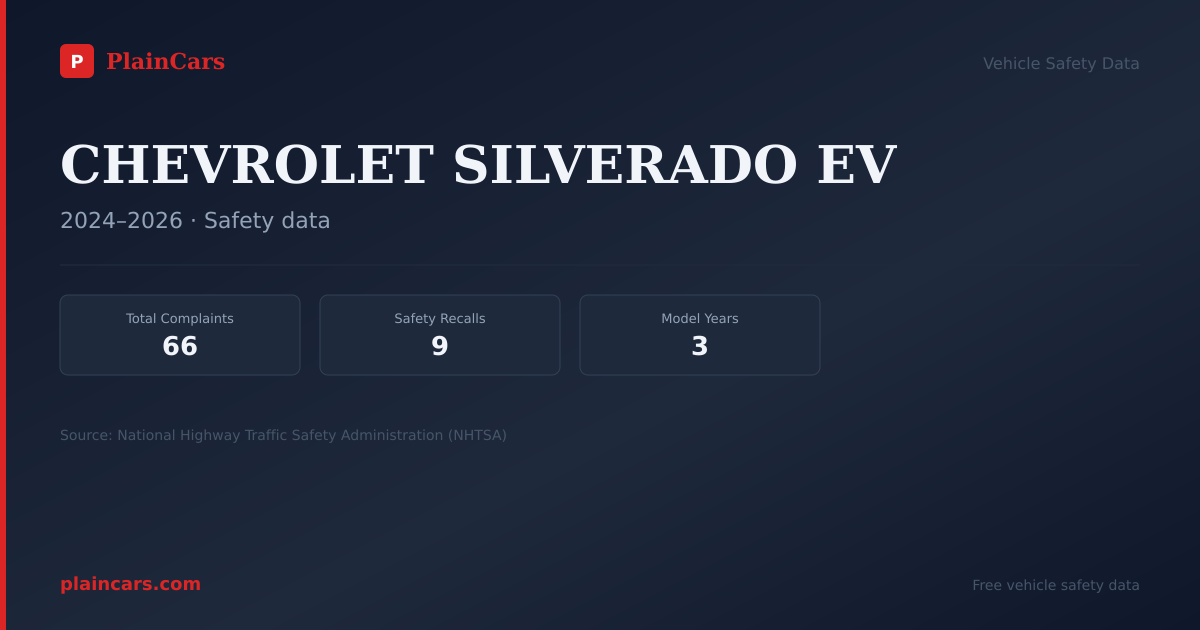
Total Complaints
41 filings
Chevrolet Silverado EV · model year
41 NHTSA complaints, 2 crash reports, and 4 recall campaigns listed for this cohort. A VIN lookup is required to determine whether a specific vehicle has an unrepaired recall.
NHTSA overall rating
Not crash-tested
New Car Assessment Program
The 2024ChevroletSilverado EV carries 41 consumer safety complaints in NHTSA's Office of Defects Investigation database for this specific model-year cohort. Within that volume, owners reported 2 crashes, 0 fires, 2 injuries, and 0 fatalities. For crash performance, NHTSA's New Car Assessment Program gave this cohort an overall Not Rated/5 rating, with Not Rated/5 front crash, Not Rated/5 side crash, and Not Rated/5 rollover scores derived from standardized barrier and dynamic tests.
The most frequently selected component label in reports for the 2024 Silverado EV is electrical system with 9 filings, followed by structure:body (6) and unknown or other (4). Complaint categories reflect owner reports and intake categorization; they do not establish a defect pattern or cause. This cohort has 4 NHTSA recall campaigns listed below. Enter a VIN in NHTSA's official recall lookup to determine whether a specific vehicle has an unrepaired recall.
NHTSA currently has 57 investigation files overlapping the 2024 Silverado EV, and 2 remain open. Owners comparing this cohort against neighboring years should read the complaint-by-year trend as report volume, not a causal diagnosis. Use the related-complaint feed and the official recall lookup when researching a specific vehicle.
PlainCars' own composite of NHTSA NCAP crash-test ratings and rollover-risk assessment, each dimension normalized against the federal scale or the full national model-year corpus. Not an official NHTSA figure, and not a substitute for a specific vehicle's VIN-level recall check.
Total Complaints
41 filings
Crashes Reported
2 reports
Source
NHTSA ODI
Federal complaints database
At or below the fleet median complaint volume.
| Component | Count |
|---|---|
| ELECTRICAL SYSTEM | 9 |
| STRUCTURE:BODY | 6 |
| UNKNOWN OR OTHER | 4 |
| VISIBILITY/WIPER | 3 |
| EXTERIOR LIGHTING | 3 |
| VEHICLE SPEED CONTROL | 2 |
| ELECTRICAL SYSTEM:PROPULSION SYSTEM | 2 |
| POWER TRAIN | 2 |
| TIRES:PRESSURE MONITORING AND REGULATING SYSTEMS | 1 |
| SEAT BELTS | 1 |
| ENGINE | 1 |
| FUEL/PROPULSION SYSTEM | 1 |
| SERVICE BRAKES | 1 |
| FORWARD COLLISION AVOIDANCE: AUTOMATIC EMERGENCY BRAKING | 1 |
| FORWARD COLLISION AVOIDANCE: WARNINGS | 1 |
SEAT BELTS:FRONT:ANCHORAGE
General Motors, LLC (GM) is recalling certain 2023-2024 GMC Hummer EV pick up, 2024 GMC Hummer EV SUV, and 2024 Chevrolet Silverado EV vehicles. The left or right front seat belt buckle attachment bolts may not be tightened properly.
SEAT BELTS:REAR/OTHER:ANCHORAGE
General Motors, LLC (GM) is recalling certain 2024 Chevrolet Silverado EV and 2024-2025 GMC Sierra EV pickup trucks. The bolt that secures the rear center seat belt assembly to the seat structure may not have been properly tightened.
ELECTRICAL SYSTEM:WIRING
General Motors, LLC (GM) is recalling certain 2024 Cadillac Lyriq, Chevrolet Blazer EV, Chevrolet Silverado EV, GMC Hummer EV SUV, and GMC Sierra EV vehicles. The electric motors in the rear drive units may have insufficiently insulated wires that can contact each other, resulting in a loss of driv
SEAT BELTS:REAR/OTHER
General Motors (GM) is recalling certain 2024 Chevrolet Silverado EV vehicles. An incorrect seat belt bezel on the second-row center seat belt may damage or tear the seat belt in the event of a crash.
The contact owns a 2024 Chevrolet Silverado EV. The contact stated that while operating the vehicle in sub-zero temperatures, the HVAC unit failed to blow hot air through the vents. During the failur,e the contact was unable to defrost the windows. The vehicle was taken to the local dealer who determined that the heater control module was inoperable and needed to be replaced. The vehicle was not repaired. The contact was informed that the heater control module part was on a national back order and currently not available. The manufacturer was notified of the failure, but no assistance was provided. The failure mileage was 13,000.
Mileage: 13,000
When charging my Silverado EV at Level 3 DC Fast chargers it is not charging at the same Voltage / Power as it has been in the past at the same stations (roughly half the power). I have taken it to the service center for diagnostics but they were unable to isolate the component that caused this problem, only reproduce the problem. Further details below. What component or system failed or malfunctioned, and is it available for inspection upon request? - The Level 3 DC high voltage charging is not charging at the same voltage as a comparable Silverado EV. (Pictures attached) - I can demonstrate the problem with my car on request, I have attached pictures of a new Silverado EV charging as well. How was your safety or the safety of others put at risk? - I would not consider it safe for level 3 DC charging which involves high current and high voltage to not be working as designed. It is also unsafe to not have any warning lights indicating that the charging is not working as designed.
On 1/20/26, we purchased a ‘24 Chevy Silverado EV from a Chevrolet dealership. 2 days later, on 1/22/26, while my husband was driving on the interstate, the tonneau cover partially detached and flew backwards lifting upwards and flapping violently. One of the metal crossbars detached completely from the tonneau cover and flew off the truck, and a second crossbar began to tear away. The cover was flapping forcefully which created a highly unstable and dangerous condition. My husband pulled over on the side of the interstate to remove the tonneau cover to prevent it from fully detaching. He placed the cover into the truck bed. This incident occurred suddenly, with no warning. This was a near-miss incident with potentially catastrophic consequences. If the tonneau cover had fully detached, it could have become airborne and struck another vehicle. The crossbar that flew off, could have struck another vehicle, easily penetrating a windshield, causing another driver to lose control, or
The contact owned a 2024 Chevrolet Silverado EV. The contact stated that when idle, the vehicle would hesitate before accelerating. Continuing to drive at approximately 55 MPH, the accelerator was released, and the vehicle continued to accelerate. The vehicle veered off the road, where the vehicle flipped a total of 5 times before coming to a stop. The contact received injuries to their back, whipflash, and a contusion of the stomach. Medical treatment was needed and had been ongoing. The vehicle was towed and totaled. A police report was filed. The manufacturer was not informed of the failure. The failure mileage was unknown.
Mileage: 55
The contact owned a 2024 Chevrolet Silverado EV. The contact stated that when idle, the vehicle would hesitate before accelerating. Continuing to drive at approximately 55 MPH, the accelerator was released, and the vehicle continued to accelerate. The vehicle veered off the road, where the vehicle flipped a total of 5 times before coming to a stop. The contact received injuries to their back, whipflash, and a contusion of the stomach. Medical treatment was needed and had been ongoing. The vehicle was towed and totaled. A police report was filed. The manufacturer was not informed of the failure. The failure mileage was unknown.
Mileage: 55
See attached document for complaint.
See attached document for complaint.
See attached document for complaint.
Under heavy acceleration the vehicle swerves from lane to lane and the operator is unable to counter the steering. The behavior continues until the acceleration is halted. The vehicle was grounded due to it being deemed unsafe by the originating dealership technician and repairs were attempted but were unsuccessful. The dealership had another vehicle like mine in inventory so they tested that one and found the same erratic behavior but rather than deeming it to be a problem they declared the steering issue it to be normal for that model. This is section 4 of the attached dealership service report.
On multiple occasion parking sensors activate for no reason. Emergency braking occurred while backing as well as while driving for no reason at all. High possibility of a crash occurring. Gm refuses to repair or replace. Gm stated dealer says vehicle has completed repairs and vehicle ready for pickup. Dealer has not repaired or replaced any items or parts.
On multiple occasion parking sensors activate for no reason. Emergency braking occurred while backing as well as while driving for no reason at all. High possibility of a crash occurring. Gm refuses to repair or replace. Gm stated dealer says vehicle has completed repairs and vehicle ready for pickup. Dealer has not repaired or replaced any items or parts.
On multiple occasion parking sensors activate for no reason. Emergency braking occurred while backing as well as while driving for no reason at all. High possibility of a crash occurring. Gm refuses to repair or replace. Gm stated dealer says vehicle has completed repairs and vehicle ready for pickup. Dealer has not repaired or replaced any items or parts.
The front trunk latch mechanism repeatedly fails. When this occurs, the vehicle believes the trunk is open and will not let you drive in normal mode. It forces you to proceed in limp mode which is dangerous. The 12v battery has to be reset to have the sensor redetect the close latch. Reports from multiple forum sources show this to be a widespread problem and currently dealer are replacing with the same mechanism and the problems reoccur.
The soft tonneau cover that was installed on the vehicle was faulty and became detached from the metal tension bar and cant be reattached.
The soft tonneau cover that was installed on the vehicle was faulty and became detached from the metal tension bar and cant be reattached.
The exterior passenger side mirror is manufactured with flat glass and not convex glass. The flat glass field of view is not nearly wide enough for this large truck. This flat glass combined with the width (distance from the driver's head/eyes to the passenger door mirror), height, and length of the truck creates a substantial risk for an accident while traveling on any roadway or even maneuvering while parking. It is impossible to adjust the flat glass mirror to bring a smaller car to the right side of this truck into the driver's field of view, and at the same time, approaching traffic from the right rear. This is particularly dangerous when needing to make a quick "glance and maneuver". GM Parts has advised there is no alternative replacement mirror for this truck. Replacing the flat glass mirror on the passenger side with the commonly used passenger convex mirror glass would correct this hazardous situation.
While in traffic over 45 miles per hour, the vehicle placed itself into a hazard mode due to the electric vehicle propulsion system. This happened so fast and the deceleration rate was so quick that it risked a rear end collision. This is the second time this has happened and both were following a heavy rain storm. I drove through a modest puddle that did not even submerge half of the tire wall making contact with the road and did so slowly. Less than five miles later, the vehicle goes into what my service advisor calls "limp mode." I have asked General Motors to give me an even exchange or, in lieu of the fear this vehicle gave me, an upgrade to a Cadillac Escalade IQ.
While in traffic over 45 miles per hour, the vehicle placed itself into a hazard mode due to the electric vehicle propulsion system. This happened so fast and the deceleration rate was so quick that it risked a rear end collision. This is the second time this has happened and both were following a heavy rain storm. I drove through a modest puddle that did not even submerge half of the tire wall making contact with the road and did so slowly. Less than five miles later, the vehicle goes into what my service advisor calls "limp mode." I have asked General Motors to give me an even exchange or, in lieu of the fear this vehicle gave me, an upgrade to a Cadillac Escalade IQ.
While in traffic over 45 miles per hour, the vehicle placed itself into a hazard mode due to the electric vehicle propulsion system. This happened so fast and the deceleration rate was so quick that it risked a rear end collision. This is the second time this has happened and both were following a heavy rain storm. I drove through a modest puddle that did not even submerge half of the tire wall making contact with the road and did so slowly. Less than five miles later, the vehicle goes into what my service advisor calls "limp mode." I have asked General Motors to give me an even exchange or, in lieu of the fear this vehicle gave me, an upgrade to a Cadillac Escalade IQ.
The backup camera stopped working around July 1. I took the vehicle to the dealer and the dealer could not fix the problem. The dealer says GM is aware that some vehicles have their backup camera stop working and is working on a software fix. Backup cameras have been a required safety item on all cars sold in the US since 2018. An inoperable camera thus is a safety risk. There are no warning lights or other messages.
Loss of motive power due to engine failure
Loss of Motive Power due to the Battery Energy Control Module
Electric Vehicle Battery Fires
Outboard Front Seat Belt Anchor Cable Failure
Fuel Line Leak
Data vintage: August 2026. Sources: NHTSA Office of Defects Investigation (ODI) complaints database, NHTSA recall campaign API, NHTSA NCAP crash-test ratings, and NHTSA FARS for fatality cross-reference.
Every figure on PlainCars is rendered directly from NHTSA complaint and safety data, no number is typed in by an editor. This year-specific record is rendered from NHTSA ODI, recall, and NCAP rows for the 2024 Chevrolet Silverado EV; no figure is typed in by an editor. See our editorial standards & corrections policy, the methodology behind these numbers, or report a data error. Data current as of August 2026.
Read our methodology - how this data is sourced, computed, and verified.