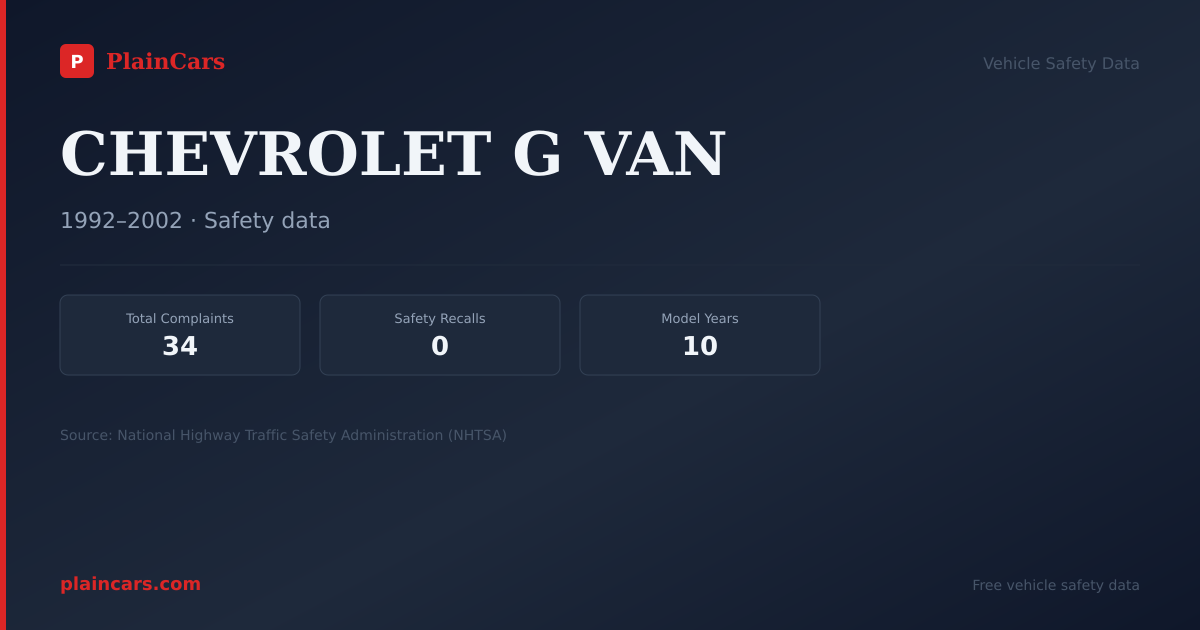
Total Complaints
3 filings
Chevrolet G VAN · model year
3 NHTSA complaints. A VIN lookup is required to determine whether a specific vehicle has an unrepaired recall.
NHTSA overall rating
Not crash-tested
New Car Assessment Program
The verdict
The 1999 Chevrolet G VAN posts below-average complaint volume among its own model-year siblings.
The 1999ChevroletG VAN carries 3 consumer safety complaints in NHTSA's Office of Defects Investigation database for this specific model-year cohort. Within that volume, owners reported 0 crashes, 0 fires, 2 injuries, and 0 fatalities. No NCAP 5-star crash-test rating is available for this model year in the federal database.
The most frequently selected component label in reports for the 1999 G VAN is air bags with 1 filings, followed by service brakes, hydraulic (1) and electrical system:ignition:module (1). Complaint categories reflect owner reports and intake categorization; they do not establish a defect pattern or cause.
NHTSA currently has 57 investigation files overlapping the 1999 G VAN, and 2 remain open. Owners comparing this cohort against neighboring years should read the complaint-by-year trend as report volume, not a causal diagnosis. Use the related-complaint feed and the official recall lookup when researching a specific vehicle.
PlainCars' own composite of NHTSA NCAP crash-test ratings and rollover-risk assessment, each dimension normalized against the federal scale or the full national model-year corpus. Not an official NHTSA figure, and not a substitute for a specific vehicle's VIN-level recall check.
Total Complaints
3 filings
Crashes Reported
0 reports
Source
NHTSA ODI
Federal complaints database
At or below the fleet median complaint volume.
| Component | Count |
|---|---|
| AIR BAGS | 1 |
| SERVICE BRAKES, HYDRAULIC | 1 |
| ELECTRICAL SYSTEM:IGNITION:MODULE | 1 |
MAJOR DESIGN FLAWS IN THE ECM MODULE ENCLOSURE AND LOCATION OF ECM IN THE ENGINE COMPARTMENT CAUSE PREMATURE AND CATASTROPHIC FAILURE. PERMANENT DAMAGE TO WIRING HARNESS ALSO OCCURS DUE TO WATER INTRUSION COMPLICATED BY ROAD SALT CONTAMINATION OF HARNESS CONNECTORS AND WIRING. ELECTRONIC PRINTED CIRCUIT BOARDS IN THE ECM BECOME EXPOSED TO ROAD SPRAY AND WHICH ALLOWS WATER TO POOL WITHIN THE ECM MODULE'S CASING. AFTER EVAPORATING, THIS WATER WILL LEAVE BEHIND THE ROAD SALTS THAT WERE IN SOLUTION CAUSING A BUILDUP OF SAME UNTILL UNIT FAILS. THESE CONDITIONS WILL BE FOUND ON NUMEROUS VEHICLES IN FREEZING/THAWING CYCLIC REGIONS. RECENTLY GM ISSUED A SERVICE BULLETIN THAT ACKNOWLEGES THIS PROBLEM. UNFORTUNATELY, IT DOES NOT EFFECTIVLY REACH OUT TO THE OWNERS OF THESE VEHICLE WHO MAY HAVE TOTAL ENGINE CONTROL FAILURE OCCUR UNDER THE WORST OF WEATHER CONDITIONS THEREBY CREATING A REAL COLLISION SAFETY HAZARD. *AK
Mileage: 93,000
TIMES THE BRAKES DO NOT WORK, THE VAN HAS BEEN BACK TO THE DEALER FOR THIS PROBLEM AND NOW ON 10/24/2002 THERE WAS AN ACCIDENT. DT
VEHICLE WAS INVOLVED IN A FRONT END COLLISION, THE AIRBAGS EXPERIENCED NO DEPLOYMENT, THE AIRBAG WARNING LIGHT WAS ON, DEALER FOUND THE MODULE TO BE DAMAGED. *SLC
Loss of motive power due to engine failure
Loss of Motive Power due to the Battery Energy Control Module
Electric Vehicle Battery Fires
Outboard Front Seat Belt Anchor Cable Failure
Fuel Line Leak
Data vintage: August 2026. Sources: NHTSA Office of Defects Investigation (ODI) complaints database, NHTSA recall campaign API, NHTSA NCAP crash-test ratings, and NHTSA FARS for fatality cross-reference.
Every figure on PlainCars is rendered directly from NHTSA complaint and safety data, no number is typed in by an editor. This year-specific record is rendered from NHTSA ODI, recall, and NCAP rows for the 1999 Chevrolet G VAN; no figure is typed in by an editor. See our editorial standards & corrections policy, the methodology behind these numbers, or report a data error. Data current as of August 2026.
Read our methodology - how this data is sourced, computed, and verified.