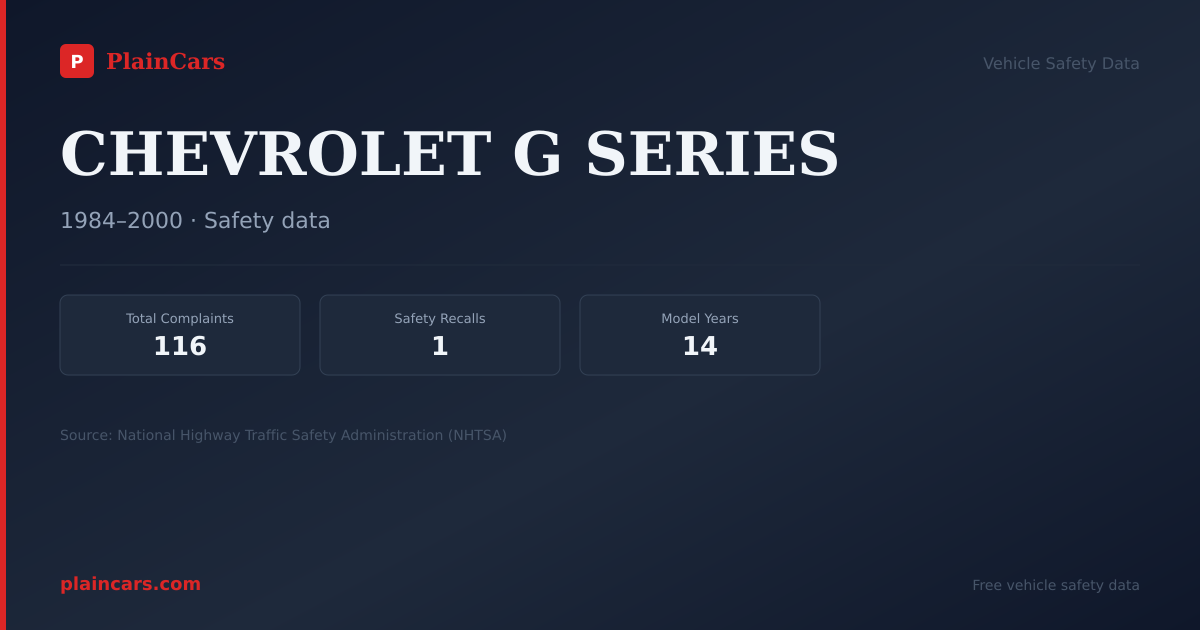
Total Complaints
2 filings
Chevrolet G Series · model year
2 NHTSA complaints. A VIN lookup is required to determine whether a specific vehicle has an unrepaired recall.
NHTSA overall rating
Not crash-tested
New Car Assessment Program
The verdict
The 1999 Chevrolet G Series posts top-1% complaint standing (fewest filings) among its own model-year siblings.
The 1999ChevroletG Series carries 2 consumer safety complaints in NHTSA's Office of Defects Investigation database for this specific model-year cohort. Within that volume, owners reported 0 crashes, 0 fires, 0 injuries, and 0 fatalities. No NCAP 5-star crash-test rating is available for this model year in the federal database.
The most frequently selected component label in reports for the 1999 G Series is service brakes, hydraulic:antilock/traction control/electronic limited slip with 1 filings, followed by engine and engine cooling (1). Complaint categories reflect owner reports and intake categorization; they do not establish a defect pattern or cause.
NHTSA currently has 57 investigation files overlapping the 1999 G Series, and 2 remain open. Owners comparing this cohort against neighboring years should read the complaint-by-year trend as report volume, not a causal diagnosis. Use the related-complaint feed and the official recall lookup when researching a specific vehicle.
PlainCars' own composite of NHTSA NCAP crash-test ratings and rollover-risk assessment, each dimension normalized against the federal scale or the full national model-year corpus. Not an official NHTSA figure, and not a substitute for a specific vehicle's VIN-level recall check.
Total Complaints
2 filings
Crashes Reported
0 reports
Source
NHTSA ODI
Federal complaints database
At or below the fleet median complaint volume.
| Component | Count |
|---|---|
| SERVICE BRAKES, HYDRAULIC:ANTILOCK/TRACTION CONTROL/ELECTRONIC LIMITED SLIP | 1 |
| ENGINE AND ENGINE COOLING | 1 |
I AM THE OWNER OF A 1999 CHEVROLET VENTURE WITH 64,346 MILES ON THE ODOMETER. THE TEMPERATURE GAUGE WOULD SHOW AN INCREASE IN HEAT THEN DROP DOWN TO NORMAL. I CHECKED THE ANTIFREEZE LEVEL, WHICH SHOWED IT NEEDED TO BE FILLED. I ADDED THE PROPER COOLANT, DEXCOOL ANTIFREEZE MIXTURE OF 50-50. THE PROBLEM WAS FIXED FOR A FEW DAYS, BUT THEN IT RECURRED. THERE WAS NO LEAK OF ANY COOLANT THAT I COULD SEE ANYWHERE UNDER THE HOOD OR ON THE GROUND. THIS HAPPENED SEVERAL TIMES OVER A PERIOD OF TWO TO THREE WEEKS. I EXPLAINED THE PROBLEM TO MY MECHANIC. HE CHECKED IT OUT AND TOLD ME THAT THE UPPER AND LOWER INTAKE MANIFOLD GASKETS WERE DAMAGED AND ANTIFREEZE WAS GETTING INTO THE ENGINE. THE OIL DIP STICK WHEN CHECKED SHOWED A FLUID LEVEL ABOUT 6 INCHES ABOVE THE OIL-FULL LEVEL MARK. HE FOUND THAT THE NEW GASKETS HAD BEEN REDESIGNED BY GM, AND THAT MANY THOUSANDS OF PEOPLE HAD THIS PROBLEM WITH THE 3.4 V6 ENGINE. THE COST OF REPAIR WAS OVER $600.00. MY RESEARCH ONLINE SHOWED HUNDREDS OF COMPLAI
WHEN DRIVING REAR BRAKES DON'T WORK AT ALL. THERE IS NO PRIOR WARNING AT THIS POINT. DEALERSHIP IS AWARE OF PROBLEM. *AK
Loss of motive power due to engine failure
Loss of Motive Power due to the Battery Energy Control Module
Electric Vehicle Battery Fires
Outboard Front Seat Belt Anchor Cable Failure
Fuel Line Leak
Data vintage: August 2026. Sources: NHTSA Office of Defects Investigation (ODI) complaints database, NHTSA recall campaign API, NHTSA NCAP crash-test ratings, and NHTSA FARS for fatality cross-reference.
Every figure on PlainCars is rendered directly from NHTSA complaint and safety data, no number is typed in by an editor. This year-specific record is rendered from NHTSA ODI, recall, and NCAP rows for the 1999 Chevrolet G Series; no figure is typed in by an editor. See our editorial standards & corrections policy, the methodology behind these numbers, or report a data error. Data current as of August 2026.
Read our methodology - how this data is sourced, computed, and verified.