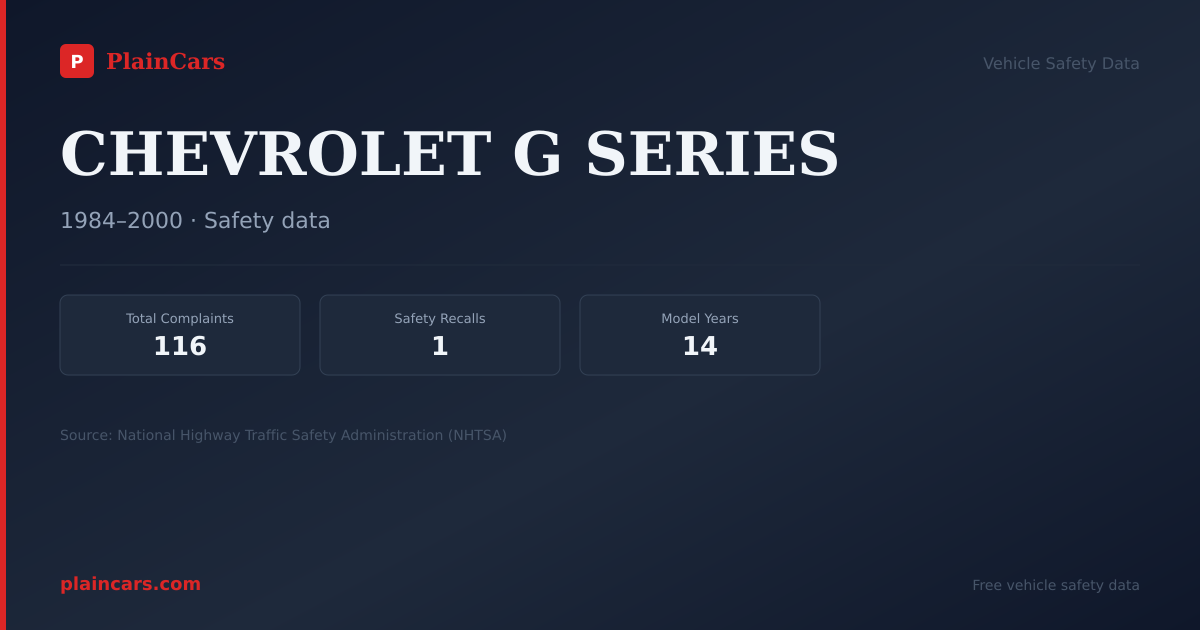
Total Complaints
17 filings
Chevrolet G Series · model year
17 NHTSA complaints, 1 crash report. A VIN lookup is required to determine whether a specific vehicle has an unrepaired recall.
NHTSA overall rating
Not crash-tested
New Car Assessment Program
The verdict
The 1994 Chevrolet G Series posts above-average complaint volume among its own model-year siblings.
The 1994ChevroletG Series carries 17 consumer safety complaints in NHTSA's Office of Defects Investigation database for this specific model-year cohort. Within that volume, owners reported 1 crash, 0 fires, 1 injury, and 0 fatalities. No NCAP 5-star crash-test rating is available for this model year in the federal database.
The most frequently selected component label in reports for the 1994 G Series is service brakes, hydraulic:antilock/traction control/electronic limited slip with 2 filings, followed by power train:axle assembly:axle shaft:seal (1) and power train:driveline (1). Complaint categories reflect owner reports and intake categorization; they do not establish a defect pattern or cause.
NHTSA currently has 57 investigation files overlapping the 1994 G Series, and 2 remain open. Owners comparing this cohort against neighboring years should read the complaint-by-year trend as report volume, not a causal diagnosis. Use the related-complaint feed and the official recall lookup when researching a specific vehicle.
PlainCars' own composite of NHTSA NCAP crash-test ratings and rollover-risk assessment, each dimension normalized against the federal scale or the full national model-year corpus. Not an official NHTSA figure, and not a substitute for a specific vehicle's VIN-level recall check.
Total Complaints
17 filings
Crashes Reported
1 reports
Source
NHTSA ODI
Federal complaints database
At or below the fleet median complaint volume.
| Component | Count |
|---|---|
| SERVICE BRAKES, HYDRAULIC:ANTILOCK/TRACTION CONTROL/ELECTRONIC LIMITED SLIP | 2 |
| POWER TRAIN:AXLE ASSEMBLY:AXLE SHAFT:SEAL | 1 |
| POWER TRAIN:DRIVELINE | 1 |
| UNKNOWN OR OTHER | 1 |
| ELECTRICAL SYSTEM:IGNITION | 1 |
| SERVICE BRAKES, HYDRAULIC:PEDALS AND LINKAGES | 1 |
| AIR BAGS:FRONTAL | 1 |
| STRUCTURE:FRAME AND MEMBERS | 1 |
| VEHICLE SPEED CONTROL | 1 |
| SEAT BELTS:FRONT:ANCHORAGE | 1 |
| ENGINE AND ENGINE COOLING:ENGINE:GASOLINE | 1 |
| SERVICE BRAKES, HYDRAULIC:FOUNDATION COMPONENTS:DISC | 1 |
| SERVICE BRAKES, HYDRAULIC:FOUNDATION COMPONENTS:DRUM | 1 |
| TIRES | 1 |
| SUSPENSION:REAR | 1 |
CONSUMER STATED WHEN ATTEMPTING TO STOP THE BRAKES FAILED. DEALER CLAIMED THE BRAKE PEDAL PUSH ROD RETAINER NEEDED TO BE REPLACED. A RECALL 93V152000 WAS ISSUED, HOWEVER THIS VEHICLE WAS NOT INCLUDED IN THE RECALL DUE TO VIN. *AK
Mileage: 76,000
AIR CONDITIONER COMPRESSOR WENT OUT. THIS CAUSES THE CAR TO BE VERY WARM INSIDE. *AK
WHEN DRIVING AT 25 TO 35 MPH AND APPLYING THE BRAKES, THE BRAKES WERE HARD AND IT FELT LIKE THERE WAS BRICK BEHIND THE PEDAL. ALSO, BRAKES MADE A GRINDING NOISE.AK
FRONT BRAKES REPLACED 5 TIMES.
REAR BRAKES REPLACED TWICE.
TIRES REPLACED TWICE.
REAR AXLE FAILED.
INTERMITTENT STALLING. *SD
SEAT BELTS IN REAR BENCH SEAT DO NOT FIT RIGHT DUE TO WHERE THE ENDS ARE ANCHORED TO THE FRAME. *DSH
CRUISE CONTROL SHUTS ITSELF OFF INTERMITTENTLY, CAUSING THE ACCELERATOR TO FAIL. *DSH
ADHESIVE USED IN CONVERSION DESIGN GIVES OFF FUMES, IRRITATING EYES/NOSE. *SD
BRAKE PEDAL LINKAGE MALFUNCTIONED, CAUSING BRAKES TO FAIL, RESULTING IN LOSS OF CONTROL PRIOR TO RECALL (93V-152). *AK
NO DEPLOYMENT OF DRIVER'S AIR BAG DURING ACCIDENT, RESULTING IN AN INJURY.
THE VEHICLE WILL SHUT OFF WHILE GOING AT HIGHWAY SPEEDS OF 55MPH AND UP. TT
VEHICLE OWNER UNABLE TO COMPLETE RECALL OF SPRAYING FLAME RETARDENT ON CURTAINS DUE TO LEAKING CONTAINER, UNABLE TO REPLACE. (STANDARD 302) *TW
AXLE SEAL LEAKED, SOAKING BRAKE SHOES, CAUSING ABS SYSTEM TO MALFUNCTION/LOSS OF CONTROL. *TW
FRONT PINION SEAL LEAKED.
Loss of motive power due to engine failure
Loss of Motive Power due to the Battery Energy Control Module
Electric Vehicle Battery Fires
Outboard Front Seat Belt Anchor Cable Failure
Fuel Line Leak
Data vintage: August 2026. Sources: NHTSA Office of Defects Investigation (ODI) complaints database, NHTSA recall campaign API, NHTSA NCAP crash-test ratings, and NHTSA FARS for fatality cross-reference.
Every figure on PlainCars is rendered directly from NHTSA complaint and safety data, no number is typed in by an editor. This year-specific record is rendered from NHTSA ODI, recall, and NCAP rows for the 1994 Chevrolet G Series; no figure is typed in by an editor. See our editorial standards & corrections policy, the methodology behind these numbers, or report a data error. Data current as of August 2026.
Read our methodology - how this data is sourced, computed, and verified.