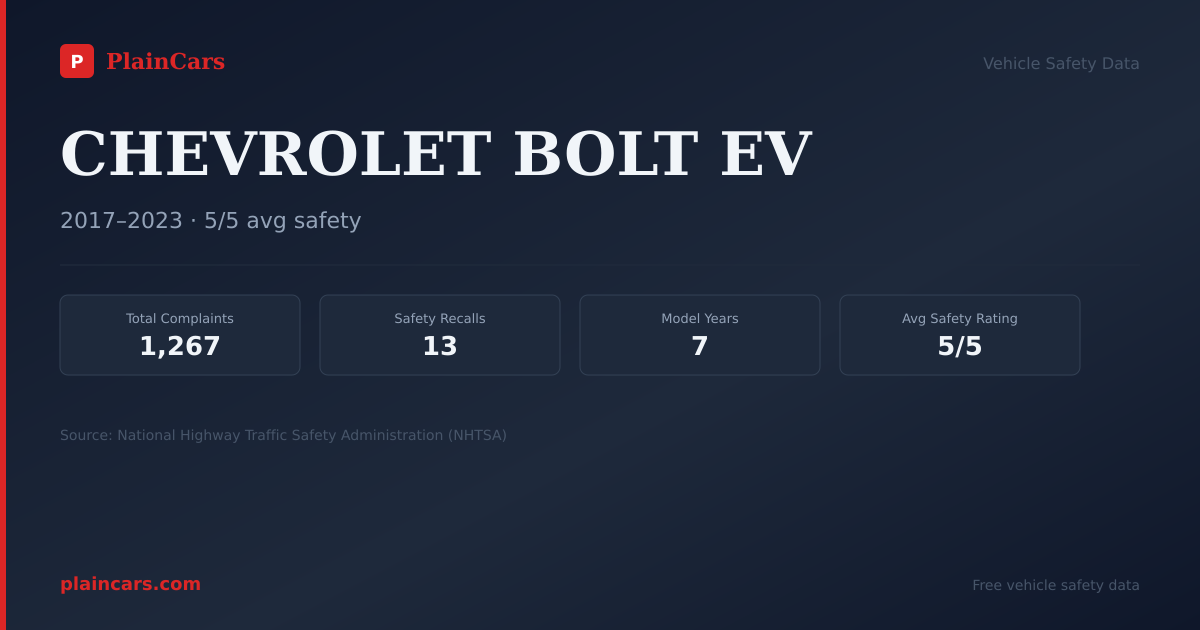
Total Complaints
93 filings
Chevrolet Bolt EV · model year
93 NHTSA complaints, 6 crash reports, and 5 recall campaigns listed for this cohort. A VIN lookup is required to determine whether a specific vehicle has an unrepaired recall.
NHTSA overall rating
5 / 5 ★
New Car Assessment Program
The verdict
The 2021 Chevrolet Bolt EV pairs below-average complaint volume with a top NHTSA safety rating.
The 2021ChevroletBolt EV carries 93 consumer safety complaints in NHTSA's Office of Defects Investigation database for this specific model-year cohort. Within that volume, owners reported 6 crashes, 0 fires, 1 injury, and 0 fatalities. For crash performance, NHTSA's New Car Assessment Program gave this cohort an overall 5/5 rating, with 4/5 front crash, 5/5 side crash, and 5/5 rollover scores derived from standardized barrier and dynamic tests.
The most frequently selected component label in reports for the 2021 Bolt EV is electrical system with 30 filings, followed by fuel/propulsion system (14) and unknown or other (12). Complaint categories reflect owner reports and intake categorization; they do not establish a defect pattern or cause. This cohort has 5 NHTSA recall campaigns listed below. Enter a VIN in NHTSA's official recall lookup to determine whether a specific vehicle has an unrepaired recall.
NHTSA currently has 57 investigation files overlapping the 2021 Bolt EV, and 2 remain open. Owners comparing this cohort against neighboring years should read the complaint-by-year trend as report volume, not a causal diagnosis. Use the related-complaint feed and the official recall lookup when researching a specific vehicle.
PlainCars' own composite of NHTSA NCAP crash-test ratings and rollover-risk assessment, each dimension normalized against the federal scale or the full national model-year corpus. Not an official NHTSA figure, and not a substitute for a specific vehicle's VIN-level recall check.
Total Complaints
93 filings
Crashes Reported
6 reports
Source
NHTSA ODI
Federal complaints database
At or below the fleet median complaint volume.
| Component | Count |
|---|---|
| ELECTRICAL SYSTEM | 30 |
| FUEL/PROPULSION SYSTEM | 14 |
| UNKNOWN OR OTHER | 12 |
| POWER TRAIN | 10 |
| STEERING | 8 |
| ENGINE | 4 |
| SERVICE BRAKES | 3 |
| SUSPENSION | 2 |
| VEHICLE SPEED CONTROL | 2 |
| ELECTRICAL SYSTEM:12V/24V/48V BATTERY | 2 |
| AIR BAGS | 2 |
| LANE DEPARTURE: BLIND SPOT DETECTION | 1 |
| TIRES | 1 |
| STRUCTURE | 1 |
| SEAT BELTS | 1 |
ELECTRICAL SYSTEM:PROPULSION SYSTEM:TRACTION BATTERY
General Motors, LLC (GM) is recalling certain 2020-2022 Chevrolet Bolt EV and 2022 Bolt EUV vehicles previously repaired under Recall 21V-650. The installation of advanced diagnostic software may have failed. As such, the high voltage battery could catch fire when charged to full or nearly full ca
ELECTRICAL SYSTEM:PROPULSION SYSTEM:TRACTION BATTERY
General Motors, LLC (GM) is recalling certain 2020-2022 Chevrolet Bolt EV and 2022 Chevrolet Bolt EUV vehicles that were previously remedied under recall number 21V-650. The advanced diagnostic software may have been incorrectly installed and fail to detect defective battery modules, possibly resul
ELECTRICAL SYSTEM:PROPULSION SYSTEM:TRACTION BATTERY
General Motors, LLC (GM) is recalling certain 2020-2022 Chevrolet Bolt EV and 2022 Chevrolet Bolt EUV vehicles. The high voltage battery could catch fire when charged to full or nearly full capacity.
STRUCTURE:BODY:ROOF AND PILLARS
General Motors, LLC (GM) is recalling certain 2017-2023 Chevrolet Bolt EV vehicles. After a crash with seat belt pretensioner deployment, the pretensioner exhaust may ignite carpet fibers near the B-pillar, causing a fire.
STRUCTURE:BODY:ROOF AND PILLARS
General Motors, LLC (GM) is recalling certain 2017-2023 Chevrolet Bolt EV vehicles. This recall includes certain vehicles previously repaired incorrectly under NHTSA recall number 22V-930. After a crash with seat belt pretensioner deployment, the pretensioner exhaust may ignite carpet fibers near
I was in a car accident on February 9th, in which my airbags did not deploy, however, I did receive an error in my Chevy app that my Air Bag system requires attention. I sustained facial injuries due to impact with the steering wheel. I believe the airbags should have deployed, but did not.
Steering rack binding. Becoming progressively harder to turn over time. Steering wheel doesn't return to center. Clunking in front end occasionally heard when hitting bumps.
The steering wheel will not return to center and feels like its binding on something, sometimes its tough to steer other times not. Does not feel safe. No warning lamps and nobody has inspected or worked on it yet.
Steering gear is bound up due to a documented manufacturing error. Steering is increasingly stiff at speed, and will not return to center without significant driver input. This is a widespread issue that has been documented and causes a major safety concern to Chevy Bolt owners and should be addressed and repaired by the manufacturer.
What component or system failed or malfunctioned, and is it available for inspection upon request? Steering rack. Steering wont return to center at 38,000 miles. How was your safety or the safety of others put at risk? Car handles unpredictably posing safety risk to others and myself. Has the problem been reproduced or confirmed by a dealer or independent service center? Yes. Quoted $2,700 to replace rack and pinion. I refused service as vehicle has less than 40k miles. Has the vehicle or component been inspected by the manufacturer, police, insurance representatives or others? No Were there any warning lamps, messages or other symptoms of the problem prior to the failure, and when did they first appear? No
Video available and was given to USAA insurance company. This 2021 GM Chevrolet Bolt EV Premier trim vehicle experienced a sudden uncommanded extreme acceleration when I selected "D" (drive) mode on the transmission selector after using "R" (reverse) to back out of a parking lot parking space. The vehicle, despite my stomping and holding the brake pedal down and repeatedly selecting a different mode on the transmission selector, could not be stopped and still wanted to accelerate. The vehicle traveled an estimated 250 feet through a parking lot, crossing a street, hitting the curbs at high speed and through a field. The vehicle stopped against some concrete debris in the field pushing in the bumper slightly but with no airbag deployment. The mishap incident was video recorded and thankfully, there were no passengers or public / private property damages / injuries.
Video available and was given to USAA insurance company. This 2021 GM Chevrolet Bolt EV Premier trim vehicle experienced a sudden uncommanded extreme acceleration when I selected "D" (drive) mode on the transmission selector after using "R" (reverse) to back out of a parking lot parking space. The vehicle, despite my stomping and holding the brake pedal down and repeatedly selecting a different mode on the transmission selector, could not be stopped and still wanted to accelerate. The vehicle traveled an estimated 250 feet through a parking lot, crossing a street, hitting the curbs at high speed and through a field. The vehicle stopped against some concrete debris in the field pushing in the bumper slightly but with no airbag deployment. The mishap incident was video recorded and thankfully, there were no passengers or public / private property damages / injuries.
Video available and was given to USAA insurance company. This 2021 GM Chevrolet Bolt EV Premier trim vehicle experienced a sudden uncommanded extreme acceleration when I selected "D" (drive) mode on the transmission selector after using "R" (reverse) to back out of a parking lot parking space. The vehicle, despite my stomping and holding the brake pedal down and repeatedly selecting a different mode on the transmission selector, could not be stopped and still wanted to accelerate. The vehicle traveled an estimated 250 feet through a parking lot, crossing a street, hitting the curbs at high speed and through a field. The vehicle stopped against some concrete debris in the field pushing in the bumper slightly but with no airbag deployment. The mishap incident was video recorded and thankfully, there were no passengers or public / private property damages / injuries.
12v battery warning light and ion Lucian battery light came on manufacture does not want to buy back and apple car play keeps breaking.
12v battery warning light and ion Lucian battery light came on manufacture does not want to buy back and apple car play keeps breaking.
STEERING GEER HAVING ISSUES OF THE STEERING WHEEL COMING BACK TO CENTER AFTER THE TURN. NOW NEED TO REPLACE STEERING GEER
Shift selector failed. Could no shift into gear Drive, low or Reverse. Locked in park but could shift to neutral. no power steering or AC. If this design flaw failure occurred while the car was on the highway, it could cause an accident. I have contacted General Motors and reported the potential safety issue and awaiting there response.
Car stalled suddenly on road. Can’t change to any driving gear, only neutral. Towed to dealer, diagnose indicated wiring harness was the cause. Expensive fix for ~$400 part with ~$3200 labor cost in addition to dangerous sudden stall.
The contact owns a 2021 Chevrolet Bolt EV. The contact stated that while driving at 15 MPH, the vehicle failed to stop as needed, and struck a pole. The contact stated that the Forward Collison Avoidance feature failed to stop the vehicle. The contact was unaware of a warning light being illuminated. The vehicle was not towed. The vehicle was taken to an independent mechanic to be diagnosed. The contact was informed that the Forward Collision Avoidance was inoperable. The vehicle was repaired; however, the contact was advised to take the vehicle to a dealer to get the Forward Collision Avoidance system repaired. The dealer was made aware of the failure; however, the contact received no assistance. The manufacturer was made aware of the failure and opened a case. The failure mileage was approximately 5,000.
Mileage: 5,000
The contact owns a 2021 Chevrolet Bolt EV. The contact stated while driving approximately 40 MPH, the "Reduced Propulsion Power" warning light illuminated, and a warning chime sounded. The contact was able to drive back to the residence. The contact called a local dealer who advised her not to drive the vehicle and to have the vehicle towed to the dealer. The contact stated that the dealer was unsure if the battery could be replaced. The vehicle was not repaired. The manufacturer was informed of the failure. The contact stated that the vehicle was repaired under NHTSA Campaign Number: 21V650000 (Electrical System) and stated that the system was to monitor the condition of the battery and related the failure to the safety campaign. The failure mileage was approximately 20,000.
Mileage: 20,000
The contact owns a 2021 Chevrolet Bolt EV. The contact stated that while driving at an undisclosed speed, she was unable to keep the vehicle centered, and the vehicle was pulling either to the left or the right. After restarting the vehicle, the vehicle seemed to return to normal functionality; however, the failure had since become a persistent failure. No warning lights were illuminated. The vehicle was taken to the dealer, who diagnosed that a front alignment was required. The vehicle received the front wheel alignment, but the failure reoccurred. The vehicle was taken back to the dealer two additional times, but a cause for the failure was not determined; but the vehicle received a second alignment. The vehicle was taken to an independent mechanic, who diagnosed a failure with the rear axle. The rear axle was replaced, but the failure continued. The manufacturer was notified of the failure and agreed to buy back the vehicle. The failure mileage was 691.
Mileage: 691
The contact owns a 2021 Chevrolet Bolt EV. The contact stated that while driving at an undisclosed speed, she was unable to keep the vehicle centered, and the vehicle was pulling either to the left or the right. After restarting the vehicle, the vehicle seemed to return to normal functionality; however, the failure had since become a persistent failure. No warning lights were illuminated. The vehicle was taken to the dealer, who diagnosed that a front alignment was required. The vehicle received the front wheel alignment, but the failure reoccurred. The vehicle was taken back to the dealer two additional times, but a cause for the failure was not determined; but the vehicle received a second alignment. The vehicle was taken to an independent mechanic, who diagnosed a failure with the rear axle. The rear axle was replaced, but the failure continued. The manufacturer was notified of the failure and agreed to buy back the vehicle. The failure mileage was 691.
Mileage: 691
I believe the recall remedy gm n21345944 is not sufficient because it dies not monitor the system during the 80-100 % charge. It only allows ip to 80 which is not when it fails. Also it just gives an alert and does not shut down the battery which can allow the fure to happen. According to gm recall 212345940 a new battery was promised. I do not feel safe driving a car which has only been tested up to 80% range when that id not the failure mode. I want a new fixed battery.
In nearly exactly the same fashion as Tesla, Chevrolet has reduced my battery range by 15-20% and they don't have any idea when or if they will restore what I've paid for.
Our car (2021 Chevy Bolt) has been under recall N212345940 since September 2021 for a battery that could catch fire if charged to full capacity. The GM recall stated "when parts are available, your Chevrolet dealer will replace the defective lithium ion battery modules in your vehicle with new lithium ion battery modules." For almost 2 years we've been worried, unable to park our car in a garage or charge to 100%. In the interim, when I spoke to a Chevy salesperson who tried to sell me a newer model year Bolt, they informed me that all the used cars on the lot had already had their batteries replaced. On June 14th I got an email stating: Recall Status: "Remedy Available Recall Number: N212345944 High Voltage Battery May Melt or Burn". I was extremely excited and took the car in last week. As I left I realized that they had NOT replaced the battery, instead they programmed in a diagnostic tool to try and identify defective battery cells over the next 6000 miles. The recall on my veh
Loss of motive power due to engine failure
Loss of Motive Power due to the Battery Energy Control Module
Electric Vehicle Battery Fires
Outboard Front Seat Belt Anchor Cable Failure
Fuel Line Leak
Data vintage: August 2026. Sources: NHTSA Office of Defects Investigation (ODI) complaints database, NHTSA recall campaign API, NHTSA NCAP crash-test ratings, and NHTSA FARS for fatality cross-reference.
Every figure on PlainCars is rendered directly from NHTSA complaint and safety data, no number is typed in by an editor. This year-specific record is rendered from NHTSA ODI, recall, and NCAP rows for the 2021 Chevrolet Bolt EV; no figure is typed in by an editor. See our editorial standards & corrections policy, the methodology behind these numbers, or report a data error. Data current as of August 2026.
Read our methodology - how this data is sourced, computed, and verified.