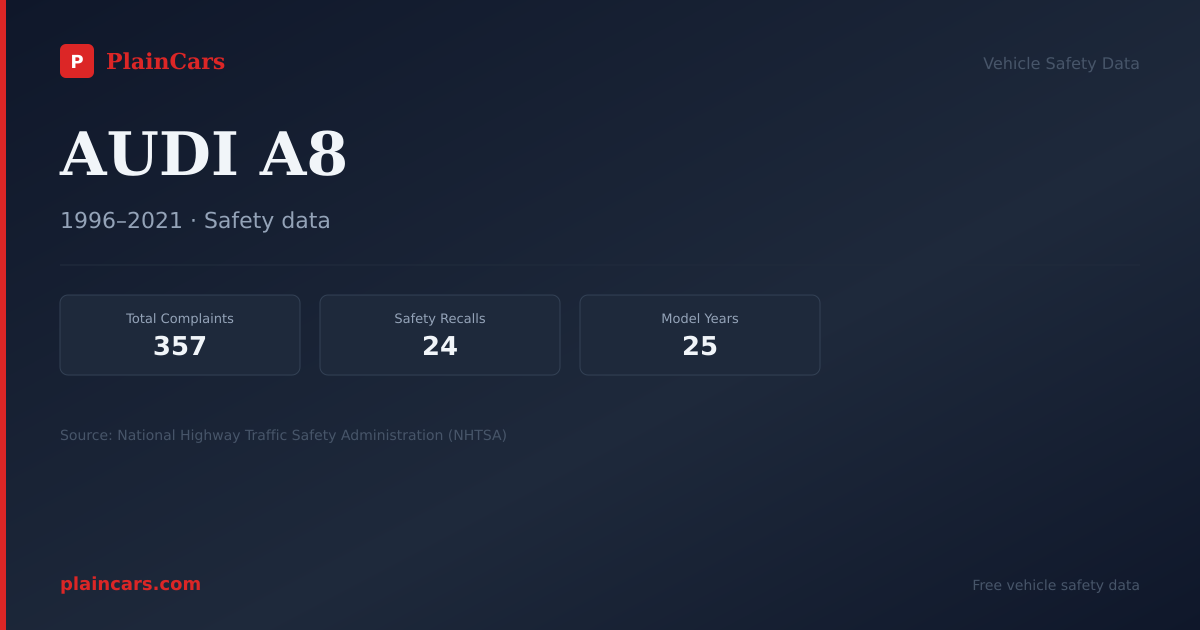
Total Complaints
1 filings
Audi A8 · model year
1 NHTSA complaints, and 1 recall campaign listed for this cohort. A VIN lookup is required to determine whether a specific vehicle has an unrepaired recall.
NHTSA overall rating
Not crash-tested
New Car Assessment Program
The verdict
The 2010 Audi A8 posts top-1% complaint standing (fewest filings) among its own model-year siblings.
The 2010AudiA8 carries 1 consumer safety complaint in NHTSA's Office of Defects Investigation database for this specific model-year cohort. Within that volume, owners reported 0 crashes, 0 fires, 0 injuries, and 0 fatalities. No NCAP 5-star crash-test rating is available for this model year in the federal database.
The most frequently selected component label in reports for the 2010 A8 is visibility with 1 filings. Complaint categories reflect owner reports and intake categorization; they do not establish a defect pattern or cause. This cohort has 1 NHTSA recall campaign listed below. Enter a VIN in NHTSA's official recall lookup to determine whether a specific vehicle has an unrepaired recall.
NHTSA currently has 9 investigation files overlapping the 2010 A8. Owners comparing this cohort against neighboring years should read the complaint-by-year trend as report volume, not a causal diagnosis. Use the related-complaint feed and the official recall lookup when researching a specific vehicle.
PlainCars' own composite of NHTSA NCAP crash-test ratings and rollover-risk assessment, each dimension normalized against the federal scale or the full national model-year corpus. Not an official NHTSA figure, and not a substitute for a specific vehicle's VIN-level recall check.
Total Complaints
1 filings
Crashes Reported
0 reports
Source
NHTSA ODI
Federal complaints database
At or below the fleet median complaint volume.
| Component | Count |
|---|---|
| VISIBILITY | 1 |
ENGINE AND ENGINE COOLING:ENGINE
Volkswagen Group of America, Inc. (Volkswagen) is recalling certain model year 2010-2013 Audi A8 vehicles manufactured May 15, 2010, to May 14, 2012. The affected vehicles have a coolant valve that may leak, allowing coolant to enter the engine control module causing a loss of power or the engine t
INFORMATION REDACTED PURSUANT TO THE FREEDOM OF INFORMATION ACT (FOIA), 5 U.S.C. 552(B)(6) MY COMPLAINT COVERS ALL RADAR BASED BLIND SPOT MONITORING DEVICES. THE FOLLOWING SCENARIO HAS PERSONALLY OCCURRED TO ME TWICE WITHIN THE LAST MONTH. I WAS ONE IN A LINE OF VEHICLES DRIVING ON A CLEAR HIGHWAY WHEN AN AUDI WITH BLIND SPOT MONITORING ENTERED THE HIGHWAY DIRECTLY IN FRONT OF THE LINE OF VEHICLES. BECAUSE OF THE LOW POWER OF ITS BLIND SPOT MONITORING SYSTEM'S RADAR COUPLED WITH THE EFFECTS OF THE INVERSE SQUARE LAW OF PHYSICS, THE RADAR DETECTOR EQUIPPED DRIVER CLOSEST TO THE AUDI THOUGHT THEY WERE BEING MONITORED BY INSTANT ON POLICE RADAR AND JAMMED ON THEIR BRAKES, CAUSING PANIC STOPPING BY ALL OF THE VEHICLES BEHIND THEM. MYSELF AND SEVERAL OTHER VEHICLES WERE REQUIRED TO USE THE ROAD'S SHOULDER TO AVOID BEING REAR-ENDED. I FEEL FAIRLY CONFIDENT THAT WITHIN THE US THERE HAVE BEEN ACCIDENTS CAUSED BY THESE DEVICES, YET THE ACCIDENT WILL NEVER BE ATTRIBUTED TO THE DEVICE BECAUSE
Data vintage: August 2026. Sources: NHTSA Office of Defects Investigation (ODI) complaints database, NHTSA recall campaign API, NHTSA NCAP crash-test ratings, and NHTSA FARS for fatality cross-reference.
Every figure on PlainCars is rendered directly from NHTSA complaint and safety data, no number is typed in by an editor. This year-specific record is rendered from NHTSA ODI, recall, and NCAP rows for the 2010 Audi A8; no figure is typed in by an editor. See our editorial standards & corrections policy, the methodology behind these numbers, or report a data error. Data current as of August 2026.
Read our methodology - how this data is sourced, computed, and verified.