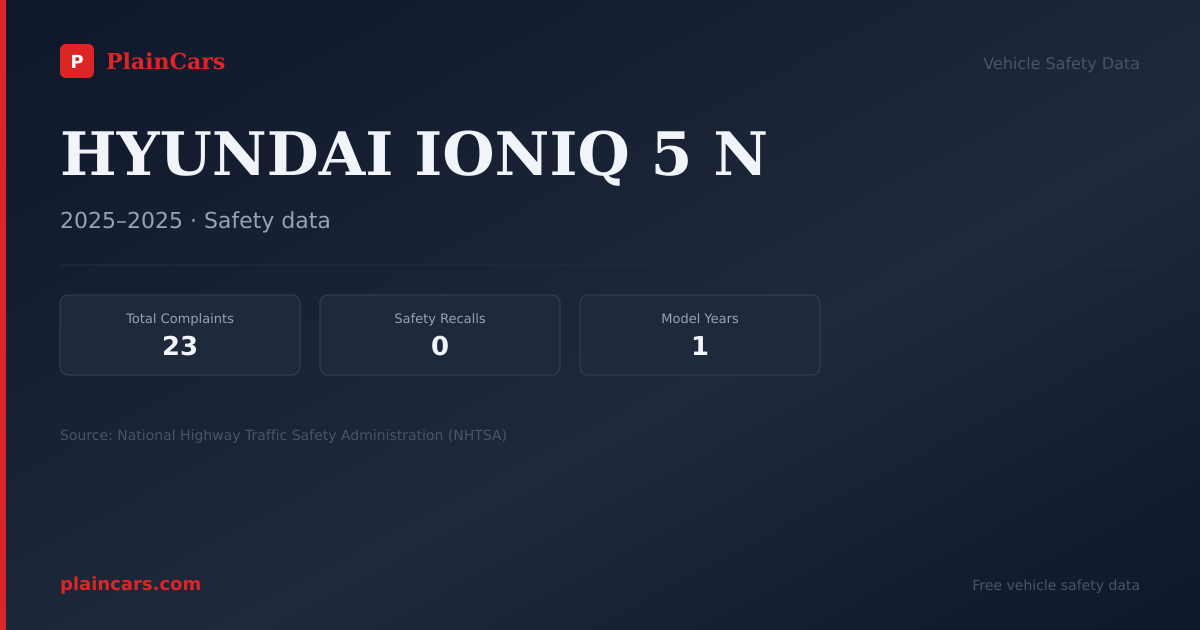
Total Complaints
23 filings
Hyundai Ioniq 5 N · model year
23 NHTSA complaints. A VIN lookup is required to determine whether a specific vehicle has an unrepaired recall.
NHTSA overall rating
Not crash-tested
New Car Assessment Program
The 2025HyundaiIoniq 5 N carries 23 consumer safety complaints in NHTSA's Office of Defects Investigation database for this specific model-year cohort. Within that volume, owners reported 0 crashes, 0 fires, 0 injuries, and 0 fatalities. For crash performance, NHTSA's New Car Assessment Program gave this cohort an overall Not Rated/5 rating, with Not Rated/5 front crash, Not Rated/5 side crash, and Not Rated/5 rollover scores derived from standardized barrier and dynamic tests.
The most frequently selected component label in reports for the 2025 Ioniq 5 N is electrical system with 7 filings, followed by vehicle speed control (6) and fuel/propulsion system (3). Complaint categories reflect owner reports and intake categorization; they do not establish a defect pattern or cause.
NHTSA currently has 37 investigation files overlapping the 2025 Ioniq 5 N, and 1 remain open. Owners comparing this cohort against neighboring years should read the complaint-by-year trend as report volume, not a causal diagnosis. Use the related-complaint feed and the official recall lookup when researching a specific vehicle.
PlainCars' own composite of NHTSA NCAP crash-test ratings and rollover-risk assessment, each dimension normalized against the federal scale or the full national model-year corpus. Not an official NHTSA figure, and not a substitute for a specific vehicle's VIN-level recall check.
Total Complaints
23 filings
Crashes Reported
0 reports
Source
NHTSA ODI
Federal complaints database
At or below the fleet median complaint volume.
| Component | Count |
|---|---|
| ELECTRICAL SYSTEM | 7 |
| VEHICLE SPEED CONTROL | 6 |
| FUEL/PROPULSION SYSTEM | 3 |
| ENGINE | 3 |
| POWER TRAIN | 2 |
| UNKNOWN OR OTHER | 1 |
| SERVICE BRAKES, HYDRAULIC | 1 |
Driving under normal conditions, heard a “pop” near the rear of the car and within seconds had an immediate loss of power. The dashboard had lit up with “Check electric vehicle system” and was limited to 20 MPH on a 45 MPH road with no safe place to stop. Was able to limp car home, dealer confirmed ICCU was faulty and had to be replaced. My family was very very lucky to not be on a highway when this occurred. Hyundai has continuously failed to not only fix the ICCU issues with this vehicle, but also hasn’t extended the warranty on the faulty component here in the US like they’ve done in Asian markets. As a consumer, I’m begging the NHTSA to hold Hyundai accountable for these ongoing EV issues.
Driving under normal conditions, heard a “pop” near the rear of the car and within seconds had an immediate loss of power. The dashboard had lit up with “Check electric vehicle system” and was limited to 20 MPH on a 45 MPH road with no safe place to stop. Was able to limp car home, dealer confirmed ICCU was faulty and had to be replaced. My family was very very lucky to not be on a highway when this occurred. Hyundai has continuously failed to not only fix the ICCU issues with this vehicle, but also hasn’t extended the warranty on the faulty component here in the US like they’ve done in Asian markets. As a consumer, I’m begging the NHTSA to hold Hyundai accountable for these ongoing EV issues.
Driving under normal conditions, heard a “pop” near the rear of the car and within seconds had an immediate loss of power. The dashboard had lit up with “Check electric vehicle system” and was limited to 20 MPH on a 45 MPH road with no safe place to stop. Was able to limp car home, dealer confirmed ICCU was faulty and had to be replaced. My family was very very lucky to not be on a highway when this occurred. Hyundai has continuously failed to not only fix the ICCU issues with this vehicle, but also hasn’t extended the warranty on the faulty component here in the US like they’ve done in Asian markets. As a consumer, I’m begging the NHTSA to hold Hyundai accountable for these ongoing EV issues.
I have experienced two high voltage battery failures both requiring hv battery replacement. The first occurred around 6000 miles and the second occurred around 13,000 miles. I also had several dead 12v battery episodes where the card would be dead; even when plugged into the home charger overnight. I had to replace the 12v battery at 12000 miles.
ICCU failure and fuse, the car became unoperational and needed to stop. The car would no longer charge the 12V battery, and the EV battery would not charge. Hybrid Control Problem Detected at 3,160 miles. DTC P056216
What happened to me is a common problem with these models. I had an issue with the 12 V battery not being charged by the main battery as it should be. This led to a blowing of the main fuse which took out the ICCU unit. This seems to be fairly prevalent from what I can tell from online forums, and there needs to be a recall from Hyundai.
The contact owns a 2025 Hyundai Ioniq 5 N. The contact stated that while driving at 40 MPH, the service battery immediate warning light illuminated. A dealer was contacted. The vehicle was taken to the dealer because the ICCU unit needed to be replaced. The vehicle was not repaired. The manufacturer was not notified of the failure. The approximate failure mileage was 8,000.
Mileage: 8,000
While driving home, I experienced a sudden and complete power system failure in my Hyundai Ioniq 5 N. The failure occurred shortly after starting the drive, and was preceded by a faint "pop" sound. Within moments, the dashboard displayed the following critical warnings: Red 12V battery icon Red warning: "Stop vehicle and check power supply" Turtle icon (indicating limp mode / low power) Brake warning light ⚠️ The vehicle immediately entered limp mode, then fully lost power within approximately 3 minutes. I was able to safely pull into a nearby parking space before total shutdown and loss of power. Restarting the vehicle had no effect.
While driving home, I experienced a sudden and complete power system failure in my Hyundai Ioniq 5 N. The failure occurred shortly after starting the drive, and was preceded by a faint "pop" sound. Within moments, the dashboard displayed the following critical warnings: Red 12V battery icon Red warning: "Stop vehicle and check power supply" Turtle icon (indicating limp mode / low power) Brake warning light ⚠️ The vehicle immediately entered limp mode, then fully lost power within approximately 3 minutes. I was able to safely pull into a nearby parking space before total shutdown and loss of power. Restarting the vehicle had no effect.
While driving home, I experienced a sudden and complete power system failure in my Hyundai Ioniq 5 N. The failure occurred shortly after starting the drive, and was preceded by a faint "pop" sound. Within moments, the dashboard displayed the following critical warnings: Red 12V battery icon Red warning: "Stop vehicle and check power supply" Turtle icon (indicating limp mode / low power) Brake warning light ⚠️ The vehicle immediately entered limp mode, then fully lost power within approximately 3 minutes. I was able to safely pull into a nearby parking space before total shutdown and loss of power. Restarting the vehicle had no effect.
The contact owns a 2025 Hyundai Ioniq 5 N. The contact stated that while driving and exceeding 30 MPH on several occasions, the accelerator pedal was released; however, the vehicle accelerated unintendedly for three seconds. Additionally, the contact stated that upon depressing the brake pedal, the vehicle responded as intended after three seconds. The vehicle was taken to an unknown dealer, where it was diagnosed and determined that the ABS module had failed, and a software update was needed. The vehicle was not repaired. The manufacturer was notified of the failure. The failure mileage was 9,200.
Mileage: 9,200
After recent software update on 17 March 2025, the vehicle demonstrated unpredictable high acceleration. Vehicle is unsafe in E-shift mode. Vehicle can only be driven safely in automatic mode. Per a Hyundai communication: "there have been complications reported related to the Vehicle Control Unit (VCU) software that may cause momentary continued acceleration during the release of the accelerator pedal while the vehicle’s N e-shift feature is engaged, increasing the risk of a crash. Our records indicate that your vehicle, VIN [XXX] , has had this software update installed as the remedy for recall 275. Hyundai is currently investigating the root cause of this complication and will provide an update when available. In the meantime, Hyundai recommends all owners who previously received remedy repair for recall 275 NOT TO USE the N e-SHIFT Feature." INFORMATION REDACTED PURSUANT TO THE FREEDOM OF INFORMATION ACT (FOIA), 5 U.S.C. 552(B)(6)
After recent software update on 17 March 2025, the vehicle demonstrated unpredictable high acceleration. Vehicle is unsafe in E-shift mode. Vehicle can only be driven safely in automatic mode. Per a Hyundai communication: "there have been complications reported related to the Vehicle Control Unit (VCU) software that may cause momentary continued acceleration during the release of the accelerator pedal while the vehicle’s N e-shift feature is engaged, increasing the risk of a crash. Our records indicate that your vehicle, VIN [XXX] , has had this software update installed as the remedy for recall 275. Hyundai is currently investigating the root cause of this complication and will provide an update when available. In the meantime, Hyundai recommends all owners who previously received remedy repair for recall 275 NOT TO USE the N e-SHIFT Feature." INFORMATION REDACTED PURSUANT TO THE FREEDOM OF INFORMATION ACT (FOIA), 5 U.S.C. 552(B)(6)
After recent software update on 17 March 2025, the vehicle demonstrated unpredictable high acceleration. Vehicle is unsafe in E-shift mode. Vehicle can only be driven safely in automatic mode. Per a Hyundai communication: "there have been complications reported related to the Vehicle Control Unit (VCU) software that may cause momentary continued acceleration during the release of the accelerator pedal while the vehicle’s N e-shift feature is engaged, increasing the risk of a crash. Our records indicate that your vehicle, VIN [XXX] , has had this software update installed as the remedy for recall 275. Hyundai is currently investigating the root cause of this complication and will provide an update when available. In the meantime, Hyundai recommends all owners who previously received remedy repair for recall 275 NOT TO USE the N e-SHIFT Feature." INFORMATION REDACTED PURSUANT TO THE FREEDOM OF INFORMATION ACT (FOIA), 5 U.S.C. 552(B)(6)
The dealership performed the software update from the Hyundai recall 275. After the update, when using the e-shift feature in N mode the car sometimes will accelerate out of control on its own without the accelerator pedal being engaged. Hyundai also changed the motor sounds and e-shift feel.
With Eshift enabled, the car continues accelerating under heavy throttle even after releasing the accelerator pedal.
The Hyundai Ioniq 5N features a unique mode called N e-Shift which enables a software simulated 8-speed transmission that attempts to emulate the gear changes and driving dynamics of a traditional automatic transmission that would be found in an internal combustion engine vehicle. Unfortunately, the mode has a dangerous component in the programming, wherein, when the driver has been accelerating in a spirited fashion and lifts off the throttle, the vehicle CONTINUES TO ACCELERATE for approximately 1-2 seconds despite there being no input from the operator to do so. This unintended acceleration, given the performance characteristics of an electric vehicle with 640HP, could quickly place the vehicle and the operator in an unsafe and undesired situation that could result in a crash. I purchased this vehicle recently and have experienced the dangerous condition repeatedly, it is easily reproducible and appears to be an intended feature of the N e-Shift mode. The first time I performed a
After the recent RECALL, while driving up I almost got in an accident because after upshifting the car, the car accelerated more than I intended, prolonged movement forward that never happened before the recall. This is a very dangerous situation.
When accelerating using the N e-shift mode and letting off the accelerator the car continues to accelerate.
When accelerating using the N e-shift mode and letting off the accelerator the car continues to accelerate.
Data vintage: August 2026. Sources: NHTSA Office of Defects Investigation (ODI) complaints database, NHTSA recall campaign API, NHTSA NCAP crash-test ratings, and NHTSA FARS for fatality cross-reference.
Every figure on PlainCars is rendered directly from NHTSA complaint and safety data, no number is typed in by an editor. This year-specific record is rendered from NHTSA ODI, recall, and NCAP rows for the 2025 Hyundai Ioniq 5 N; no figure is typed in by an editor. See our editorial standards & corrections policy, the methodology behind these numbers, or report a data error. Data current as of August 2026.
Read our methodology - how this data is sourced, computed, and verified.